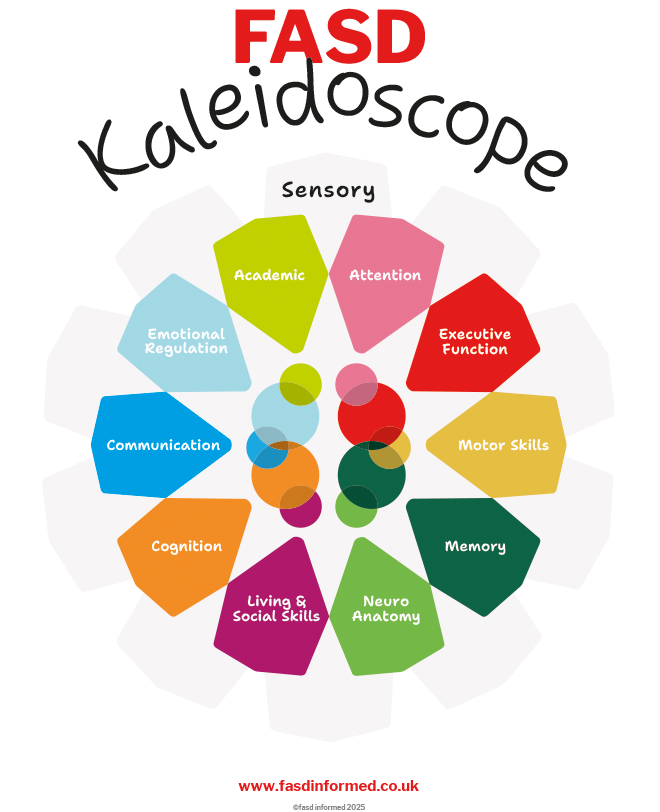

FASD-Informed Education, Health and Care Plan
A Practical Guide to EHCP Drafting, Safeguarding and Educational Need
For Educational Psychologists, SEND caseworkers and SENCOs, confirmed FASD or known, probable, suspected or recorded prenatal alcohol exposure should change the formulation from the start.
Where a child presents with uneven development, dysregulation, verbal fluency alongside poor functional understanding, suggestibility, sensory overload or difficulty learning from consequences, the task is to consider whether outward behaviour is the visible expression of likely FASD or a wider neurodevelopmental profile, rather than waiting for crisis, exclusion or placement breakdown.
Professionals should not assume an SEMH formulation simply because distress, dysregulation or apparent non-compliance is visible. In many children with prenatal alcohol exposure or likely FASD, the opposite may be true: the behaviour is not the primary need, but the visible sign of memory, processing, language, executive functioning, sensory regulation, adaptive functioning, social understanding or safeguarding difficulties.
Starting with SEMH can therefore lead professionals away from the child’s actual neurodevelopmental profile and towards provision that is too behavioural, too general or too late.
This approach is supported by clinical guidance for alcohol and NICE Quality Standards for FASD 204 and SIGN 156. NICE states that children and young people with probable prenatal alcohol exposure and significant physical, developmental or behavioural difficulties should be referred for assessment, and that those with confirmed prenatal alcohol exposure should have a neurodevelopmental assessment where there are clinical concerns.
UK clinical guidance on alcohol treatment in pregnancy and perinatal care also reinforces the importance of identifying and recording alcohol exposure, multi-agency planning and support.
For EHCP purposes, prenatal alcohol exposure should help professionals consider and, where appropriate, “rule in” FASD-informed early intervention, assessment, safeguarding analysis and provision planning while further evidence is gathered.
EHCP support should not wait for diagnostic completion where the child’s functioning already indicates need. This page supports Educational Psychology and SEND practice by showing how to move from evidence of confirmed FASD, likely FASD or prenatal alcohol exposure to clear Section B wording, meaningful Section E outcomes, specific Section F provision, safeguarding analysis and placement suitability.
Griffiths’ 2025 guide for Educational Psychologists working with young people with FASD and their families emphasises the value of Educational Psychology advice in helping to make sense of the child’s profile, not simply describe behaviour or test scores. In EHCP work, this means using formulation to explain why a child may appear more able in some contexts than they are in daily functioning, and why family accounts of inconsistency, fatigue, distress, vulnerability or failure to generalise learning should be treated as important evidence rather than peripheral background.
.png)
“If Section B misdescribes the need, Section F is unlikely to specify the right provision.”
“The test is not whether behaviour can be contained, but whether provision can be delivered consistently across the whole school day.”
“A suitable placement must teach, support, regulate and safeguard — not simply manage outward presentation.”
Prompts for Educational Psychologists
Educational Psychology advice can be decisive in preventing FASD from being misdescribed as broad SEMH need. Reports should explain the child’s neurodevelopmental profile, interpret behaviour through the lens of brain-based impairment, identify adaptive functioning and developmental mismatch, and make recommendations that can be translated directly into Sections B, E, F and I.
Where prenatal alcohol exposure is known or likely, Educational Psychology advice can help the professional network understand why a child may appear more able than they are, why behaviour may be inconsistent across settings, and why verbal ability should not be treated as reliable evidence of understanding, judgement or adaptive functioning.
The Educational Psychologist’s formulation should not simply describe what the child does, but explain what the presentation may mean. For FASD, this means considering developmental mismatch, adaptive functioning, fatigue, inconsistency, environmental demand, sensory load, suggestibility and the child’s ability to generalise learning beyond the assessment or classroom context.
“A useful Educational Psychology formulation explains not only what the child does, but what the presentation may mean.”
-
Does the report describe executive functioning, memory, processing, language, sensory regulation, fatigue and generalisation of learning?
-
Does it distinguish primary neurodevelopmental impairment from secondary anxiety, trauma or school-based distress?
-
Does it explain safeguarding vulnerability, suggestibility and risk awareness?
-
Does it state whether a specialist environment is required and why intermittent support or a resource base would not be sufficient?
-
Are recommendations specific enough to become enforceable EHCP wording?
In an EHCP, the central question is not whether a setting can contain distressed behaviour. The question is whether the setting can identify, anticipate and meet the child’s underlying neurodevelopmental profile, secure the special educational provision required in Section F, and provide a placement in Section I that is genuinely suitable for the child’s age, ability, aptitude, special educational needs and safeguarding profile.
Decision-makers should be cautious about relying on surface presentation. Verbal fluency, apparent compliance, social interest or seeming agreement may mask significant impairment in understanding, judgement, consent, risk awareness and adaptive functioning. Where a young person aged 16 or over may lack capacity for a specific decision, conclusions should not be drawn from appearance alone.
The Mental Capacity Act 2005 requires capacity to be considered in relation to the particular decision at the time it needs to be made, with practicable steps taken to support decision-making before concluding that capacity is lacking. Any assessment should therefore be decision-specific, evidence-based and informed by the Mental Capacity Act 2005 and its Code of Practice.
“Apparent agreement is not the same as real-world understanding, judgement or safety.”
Early identification and intervention
Where there is confirmed or suspected prenatal alcohol exposure, education professionals should not wait for formal diagnosis, crisis point or placement breakdown before considering FASD-informed support. NICE Quality Standard QS204 states that children and young people with probable prenatal alcohol exposure and significant physical, developmental or behavioural difficulties should be referred for assessment, and that those with confirmed prenatal alcohol exposure or all three sentinel facial features should have a neurodevelopmental assessment where there are clinical concerns.
Clinical guidance on alcohol treatment in pregnancy and perinatal care also reinforces the importance of clear information, sensitive enquiry, recording of alcohol use, multi-agency planning and support where alcohol exposure in pregnancy is known or possible. For EHCP purposes, this matters because confirmed, probable or suspected prenatal alcohol exposure should prompt professionals to actively consider likely FASD as part of the child’s neurodevelopmental formulation.
Support should not wait for crisis, exclusion, placement breakdown or completion of a diagnostic pathway where the child’s functioning already indicates need. Instead, prenatal alcohol exposure should help professionals “rule in” FASD-informed early intervention, assessment, safeguarding analysis and provision planning while further evidence is gathered.
“Known or suspected prenatal alcohol exposure should change the questions professionals ask, even while assessment is still ongoing.”
Why FASD should not be reduced to SEMH
The broad SEND areas of need can help organise thinking, but they must not replace a proper description of the child’s actual difficulties. Where dysregulation, apparent non-compliance, emotional outbursts or risk-taking are manifestations of neurodevelopmental impairment, an EHCP should not describe the child primarily as SEMH unless there is separate evidence of a distinct mental health need.
An inaccurate SEMH formulation can distort the whole plan. Section B may fail to identify FASD-related needs, Section F may focus on behaviour management instead of learning and regulation support, and Section I may name a placement designed for behavioural presentation rather than neurodevelopmental disability.
“A broad SEMH label may describe what adults see, but it may not explain what the child needs.”
The four broad areas of need
The SEND Code of Practice commonly describes special educational needs across four broad areas. For a child with FASD, needs may appear across all four areas, so the EHCP should describe the full functional profile rather than forcing the child into one narrow label.
-
Communication and interaction: speech, language, social communication, understanding instructions and interpreting social situations.
-
Cognition and learning: memory, processing, attention, learning, sequencing, reasoning and generalisation of learning.
-
Social, emotional and mental health: emotional regulation, anxiety, distress, relationships, self-esteem, attendance and behaviour that may communicate unmet need.
-
Sensory and/or physical needs: sensory processing, overload, regulation, physical access, medical needs, hearing or visual needs affecting education.
“Section B should describe the child’s functional profile, not simply the behaviour that brings them to professional attention.”
What Section B should say
Section B should identify the child’s special educational needs in clear, functional and evidence-based terms. Where FASD is confirmed or strongly suspected, the plan should describe the educational consequences of the child’s neurodevelopmental profile, including executive functioning, working memory, attention, processing speed, receptive and expressive language, sensory regulation, adaptive functioning, emotional regulation, social understanding, suggestibility, risk awareness and difficulty generalising learning.
Where behaviour is referenced, it should be framed as a manifestation of underlying impairment and unmet need, unless the evidence identifies an additional mental health condition. This helps avoid confusing the consequence of disability with the disability itself.
Good-practice EHCP outcomes for FASD
Section E outcomes should describe the difference that provision is expected to make for the child or young person. For FASD, strong outcomes should not focus narrowly on behaviour reduction. They should reflect learning, communication, regulation, participation, adaptive functioning, relationships, safety and preparation for adulthood. Outcomes should be specific enough to review, but broad enough to remain meaningful across settings and over time.
Where the child is socially vulnerable, suggestible or at risk of coercion, grooming or exploitation, safeguarding outcomes should be explicit. The outcome should not simply say that the child will “make safe choices” without recognising that adult scaffolding, supervision, repetition and environmental protection may be required because the child’s disability affects judgement, inhibition, cause-and-effect reasoning, social understanding and the ability to resist pressure.
Example outcomes
-
FASD-related learning access: By the next annual review, the child will access learning more consistently because teaching will recognise FASD-related difficulties with memory, processing, executive functioning and generalisation, and will be matched to developmental profile, delivered in small steps, repeated over time and supported by adult scaffolding, visual structure and checks for understanding.
-
FASD-related working memory and retention: By the next review, the child will be supported to retain and revisit learning because FASD can affect working memory, recall and transfer of learning. Progress will be measured by supported use of visual prompts, overlearning, repeated rehearsal and regular review, not by independent recall alone.
-
FASD-related executive functioning: Over the next phase of education, the child will participate more successfully in classroom routines because adults will recognise FASD-related difficulties with initiation, planning, sequencing, organisation, shifting attention, impulse control and task completion, and will provide explicit modelling, prompts and reduced cognitive load.
-
FASD-related communication and processing: By the next annual review, the child will have improved access to verbal information because adults will recognise that FASD may affect receptive language, auditory processing, abstract understanding and response time, and will use simple concrete language, reduced question load, visual support, extra processing time and checks of real understanding rather than relying on verbal fluency.
-
FASD-related sensory and emotional regulation: By the next annual review, the child will have increased access to learning and reduced crisis escalation because staff will recognise FASD-related sensory overload, fatigue, emotional dysregulation and difficulty down-regulating, and will embed proactive sensory, communication and co-regulation support across lessons, transitions, breaks, lunch and the start and end of the day.
-
FASD-related transitions and change: By the next review, the child will experience less distress linked to change because adults will recognise that FASD can affect flexibility, prediction, sequencing and processing of new information. Transitions will be prepared visually and verbally, routines will be predictable, changes will be rehearsed in advance and adults will provide co-regulation before, during and after movement between activities or settings.
-
FASD-related attendance and school belonging: By the next annual review, the child will experience improved attendance, participation and sense of safety because school demands will be adjusted to reflect FASD-related cognitive fatigue, sensory overload, repeated failure, shame and difficulty coping with unpredictable expectations.
-
FASD-related safeguarding vulnerability: By the next annual review, the child will experience reduced exposure to avoidable safeguarding risk because adults will recognise FASD-related suggestibility, social naivety, poor cause-and-effect reasoning, impulsivity and reduced risk appraisal, and will provide protective scaffolding during transitions, unstructured times, online activity, community access and peer interaction.
-
FASD-related suggestibility and coercion: By the next annual review, the child will be supported to recognise when another person is pressuring, persuading or directing them to do something unsafe, because FASD may affect self-monitoring, social judgement, inhibition and the ability to resist pressure. The child will practise clear scripts, visual prompts and named trusted-adult routes for seeking help, with adult checking because independent risk appraisal may remain unreliable.
-
FASD-related grooming and exploitation risk: Over the next phase of education, the child will develop safer understanding of grooming, exploitation, secrecy, gifts, threats, online contact and unsafe peer or adult influence through repeated, concrete and developmentally matched teaching. Progress will be measured by observed use of supported help-seeking routines, not verbal knowledge alone, because FASD may affect judgement, generalisation and real-world application.
-
FASD-related peer relationships: By the next review, the child will be supported to take part in safer peer interaction because FASD may affect social cognition, boundaries, maturity, imitation, suggestibility and risk awareness. Social opportunities will be structured, supervised, explicitly taught, modelled, rehearsed and reviewed so that vulnerability does not lead to isolation, coercion or imitation of unsafe behaviour.
-
FASD-related communication, consent and apparent compliance: By the next review, adults will be able to evidence that the child’s apparent agreement, refusal, silence or compliance is not treated as reliable proof of understanding, because FASD may affect receptive language, processing, memory, judgement and self-monitoring. The child will be supported through simplified language, visual choices, extra processing time and trusted-adult checking before decisions involving safety, risk, relationships or changes to provision.
-
Mental capacity and decision-specific understanding: Where the young person is aged 16 or over and a specific decision involves education, placement, safety, consent, contact, online activity or community access, professionals should consider whether there is evidence that the young person can understand, retain, use or weigh the relevant information and communicate their decision, with support. Apparent agreement, silence, compliance or refusal should not be treated as reliable evidence of capacity where FASD-related language, memory, processing, executive functioning or suggestibility may affect the decision.
-
FASD-related adaptive functioning and independence: Over the next phase of education, the child will increase functional independence in carefully selected daily routines, while continuing to receive adult prompting, modelling and supervision because FASD may affect adaptive functioning, sequencing, time awareness, judgement, planning and safety.
-
FASD-related self-esteem and emotional safety: By the next annual review, the child will experience fewer shame-based or punitive responses because adults will recognise that FASD-related difficulty is brain-based, inconsistent and affected by fatigue, overload and context. The child will be supported through strengths-based feedback, predictable repair after incidents and adult responses that separate the child from the difficulty.
-
FASD-related therapy integration: By the next review, speech and language and/or occupational therapy advice will be embedded into daily practice because FASD may affect language processing, communication, sensory regulation, motor planning, fatigue and emotional regulation. Strategies will be used consistently by staff, monitored through review and not limited to isolated therapy sessions.
-
FASD-related preparation for adulthood: Over the next phase of education, the child or young person will develop practical life skills, supported decision-making and safer community participation through repeated, concrete and supervised learning matched to adaptive functioning rather than chronological age alone, because FASD can affect independence, judgement, future thinking, risk awareness and the transfer of learning into real-world settings.
Each outcome should be linked directly to Section F provision. For example, if the outcome concerns coercion or exploitation risk, Section F should specify the supervision model, staff training, safer peer arrangements, explicit teaching programme, online safety support, trusted-adult system and review process required to make that outcome achievable.
“An outcome without matching provision is an aspiration; Section F is where the support must become concrete.”
How to adapt these outcomes for an individual child
These examples should be personalised to the child’s FASD-related profile and assessment evidence. The wording should make clear which brain-based difficulties are affecting education, safety and participation, and what support is needed because of those difficulties.
-
Replace general phrases such as “behavioural difficulties” with the specific FASD-related need, such as working memory, processing, sensory overload, executive functioning, adaptive functioning or social vulnerability.
-
State whether the difficulty is affected by fatigue, stress, sensory load, transition, unstructured time, verbal demand or peer pressure.
-
Make clear whether the child needs adult scaffolding, visual prompts, repetition, reduced demand, co-regulation, supervision or environmental adjustment to achieve the outcome.
-
Avoid outcomes that expect independent self-management where FASD affects judgement, inhibition, memory, generalisation or real-world application.
-
Check that every outcome has matching Section F provision that explains what adults must do, how often, where and with what level of expertise.
Suggested wording to avoid and stronger FASD-informed alternatives
-
Avoid: “The child will make safe choices independently.” Use instead: “The child will be supported to recognise unsafe situations through repeated, concrete teaching, visual prompts, trusted-adult routes and adult scaffolding, because FASD affects judgement, inhibition, social understanding and generalisation.”
-
Avoid: “The child will learn from consequences.” Use instead: “Adults will support the child through repetition, repair, visual review and proactive planning because FASD can affect cause-and-effect reasoning, memory, emotional regulation and the ability to apply learning next time.”
-
Avoid: “The child will manage their emotions.” Use instead: “The child will be supported to regulate using predictable co-regulation, sensory strategies, reduced demand and low-arousal adult responses because FASD can affect emotional regulation, sensory processing and down-regulation after stress.”
-
Avoid: “The child will follow adult instructions.” Use instead: “Adults will present instructions using simple concrete language, visual support, reduced question load, extra processing time and checks for understanding because FASD can affect receptive language, auditory processing, working memory and response time.”
-
Avoid: “The child will behave appropriately with peers.” Use instead: “The child will be supported to participate safely with peers through structured, supervised and explicitly taught social opportunities because FASD can affect social cognition, boundaries, suggestibility, imitation and risk awareness.”
-
Avoid: “The child will become more independent.” Use instead: “The child will develop functional independence in selected routines through repeated practice, modelling, prompts and supervision matched to adaptive functioning, because FASD can affect sequencing, planning, time awareness, judgement and safety.”
“Safeguarding for FASD means anticipating vulnerability, not waiting for a child to prove risk through harm.”
What Section F should specify
Section F should convert identified need into practical, enforceable provision.
Wording such as “access to support”, “regular opportunities” or “staff awareness” is unlikely to be sufficient unless it is immediately defined. Provision should state what must be delivered, by whom, how often, in what setting and with what level of expertise.
-
A highly structured, predictable school day with photographic visual timetables and preparation for change.
-
Reduced cognitive load, chunked instructions, repetition, overlearning and regular checks for understanding.
-
Simple, concrete, FASD-informed declarative language and reduced question load across lessons, transitions and unstructured times.
-
Proactive sensory regulation support, including planned movement breaks and access to low-arousal or outdoor regulation spaces.
-
Close adult supervision at vulnerable times, including break, lunch, arrival, departure and transitions.
-
Specialist speech and language therapy and sensory integration occupational therapy where professional evidence identifies those needs, with strategies embedded into daily practice.
-
Staff training in FASD-informed approaches, with consistency across the whole environment.
Safeguarding and vulnerability
Safeguarding analysis should consider more than incidents or outward behaviour. Many children and young people with FASD may be socially vulnerable, suggestible, eager to please, developmentally immature or poor at judging risk. They may appear to agree, consent or understand when their real-world judgement, self-monitoring and ability to resist pressure are significantly impaired.
EHCP drafting should therefore consider coercion risk, exploitation risk, imitation of unsafe behaviour, peer vulnerability, transitions, unstructured times, online safety, community access and adult supervision. Safeguarding provision should be proactive and specific, not left to general policies or reactive incident management.
For young people aged 16 or over, safeguarding planning may also need to consider the Mental Capacity Act 2005 where there is a specific question about capacity to make decisions involving safety, consent, contact, online activity, community access or placement.
Capacity should not be assumed from verbal ability, apparent agreement or compliance. Professionals should consider whether the young person can understand, retain, use or weigh the relevant information and communicate the decision, with all practicable support provided before any conclusion is reached.
This is consistent with statutory safeguarding guidance, which emphasises a child-centred approach, early help, multi-agency working, information sharing, online safety and recognition of abuse, neglect and exploitation. For children with FASD, these principles need to be applied through a disability-informed lens because social vulnerability, apparent compliance, impulsivity and poor risk appraisal may increase exposure to harm outside and inside school.
Example safeguarding provision for Section F
-
A named adult or small team of trained adults will provide proactive supervision during arrival, departure, transitions, break, lunch, off-site activities and any known high-risk peer contact.
-
The child will have a clear trusted-adult system using visual prompts and rehearsed scripts for seeking help, reporting pressure, saying no, leaving unsafe situations and asking for clarification.
-
Staff will explicitly teach and regularly rehearse safety concepts using concrete language, role-play, visual materials and repetition, including unsafe secrets, gifts, threats, online contact, peer pressure, grooming, exploitation and coercion.
-
Online safety teaching will be individualised to the child’s developmental understanding and will include supported practice, adult monitoring arrangements and regular review of risk.
-
Safeguarding plans will be shared with relevant adults on a need-to-know basis so that vulnerability is anticipated rather than only responded to after incidents.
-
Risk assessment will be reviewed after incidents, transitions, changes in peer group, transport changes, community access, exclusions, attendance changes or concerns about online or peer influence.
Placement suitability
An appropriate placement for a child with FASD is likely to be calm, structured, low-arousal and explicitly neurodevelopmental in approach. It should be able to match teaching to developmental profile, support communication and sensory regulation, provide safe adult oversight and embed therapeutic and practical learning throughout the school day.
Placement suitability should also be assessed through a safeguarding lens, because FASD can significantly affect social judgement, impulse control, inhibition, cause-and-effect reasoning, self-monitoring and the ability to recognise pressure or unsafe influence.
Helpful features may include small groups, consistent routines, outdoor or life-skills learning, predictable staffing, integrated therapy-informed strategies, close adult supervision and a peer environment that does not expose the child to avoidable escalation, coercion, exploitation or imitation of unsafe behaviour. For some children with FASD, risk may arise not only from their own dysregulation but from mirroring the behaviour of others, copying unsafe conduct, seeking approval from peers, complying with dominant children or adults, or being drawn into situations they do not fully understand.
Decision-makers should therefore ask whether the proposed setting can actively manage suggestibility, coercion risk, peer pressure, social naivety and vulnerability to grooming or exploitation across the whole environment. This includes lessons, corridors, toilets, transport, breaktimes, lunchtimes, clubs, off-site learning, online activity and any periods where adult oversight is reduced.
A placement should be able to show how it will prevent the child being placed with peers whose behaviour they may copy, mirror or be pressured into following. It should also be able to explain how staff will identify subtle coercion, apparent consent, unsafe alliances, social manipulation, scapegoating and situations where the child may present as willing while not fully understanding the risk.
The issue is not whether all specialist, SEMH or alternative settings are unsuitable. The issue is whether the actual peer cohort, staffing model, supervision arrangements, safeguarding culture and curriculum can keep this child safe while meeting their FASD-related learning, communication, regulation and adaptive functioning needs. If the peer environment increases the likelihood of mirroring, coercion or unsafe influence, that is a central placement suitability concern, not a minor behavioural risk.
“Placement suitability is a whole-environment question: classrooms, corridors, peers, transitions, supervision and safeguarding all matter.”
Why a unit or resource base may not be enough
A unit or resource base attached to a mainstream school may be designed to supplement mainstream access rather than replace it. For a child whose FASD-related needs affect functioning across the whole day, that model may be unsuitable if provision is only consistent inside the unit but not across corridors, dining halls, playgrounds, assemblies, mainstream lessons and transitions.
The practical test is whether the full school environment can deliver Section F safely and consistently. If the child requires continuous adult scaffolding, controlled sensory input, a specialist peer group, integrated therapies, explicit safeguarding support and a curriculum built around regulation and developmental learning, a fully specialist placement may be more appropriate.
“If provision only works inside the unit, it may not meet a child whose FASD-related needs affect the whole day.”
Key legal and clinical anchors
EHCP drafting should be guided by the Children and Families Act 2014, the Special Educational Needs and Disability Regulations 2014 and the SEND Code of Practice. Section B must identify all special educational needs, and Section F must specify the special educational provision required to meet those needs. Under section 42 of the Children and Families Act 2014, the local authority must secure the special educational provision specified in an EHCP.
NICE QS204 recognises FASD as requiring assessment, diagnosis and support, including referral where probable prenatal alcohol exposure is accompanied by significant developmental, physical or behavioural difficulties, neurodevelopmental assessment where clinical concerns are present, and an individualised management plan where FASD is diagnosed. For education professionals, the practical implication is clear: FASD should be understood as a neurodevelopmental condition with educational consequences, not reduced to a behavioural label.
The Mental Capacity Act 2005 is also relevant where a young person aged 16 or over may lack capacity for a specific decision. Its key principles include the presumption of capacity, the need to take practicable steps to support decision-making, the right not to be treated as unable to decide merely because a decision appears unwise, best-interests decision-making where capacity is lacking, and consideration of the least restrictive option. For FASD-informed EHCP practice, this supports careful, decision-specific analysis where apparent consent, refusal, compliance, risk understanding or agreement is unreliable because of neurodevelopmental impairment.
Key takeaways
-
FASD is a brain-based neurodevelopmental disability, not simply a behavioural presentation.
-
EHCPs should describe the child’s actual functional needs rather than rely on a broad SEMH label.
-
Sections B and F must be linked: every identified need should have corresponding provision.
-
Section F should be detailed, specific, quantified where possible and capable of implementation.
-
Placement suitability depends on whether the whole environment can deliver the required provision safely and consistently.
-
Safeguarding analysis must consider suggestibility, coercion, exploitation risk, social naivety and apparent compliance.
-
Declarative language, reduced demand, sensory regulation and developmental curriculum differentiation should be written into the EHCP where required.
Turning understanding into action
If this article reflects your child’s or professional experience, the next step is to turn understanding into practical action. Parents and carers can ask their child’s SENCO, school team, Educational Psychologist and wider professional team to review whether the EHCP accurately describes the child’s full FASD-related profile across communication, cognition and learning, SEMH, sensory regulation, adaptive functioning and safeguarding.
FASD Informed UK™ can support parents, carers, SENCOs, schools and professionals through FASD-informed training, one-to-one online support, review preparation, education support and guidance on how to ask for clearer EHCP wording where SEMH may be masking neurodevelopmental need.
Read alongside the professionals Education overview page above for the wider education framing on hidden FASD presentations, early recognition, behaviour as communication, trauma not being the whole story, and why FASD should not be reduced to SEMH.
References and further reading for this page:
-
Department for Education and Department of Health and Social Care. SEND code of practice: 0 to 25 years. GOV.UK statutory guidance.
-
Children and Families Act 2014, section 42. Duty to secure special educational provision.
-
The Special Educational Needs and Disability Regulations 2014. Regulation framework for EHC needs assessments and EHC plans.
-
Mental Capacity Act 2005. Section 1 principles, including presumption of capacity, support to make decisions, best interests and least restrictive option.
-
Office of the Public Guardian. Mental Capacity Act Code of Practice. GOV.UK guidance for people working with or caring for people who may lack capacity to make particular decisions.
-
NICE. Fetal alcohol spectrum disorder: Quality standard QS204.
-
NICE. Fetal alcohol spectrum disorder: quality statements, including referral for assessment, neurodevelopmental assessment and management planning.
-
Department for Education. Keeping children safe in education. Statutory guidance for schools and colleges on safeguarding children, including child-centred safeguarding, online safety, abuse, neglect and exploitation.
-
Department for Education. Working together to safeguard children. Statutory guidance on multi-agency working to help, support and protect children.
-
Department of Health and Social Care. Clinical guidelines for alcohol treatment: pregnancy and perinatal care.
-
FASD Informed UK. FASD-informed early intervention and education resource.
© FASD Informed UK™. This page is provided for information and professional learning. Please reference FASD Informed UK™ when sharing or quoting from this page.
Disclaimer: This page is provided for general information and professional learning only. It is not legal, medical, clinical or educational psychology advice and should not be used as a substitute for individual assessment, professional judgment, statutory guidance or legal advice where needed. Decisions about a child or young person should be based on their own evidence, needs, circumstances and the views of the child, family and professionals involved.