

FASD awareness is only the beginning.
To support International FASD Awareness Month, FASD Informed UK is launching 'Words of the Day' - a 30-day resource created to turn awareness into practical, FASD-informed action.
Each day, we will introduce a key word or phrase to help carers, parents and professionals explore hidden needs more deeply, understand behaviour as possible communication of brain-based need, and respond with greater confidence.
Every word includes clear explanations, practical strategies, real-life examples, useful meeting language and prompts that can strengthen good practice across care, education, health and safeguarding - including care and support plans, risk assessments, positive behaviour support plans, transition and safeguarding plans, professional reports, FASD management plans and Education, Health and Care Plans (EHCPs).
Together, these 30 words will build a practical FASD toolbelt for use at home, in education and across health, social care and professional services—not only during September, but throughout the year.
Professionals are encouraged to read the Words of the Day alongside our new FASD-Informed Professional Report Writing guidance. Together, these resources support clearer, more accurate and needs-led reports that translate FASD-informed understanding into practical recommendations and provision.
30 days. 30 practical tools. FASD-informed support that lasts beyond September.
FASD Informed

FASD as a lifelong neurodevelopmental condition with changing support, expectations, communication and environments around each person’s brain-based strengths and needs.
FASD can affect learning, memory, processing, regulation, executive functioning, sensory tolerance, communication, adaptive functioning and vulnerability in different ways, so effective support must be individual, practical and consistent.
Being FASD-informed changes the question. Instead of asking, “Why won’t they?”, we ask, “What is making this hard, and what support does this person’s brain need from us?”
This is not making excuses, lowering aspirations or removing accountability. It is replacing blame with understanding and turning understanding into proactive, realistic support so success can be safer, more consistent and more achievable.
Today’s toolbelt suggested action: pause before responding to difficulty and ask, “What does their brain need from me right now?”
Then choose one practical tool: a step back, fewer words, more processing time, a photographic visual, a smaller step, co-regulation, repetition, sensory support, scaffolding or an environmental adjustment.
Assumptions and safeguarding risk: Adults may rely on chronological age, fluent speech, apparent agreement, good behaviour or one successful occasion as evidence of understanding, capacity or independence. In FASD, these surface strengths can mask variable memory, processing, generalisation, regulation and adaptive functioning.
Support that is reduced on assumptions rather than functional evidence can increase foreseeable risk across education, health, social care, relationships, travel, money, online contact and daily living.
Risk-assessment prompt: Identify the person’s actual functional needs, the assumptions that may be masking them, the foreseeable harm if support is unavailable, and the environmental or communication factors that increase risk.
Specify proactive safeguards, named responsibilities, supervision, early warning signs, responses when capacity reduces, and a clear review process involving the person, carers and relevant professionals.
EHCP phrase: “[Child/young person] requires a consistent FASD-informed approach that recognises their lifelong neurodevelopmental needs. Provision should be based on assessed functional need and should include visual and practical supports, reduced verbal load, processing time, repetition, co-regulation, environmental adjustment, scaffolding and adult support.
Difficulties should be understood as possible indicators of unmet brain-based need before they are interpreted as refusal, lack of effort or deliberate behaviour.”
FASD-Informed: Tools for Carers, Parents and Professionals
Everyday example: A child may know a routine but still need a photographic visual, an adult prompt or the steps retaught when they are tired, overloaded or in a different setting. An FASD-informed response provides the support again without shame.
School example: A child or young person who does not begin work may be carrying a high executive load, processing too much language or struggling to identify the first step. Staff reduce the task, step in or step back, provide photographic now and next, use much slower language, organise the materials, model the start and remain available rather than assuming defiance.
Home example: After a demanding day, a child may have little capacity left for questions, chores or changes. A FASD-informed home response might offer crunchy food, an ice cold drink with a straw, an ice lolly, quiet, fewer words, predictable routine, no words and/or connection before adding another demand.
Professional example: A young person may speak confidently or agree quickly while still needing support to understand, retain, weigh and apply information. Professionals use concrete examples, photographic visuals, extra processing time and checks of real-life understanding.
Meeting phrase: “An FASD-informed approach asks us to plan from the childs/person’s actual functional needs, not from age, appearance, fluent speech or what they managed once on a good day.”
EHCP evidence prompt: Record what helps the child or young person succeed: adult prompting, photographic visual information, reduced language, extra processing time, familiar routines, sensory adjustments, co-regulation, modelling, repetition, supervision or a lower-demand environment.
Evidence should show what support was present, whether the skill was safe and consistent, and whether it transferred across settings and adults.
To stay fasd-informed please subscribe further below for updates and new resources as we have them available.
Would you like more information about an FASD Informed EHCP?
Visit our FASD-Informed EHCP guide for practical help identifying needs, gathering evidence, preparing for reviews and writing specific, measurable provision:
https://www.fasdinformed.co.uk/ehcp
For FASD Informed Professional Report Writing pop along to our new page linked here:
https://www.fasdinformed.co.uk/reportwriting
For support with an EHCP consider 1:1 support from an FASD Advocate; find more details HERE
© FASD Informed UK™ All rights reserved.
Sporadic Mastery

In FASD, memory, fatigue, regulation, processing, stress and sensory load can all affect consistency. A child or young person may appear to have mastered a skill in one moment, setting or situation, but still need support to use it again later, in a different place, with a different adult, or when demands are higher.
“They did it yesterday” does not mean they can do it today without support.
This is not laziness, refusal or lack of effort. It is a brain-based support need.
Practical action: replace “but you did this before” with “what support helped last time?”
EHCP phrase: “[Child/young person] requires support that recognises sporadic mastery.
Provision should not be reduced or removed because a skill has been demonstrated once, or on a good day. Support should remain in place until the skill is shown consistently, safely and across settings.”
Sporadic Mastery: Examples for Carers, Parents and Professionals
Everyday example: A child may independently get dressed one morning, but need prompts, visual steps or hands-on support the next day because they are tired, anxious, overloaded or struggling to sequence the task.
School example: A young person may complete a piece of work once in a quiet lesson with a familiar adult, but be unable to repeat the same skill in a noisy classroom, after a transition, with a different teacher or when working memory is overloaded.
Home example: A child may manage bedtime steps one evening, then need the same routine retaught, prompted or supported the next night. This does not mean they are being difficult; it means the skill is not yet reliable without scaffolding.
Self-care example: A child may independently brush their teeth after a visual reminder one evening, but need the routine broken down and prompted again the next day when the sequence is not readily available.
Appointment example: A young person may answer questions confidently in one quiet appointment with a familiar supporter, but struggle to give the same information in a busy clinic, under time pressure or when asked by an unfamiliar professional.
Professional assessment example: A skill observed once during a structured assessment may reflect the quiet setting, one-to-one support, modelling, prompts or reduced demand. Reports should state what support was present and should not assume the skill is independent or generalised without evidence from everyday settings.
Assumptions and safeguarding risk: When a skill is seen once, adults may assume the child or young person now understands the risk, can remember the steps, can generalise the learning or can manage independently in every setting.
If prompts, supervision, visual supports or trusted-adult checks are then reduced, sporadic mastery may be mistaken for reliable independence. This can increase foreseeable safeguarding risks around roads, travel, medication, cooking, money, online contact, peer pressure, exploitation, personal care, appointments and emergency situations.
A person may repeat a safety rule or succeed in a calm, familiar situation but still be unable to apply it when tired, dysregulated, under pressure, with unfamiliar people or when plans change. Support should therefore be reduced only through an evidenced, gradual and reviewed process—not because of age, fluent speech or one successful occasion.
Risk-assessment prompt: Before reducing support, identify the specific skill, the risks if it is unavailable, the settings and conditions in which it has been demonstrated, the support present at the time, early signs that capacity is reducing, and the action adults will take if the skill cannot be accessed. Record who will supervise, how support will be restored and when the decision will be reviewed.
Meeting phrase: “We need to distinguish between a skill being demonstrated once and a skill being reliable, safe and generalised across settings.”
EHCP evidence prompt: Record what support was present when the skill was achieved: adult prompting, visual reminders, reduced demand, familiar adult, quiet environment, extra processing time, co-regulation or a good energy day.
To stay informed please subscribe further below for updates and new resources as we have them available.
Would you like more information about an FASD Informed EHCP?
Visit our FASD-Informed EHCP guide for practical help identifying needs, gathering evidence, preparing for reviews and writing specific, measurable provision:
https://www.fasdinformed.co.uk/ehcp
For FASD Informed Professional Report Writing pop along to our new page linked here:
https://www.fasdinformed.co.uk/reportwriting
For support with an EHCP consider 1:1 support from and FASD Advocate; find more details HERE
© FASD Informed UK™ All rights reserved.
Set Shifting

When set-shifting is hard, a child may appear stubborn, stuck, argumentative or unable to “just move on”.
In FASD, this can be a brain-based difficulty with flexibility and transition, not deliberate refusal or defiance.
This is not manipulation, opposition or lack of effort. It is a brain-based support need.
Practical action: give early warning things are moving on, use photographic visuals or objects of transition, offer a bridge between activities and allow recovery time during and after transitions.
Set-Shifting: Examples for Carers, Parents and Professionals
Early warning example: “In ten minutes we are going to stop Lego and get ready for lunch. I will remind you again in five minutes.”
Photographic visual example: Show a photo of the next place or activity, such as the classroom door, dinner table, car, toilet, coat peg, calm space or playground.
Object of transition example: Give the child something linked to the next activity, such as their reading book, lunchbox, coat, swimming bag, favourite regulation item or a card that says “next”.
Bridge between activities example: “First we are finishing this game, then we are going to take your cup to the kitchen together.” This gives the brain a joining step rather than a sudden stop.
Supported movement example: Walk alongside the child rather than sending them alone, using fewer words, a calm pace and a predictable route.
Recovery time before transition: Allow a quiet pause, drink, sensory item, movement break or breathing space before expecting the next demand.
Recovery time after transition: Once they arrive, give a few minutes to settle before asking questions, giving instructions or expecting learning.
School example: After playtime, the child goes to a predictable chosen quiet spot for two minutes before joining the classroom task.
Home example: Before leaving the house, the child is shown a photo of the car, handed their coat, and given a simple “coat, shoes, car” visual sequence.
Assumptions and safeguarding risk: A likely mistaken assumption is that Word of the Day: Set-Shifting is a skill the person can use consistently whenever asked, rather than an ability that may vary with stress, fatigue, sensory load, context and the amount of external support available. If this need is misread, or support is withdrawn too soon, the person may be blamed, exposed to avoidable failure, or left unable to recognise, communicate or respond to risk.
Particular safeguarding attention may be needed around busy environments, transport, personal care, eating, sleep and sensory overload. A calm, curious response should consider brain-based differences and unmet need, not presume wilful non-compliance.
Support must be based on evidenced functional need and reviewed collaboratively over time, rather than reduced because of age, fluent speech, apparent compliance, behaviour, or one successful occasion.
EHCP phrase: “[Child/young person] requires support with set-shifting and transition capacity. Provision should include planned warning, visual supports, bridging language, adult co-regulation and recovery time so they are supported to move between tasks, expectations and environments without unnecessary pressure or escalation.”
EHCP objective example: "By the end of the review period, [child/young person] will be supported to shift between tasks, routines, expectations and environments using agreed transition supports, so that adults reduce pressure when they become stuck and provide warning, visuals, bridging phrases, co-regulation and recovery time as standard provision."
Measurable provision prompt: "Success will be measured by reduced distress, dysregulation or avoidance linked to transitions; consistent use of agreed warning, visual, object-based and bridging supports across settings; and evidence that [child/young person] is given processing and recovery time before and after high-demand changes."
To stay informed please subscribe further below for updates and new resources as we have them available.
Would you like more information about an FASD Informed EHCP?
Visit our FASD-Informed EHCP guide for practical help identifying needs, gathering evidence, preparing for reviews and writing specific, measurable provision:
https://www.fasdinformed.co.uk/ehcp
For FASD Informed Professional Report Writing pop along to our new page linked here:
https://www.fasdinformed.co.uk/reportwriting
For support with an EHCP consider 1:1 support from an FASD Advocate; find more details HERE
© FASD Informed UK™ All rights reserved.
External Brain

In FASD, memory, planning, sequencing, organisation, time awareness, flexible thinking and impulse control can all be affected. A child or young person may not be able to keep the plan in mind, remember the next step, organise belongings, predict what comes next or use previous learning without external support.
When adults provide an external brain, they are not doing everything for the child. They are putting memory, planning and sequencing supports outside the person so the child can access routines, learning, safety and independence more successfully.
This is not over-helping, spoiling or creating dependence. It is a brain-based support need.
Practical action: move memory, planning and sequencing out of the child’s head and into the environment using visuals, checklists, routines, labelled places, adult prompts and step-by-step support.
External Brain: Examples for Carers, Parents and Professionals
Photographic visual timetable example: A child uses a simple photographic visual sequence to see what is happening now, what comes next and when the routine will be finished.
Checklist example: Instead of expecting the child to remember all belongings, use a picture or written checklist for bag, bottle, coat, lunchbox and homework.
Labelled place example: Shoes, school bag, visual cards, medication, regulation items or personal care supplies are kept in predictable, labelled places so the environment helps the child remember.
Adult prompt example: A trusted adult quietly gives the next step, points to the photographic visual or starts alongside the child rather than asking, “Why haven’t you remembered?”
Planning example: The adult writes down the plan, reduces it to small steps and checks what support is needed before the child is expected to begin.
School example: A pupil has a desk strip, now-next board, equipment tray and adult check-in so they do not have to hold the whole routine in working memory.
Home example: The family uses the same hook for the bag, a photo routine by the door and a calm “check the board” prompt before leaving the house.
Assumptions and safeguarding risk: 'External Brain' is a skill the person can use consistently whenever asked, rather than an ability that may vary with stress, fatigue, sensory load, context and the amount of external support available. If this need is misread, or support is withdrawn too soon, the person may be blamed, exposed to avoidable failure, or left unable to recognise, communicate or respond to risk.
Particular safeguarding attention may be needed around reporting events, giving accounts, medication, travel, online contact and remembering safety instructions.
A calm, curious response should consider brain-based differences and unmet need, not presume wilful non-compliance.
Support must be based on evidenced functional need and reviewed collaboratively over time, rather than reduced because of age, fluent speech, apparent compliance, behaviour, or one successful occasion.
EHCP evidence prompt: Record which external supports help the child access routines, learning, transitions and safety: visuals, checklists, labels, adult prompts, predictable routines, reduced verbal load and environmental organisation.
EHCP phrase: “[Child/young person] requires external brain supports to reduce reliance on internal memory, planning and sequencing.
Provision should include photographic visual timetables, checklists, labelled places, predictable routines, adult prompts, reduced verbal load and step-by-step support so they can access learning, transitions, belongings, safety and daily routines.”
EHCP objective: "By the end of the review period, [child/young person] will be supported to use agreed external brain supports across learning, transitions, routines and safety, so that staff consistently provide visuals, checklists, labelled organisation, adult prompts and step-by-step support instead of relying on independent recall, planning or sequencing."
Measurable provision prompt: "Success will be measured by increased successful completion of routines and transitions when external supports are used; reduced distress, forgetting or disorganisation linked to reliance on internal memory; consistent use of agreed visuals, checklists, labels and adult prompts across settings; and evidence that staff externalise memory, planning and sequencing demands before expecting independence."
To stay informed please subscribe for updates further below.
Would you like more information about an FASD Informed EHCP?
Visit our FASD-Informed EHCP guide for practical help identifying needs, gathering evidence, preparing for reviews and writing specific, measurable provision:
https://www.fasdinformed.co.uk/ehcp
For FASD Informed Professional Report Writing pop along to our new page linked here:
https://www.fasdinformed.co.uk/reportwriting
For support with an EHCP consider 1:1 support from an FASD Advocate; find more details HERE
© FASD Informed UK™ All rights reserved.
Verbal Masking

A child, young person or adult can sound completely confident - and still not understand what they have agreed to.
Verbal fluency can mask a lack of understanding - and capacity must never be assumed from a confident “yes”.
They said “yes”. They sounded confident.
But did they truly understand - and do they have capacity for this specific decision?
A child, young person or adult can sound completely confident - and still not understand what they have agreed to.
'Verbal Masking and Capacity': when fluent speech, quick answers or apparent agreement hide difficulties with understanding, memory, processing, reasoning, capacity or applying information in real life.
Capacity matters here! A fluent answer, apparent agreement or the ability to repeat information should not be treated as proof that a person can understand, retain, use or weigh the information relevant to a specific decision, or communicate that decision.
Capacity must be considered for the particular decision and at the particular time, with all practicable support provided - including concrete language, visuals, processing time, supported recall and checks of real-life understanding.
Verbal masking should prompt a careful, FASD-informed assessment, not an automatic assumption that capacity is either present or absent.
If your child is approaching 16 or over, it is very important to consider whether a decision-specific capacity assessment may be needed from a clinician who understands FASD.
This can help identify the support required for the young person to understand, retain, use or weigh relevant information and communicate their decision. An assessment should not rely on fluent speech, apparent confidence or a quick “yes” as evidence of capacity.
This is especially important around consent, medication, health decisions, online contact, travel and other situations where an unsupported “yes” may be mistaken for an informed choice.
Today, encourage pause before accepting repetition or agreement as proof of understanding.
Read the examples below, consider what verbal masking may look like at home, in school, in meetings and in safeguarding situations.
In FASD, a child or adult may sound as if they understand because they can repeat words, use adult language or give a quick answer. But they may still need support to retain the information, connect it to a real situation, weigh up risk, remember the steps or use the learning later.
Fluent speech should not be used as evidence of understanding.
This is not manipulation, avoidance or deliberate confusion. It is a brain-based support need.
Practical action: Before accepting agreement, consent or an independent response, staff will use at least two supported checks of understanding, such as a concrete example, photographic or real object visual choice, supported recall or practical demonstration.
Staff will record the support provided, the young person’s response and whether the information was understood and applied in that situation.
School example: A child may repeat “I need to put my book away, line up and go to assembly,” but still need the steps shown visually, one at a time, because working memory and sequencing may not hold the full instruction.
Meeting example: A young person may say “yes, I understand,” but still need an adult to check understanding by asking, “Can you show me what that means?” or “What would you do first?” using a concrete situation.
Consent example: A young person may agree verbally without understanding the risk, pressure or consequence. Staff should check understanding using simple choices, photo pictures, real-life examples and time to think.
Supported recall example: Instead of asking “Do you remember?”, ask or think “What helped you/them remember last time?” and offer photographic visual prompts, first-then cards, written steps or a familiar adult to support recall.
Home example: A child may use adult language and appear to understand a boundary, but still need it retaught with photographic pictures, role-play, short phrases or/and consistent repeated practice in real-life situations.
Professional example: A child may answer quickly in a meeting or assessment because they want to please adults, reduce pressure or move on. Professionals should always allow processing time and check understanding without leading questions.
Assumptions and safeguarding risk: A likely mistaken assumption is that a person who uses fluent language or gives a confident answer understands, remembers and can apply the information consistently.
In reality, 'verbal masking' may vary with stress, fatigue, sensory load, context, environment and the amount of external support available. If this need is misread, or support is withdrawn too soon, the person may be blamed, exposed to avoidable failure, or left unable to recognise, communicate or respond to risk.
Particular safeguarding attention may be needed around reporting events, giving accounts, medication, travel, online contact and remembering safety instructions. A calm, curious response should consider brain-based differences and unmet need, not presume wilful non-compliance. Support must be based on evidenced functional need and reviewed collaboratively over time, rather than reduced because of age, fluent speech, apparent compliance, behaviour, or one successful occasion.
EHCP evidence prompt: Record whether the child can understand, retain and apply information across settings, not only whether they can repeat it verbally in the moment.
EHCP phrase: “[Child/young person] requires support that recognises verbal masking. Staff should not rely on fluent speech, verbal repetition or apparent agreement as evidence of understanding. Provision should include concrete examples, visual supports, supported recall and checks of real-life application before expecting independent response, consent or task completion.”
EHCP objective: “By the end of the review period, [child/young person] will demonstrate understanding of relevant information through practical demonstration, supported recall, photographic visual choices or concrete examples in agreed real-life situations, with staff recording the support provided and the response shown rather than relying on fluent speech, repetition or verbal agreement alone.”
EHCP commissioning objective: “By [specified date, ideally before or shortly after the young person turns 16], the local authority will commission and fund a specialist, decision-specific and time-specific mental capacity assessment for [child/young person], completed by an appropriately qualified clinician with evidenced expertise in FASD and neuropsychological assessment. The assessment will consider each identified decision separately - for example, consenting to medical treatment or medication; choosing education, training or employment; deciding where and with whom to live; agreeing to a supported-living package; managing money, benefits or online purchases; travelling independently; and understanding relationships, consent, online contact and personal safety. For each decision, the FASD informed assessor will identify and record all practicable steps and communication supports required for [child/young person] to understand, retain, use or weigh the relevant information and communicate their decision by any reliable means. These may include photographic visuals, concrete language, information broken into one step at a time, familiar examples, supported recall, repetition on another day, additional processing time, practical demonstration, an FASD-informed trusted supporter, a quiet low-demand environment and checks that the information can be applied in the real situation. The written recommendations will be incorporated into Sections B and F of the EHCP where they describe special educational needs and provision, with any related health or social care needs and provision recorded in the appropriate sections. The responsible professionals, frequency of support, review arrangements and triggers for reassessment will be clearly specified.”
In practice, obtaining funding for this type of specialist assessment can be difficult but not impossible. A clear written recommendation from a clinician, educational psychologist, social worker, SENCO or other involved professional can make the request stronger, particularly where it explains why a general assessment would not adequately identify the young person’s FASD-related communication, memory, executive-functioning and adaptive needs. The resulting evidence may then help inform the EHCP and other decision-specific planning, including supported living or housing, adult social care, health and medication, education or training, employment support, travel, money management, benefits, online safety, relationships and consent. It should not be treated as a one-off finding of overall capacity: each decision must still be considered separately, at the time it needs to be made, with all practicable support provided.
Other measurable capacity outcome: “For every identified decision where capacity is in question, records will show the accessible information provided, the processing time and supported recall offered, the person’s responses in relation to understanding, retention, use or weighing and communication, and any specialist advice sought before agreement, consent or an independent response is accepted.”
Measurable verbal masking provision prompt: "Success will be measured by evidence that [child/young person] can show understanding through practical demonstration, supported recall, visual choices or concrete examples; reduced reliance on fluent speech as proof of comprehension; and consistent use of visual and adult-supported checks before independent response, consent or task completion."
Further information about specialist FASD-informed capacity and neuropsychological assessment from age 16 is available from Dr Cassie Jackson, Consultant Clinical Psychologist: https://www.fasdinformed.co.uk/_files/ugd/29cd79_76a4c4f9d5ec46a085ee88fd333f565c.pdf
To stay informed please subscribe for updates further below.
For FASD Informed Professional Report Writing pop along to our new page linked here:
https://www.fasdinformed.co.uk/reportwriting
© FASD Informed UK™ All rights reserved.
Kinesthetic Cues

In FASD, a child or young person may rely on body-based cues, repeated actions, familiar routes, practical routines or the feel of doing something to remember what comes next.
Verbal instruction alone may not be enough, especially when working memory, sequencing or processing are under pressure.
When kinesthetic cues are disrupted, a child may seem confused, resistant, forgetful or unable to complete a familiar task. In FASD, this can be a brain-based difficulty with memory, motor planning and sequencing, not deliberate refusal.
This is not carelessness, laziness or lack of listening. It is a brain-based support need.
Practical action: support learning and remembering with movement, modelling, hands-on practice, consistent placement of objects, familiar routes and repeated body-based routines.
Kinesthetic Cues: Examples for Carers.Parents and Professionals
Introduce kinesthetic cues slowly and through familiar routines. Begin with one small movement the adult models alongside the child, such as touching the coat before walking together to the coat peg. Keep the movement predictable, use few words and repeat it in the same context so it feels like shared support rather than a test or correction.
Morning routine example: The child practises the same physical sequence each morning: clothes from the chair, socks by the bed, shoes by the door, bag on the hook.
Classroom example: A pupil may remember where to put work because they physically walk the same route to the tray each time, not because they can hold the instruction verbally.
Practical doing example: Instead of only explaining how to complete a task, an adult models the first step, does it alongside the child, then repeats the same action pattern until it becomes familiar.
Object placement example: Keeping the lunchbox, coat, visual timetable or regulation item in the same place helps the body remember the routine before the brain has to search for the next step.
Route example: A child may manage a transition better when they follow the same route, with the same adult and the same stopping point, because the movement pattern supports memory and regulation.
Movement cue example: Movement cue example: Give each step its own finger. The child touches one finger at a time while saying or hearing the steps — for example, thumb for “coat”, first finger for “shoes” and middle finger for “bag”. Placing items in order, walking through the sequence or using a familiar gesture can also help them remember what comes next.
Tip for carers: Make the cue something you do together rather than another verbal instruction. For example, point to or lightly tap your own coat, then walk with the child to the coat peg and begin the familiar “coat, shoes, bag” sequence alongside them. Use the same simple movement each time, pause to let their body recognise what comes next, and keep any touch-based cue agreed, welcomed and never forced.
School example: Before expecting independent written work, the adult models the action, points to the equipment, walks the child through the first step and keeps materials in a predictable place.
College or supported internship example: An adult learner or intern may complete a practical task more reliably when a tutor or job coach models the first action, walks the same route to the equipment and supports repeated hands-on rehearsal in the real setting, rather than relying on verbal instructions alone.
Home example: Before leaving the house, the child physically checks the same three places each day: coat peg, shoe spot and bag hook.
Assumptions and safeguarding risk: Kinesthetic Cues is a skill the person can use consistently whenever asked, rather than an ability that may vary with stress, fatigue, sensory load, context and the amount of external support available.
If this need is misread, or support is withdrawn too soon, the person may be blamed, exposed to avoidable failure, or left unable to recognise, communicate or respond to risk.
Particular safeguarding attention may be needed around reporting events, giving accounts, medication, travel, online contact and remembering safety instructions.
A calm, curious response should consider brain-based differences and unmet need, not presume wilful non-compliance.
Support must be based on evidenced functional need and reviewed collaboratively over time, rather than reduced because of age, fluent speech, apparent compliance, behaviour, or one successful occasion.
EHCP evidence prompt: Record whether the child is more successful when learning is modelled, practised physically, supported by consistent object placement and repeated through the same movement sequence.
EHCP phrase: “[Child/young person] requires support that recognises their need for kinesthetic cues. Provision should include modelling, practical demonstration, supported rehearsal, consistent object placement, predictable routes and movement-based prompts so they can learn, remember and complete routines without relying on verbal instruction alone.”
Suggested EHCP objective: "By the end of the review period, [child/young person] will be supported to use movement, modelling, practical rehearsal, familiar routes and consistent object placement to access learning, routines and transitions, so that staff do not rely on verbal instruction alone and provide body-based cues as standard support."
Measurable provision prompt: Success will be measured by increased task completion when movement-based cues, modelling and practical rehearsal are used; reduced confusion or distress when routines are supported through predictable routes and consistent object placement; and evidence that [child/young person] can access routines with agreed kinesthetic supports across settings.
To stay informed please subscribe for updates further below.
Would you like more information about an FASD Informed EHCP?
Visit our FASD-Informed EHCP guide for practical help identifying needs, gathering evidence, preparing for reviews and writing specific, measurable provision:
https://www.fasdinformed.co.uk/ehcp
For FASD Informed Professional Report Writing pop along to our new page linked here:
https://www.fasdinformed.co.uk/reportwriting
For support with an EHCP consider 1:1 support from an FASD Advocate; find more details HERE
© FASD Informed UK™ All rights reserved.
Sleep debt

What if today’s distress is not defiance - but a brain and body trying to function after too little restorative sleep?
Sleep debt can quietly reduce capacity long before adults recognise what is happening. In FASD, tiredness may affect regulation, memory, processing, sensory tolerance, transitions and emotional recovery - changing what a child or young person can manage today.
We invite you to look beyond behaviour, ask about sleep and recovery first…. to adjust support before increasing demand.
In FASD, sleep difficulties can affect regulation, attention, memory, processing, sensory tolerance, impulse control and emotional recovery. A child, young person or adult may appear more reactive, avoidant, forgetful, distressed or unable to cope when their brain and body are carrying sleep debt.
Across the lifespan: These principles can apply to children, young people and adults. Support should reflect the person’s current functional capacity rather than their age or apparent independence.
Sleep debt can build quietly over days or weeks, especially when a child, young person or adult has broken sleep, late settling, early waking, nightmares, sensory discomfort, anxiety or difficulty switching off.
Recovery principle: Recovery from accumulated sleep debt may take time. Expectations should not automatically return to normal after one improved night.
This is not poor motivation, bad attitude or deliberate non-compliance. It is a brain-based and body-based support need.
Practical action: ask how sleep, fatigue and recovery are affecting capacity today before increasing demands, expecting emotional regulation or interpreting behaviour as intentional.
Morning example: A child, young person or adult who had broken sleep may need a slower start, reduced language, fewer choices and extra co-regulation before school, college, placement, work or daily expectations begin.
It’s okay to be late - understanding capacity matters more than keeping pace.
School example: A pupil may struggle more with attention, instructions, noise, transitions or frustration after poor sleep. Staff should reduce demand and increase visual and adult support rather than assuming refusal.
Transition example: Sleep debt can make moving from one activity to another much harder. The person may need earlier warning, a quieter route, fewer words and recovery time after the transition.
Home example: After several nights of poor sleep, the family may use a minimum-demand day with simple food, familiar routines, reduced outings and more regulation support.
Health signpost: Persistent or severe sleep difficulties should be discussed with an appropriate health professional. Seek advice particularly where there is loud snoring, pauses or difficulty in breathing, unusual movements during sleep, ongoing pain, medication concerns or significant daytime sleepiness. These signs should not be assumed to be part of FASD without further assessment.
Immediate-safety example: When sleep debt reduces alertness, memory, judgement or impulse control, additional support may be needed around travel and road safety, cooking, medication, machinery, practical placements and other safety-critical activities. A task may need to be paused, supervised or rescheduled rather than completed at the usual pace.
College or supported internship example: A young person arriving after broken or insufficient sleep may need a later or slower start, fewer instructions, reduced travel or placement demands, a quiet recovery space, additional job-coach support and flexibility to pause or reschedule higher-risk practical tasks. Tiredness-related reduced capacity should not be interpreted as poor motivation or lack of commitment.
Meeting phrase: “Sleep debt is affecting capacity, regulation and tolerance. We need to adjust expectations and support recovery rather than treating tiredness-related dysregulation as behaviour.”
Assumptions and safeguarding risk: A likely mistaken assumption is that a person can function consistently despite sleep debt, rather than recognising that capacity may vary with sleep quality, fatigue, sensory load, stress, context and the support available.
If this need is misread, or support is withdrawn too soon, the person may be blamed, exposed to avoidable failure, or left unable to recognise, communicate or respond to risk.
Particular safeguarding attention may be needed around travel, road safety, cooking, medication, machinery, practical placements, personal care, eating, sleep and sensory overload. A calm, curious response should consider brain-based and body-based differences and unmet need, not presume wilful non-compliance.
Support must be based on evidenced functional need and reviewed collaboratively over time, rather than reduced because of age, fluent speech, apparent compliance, behaviour, one successful occasion or one better night’s sleep.
EHCP evidence prompt: Record patterns between sleep, fatigue, regulation, learning, attendance, transitions, sensory tolerance and after-school collapse, including what support helped on low-capacity days.
EHCP phrase: “[Child/young person] requires support that recognises the impact of sleep debt on regulation, attention, processing, memory, sensory tolerance and emotional recovery. Provision should include adjusted expectations, reduced verbal load, visual supports, co-regulation, recovery time and home-school communication about sleep and fatigue.”
EHCP objective: "By the end of the review period, [child/young person] will be supported through agreed sleep-debt adjustments so that staff consider sleep, fatigue and recovery before expecting full regulation, learning, transition tolerance or independent task completion."
EHCP outcome for college or supported internship: “By the end of the review period, [young person] will access college learning or their supported internship through an agreed 'sleep-debt plan'. College, placement and job-coach staff will check current fatigue and capacity, adjust start times, travel, verbal and practical demands, provide access to recovery space and additional adult support, and postpone safety-critical tasks where necessary. Progress will be evidenced through improved supported attendance and engagement, fewer fatigue-related incidents or unfinished tasks, and consistent recording of the adjustments that enabled safe participation.”
Measurable provision prompt: "Success will be measured by consistent recording of sleep and fatigue patterns where relevant; reduced escalation linked to tiredness and rushed demands; increased use of agreed low-capacity day supports; and evidence that expectations are adjusted when sleep debt is affecting capacity."
Help us share FASD awareness: follow and share our Facebook page with your family, friends and professional networks: https://www.facebook.com/profile.php?id=61589819114681
Free Resource: FASD Informed Sleep Dept Plan
© FASD Informed UK™ All rights reserved.
Stronger Together: Understanding Needs, Sharing Support, Changing Lives.
© FASD Informed UK™ All rights reserved.
Somatic Signals

What if the behaviour we notice is the body asking for help before the child can find the words?
Somatic signals are internal body sensations and outward signs. The signals themselves are not necessarily “poor”; the difficulty may lie in noticing or processing them, interpreting what they mean, responding to them or communicating them to someone else.
For some children and young people with FASD, recognition or communication of hunger, pain, tiredness, anxiety, sensory overload or another body need may be delayed, inconsistent or less reliable - particularly during stress, fatigue or overload.
Others may experience certain signals very strongly, notice them accurately but struggle to identify their cause, or be hypersensitive to particular internal or external sensations.
A sudden change in behaviour may therefore be an important clue - not a reason for blame. Pause, get curious and check the body before increasing demand.
Safeguarding risk in FASD: If a person cannot reliably recognise, interpret or communicate pain, illness, hunger, thirst, toileting needs, fear, sensory distress or bodily discomfort, they may be unable to seek help early or give a clear account of what has happened.
Signs of injury, infection, medication effects, constipation, neglect, exploitation or abuse may be mistaken for behaviour, anxiety or sensory overload.
A person may also comply with unsafe touch, personal care or demands because they cannot identify discomfort, find the words to object or understand that the situation is unsafe.
Adults should notice changes from the person’s usual presentation, use calm and non-leading communication, record observations objectively, preserve the person’s dignity and consent, and follow health and safeguarding procedures whenever there is a new, concerning or unexplained change.
Why this may happen: Prenatal alcohol exposure can affect development of the brain and other body systems. FASD is highly individual, and research specifically linking FASD with interoception and autonomic regulation is still developing.
Brain-based differences in sensory processing, attention, memory, language and regulation may make it harder for some people to notice a body signal, work out what it means, respond to it or explain it to someone else.
Physical, sensory and emotional causes can also overlap: pain may increase anxiety and sensory sensitivity; constipation may affect sleep and regulation; and fatigue may reduce the ability to recognise or communicate another health need..
Important medical-safety note: Somatic signals should prompt curiosity, but they must not be used to explain away every change.
New, unexplained, persistent, severe or worsening symptoms require timely assessment by an appropriate health professional. Breathing difficulty, altered consciousness, significant injury, severe pain, repeated vomiting, dehydration or unusual drowsiness require urgent medical help. FASD, anxiety, sensory processing or behaviour should not be assumed to be the cause until illness, injury, constipation, medication effects and other health concerns have been considered.
How sensory processing may affect somatic signals: Sensory processing differences are reported in FASD, although the evidence base, particularly across the lifespan - is still developing.
Internal and external sensations may be experienced as stronger, weaker, confusing, difficult to organise or variable from one situation to another. Everyday input - such as clothing seams, touch, bright or flickering light, noise, smells, movement, heat, cold, hunger or sensations from the gut - may feel overwhelming, painful or hard to identify.
The person may show stomach ache, headache, nausea, agitation, pacing, escape, shutdown or sudden distress before they can explain the source.
At other times, pain, thirst, temperature or the need for the toilet may be noticed late. Adults should learn the individual person’s patterns, offer supported ways to communicate and reduce or change difficult sensory input, while still seeking appropriate health assessment for new, persistent, severe, worsening or unexplained symptoms rather than assuming they are sensory or part of FASD.
Possible somatic signs: Signs vary between people and are not diagnostic of FASD. They may include nausea, dizziness, appetite or bowel changes, muscle tension, trembling, altered breathing or heartbeat, sweating, feeling unusually hot or cold, low energy, unusual sleepiness, guarding part of the body, changed posture or walking, removing clothing, lying down, seeking pressure or movement, becoming unusually quiet or talkative, clinging to a trusted adult or repeatedly asking to leave. Some people notice a need only when it becomes urgent; others communicate it clearly.
Compare any change with the person’s usual presentation, record what was observed and avoid assuming a single cause.
In FASD, hunger, thirst, pain, tiredness, sensory overload, anxiety, illness, temperature or needing the toilet may show through behaviour before the child can name the need.
Somatic signals may look like agitation, shutdown, irritability, avoidance, pacing, stomach ache, headache, restlessness, refusal, tearfulness or sudden distress.
This is not automatically attention-seeking, overreacting or deliberate behaviour; it may be the body communicating an unmet need.
Practical action: Before increasing demand, ask, “Could this be pain, hunger, thirst, tiredness, sensory overload, anxiety or another body need?”
A body check should be calm, private and proportionate. Use the person’s preferred communication, offer one possibility at a time, allow processing time and avoid repeatedly suggesting a symptom. Respect dignity, consent and the person’s health, communication and safeguarding plans.
Somatic Signals: Examples for Parents, Carers and Professionals
Body-check example: Check drink, food, toilet, pain, temperature, tiredness, sensory load and whether anything has changed from the person’s usual presentation.
School example: A child who suddenly refuses work may be overloaded by noise, pain, hunger or fatigue. Staff should check body needs, use accessible communication and reduce demand before assuming avoidance.
Home example: A child who becomes distressed after school may need food, quiet, low light, comfort, movement or fewer questions before they can communicate what is wrong.
Health and medication example: A change in behaviour, alertness, appetite, sleep, bowel pattern, movement or distress may be linked to illness, pain or medication effects. Adults should record the change and seek appropriate clinical advice rather than changing prescribed medication without the prescriber’s guidance.
Pattern-recording example: Record the time, setting, recent sleep and food, bowel or toilet pattern, medication, sensory demands, observable signs, the person’s own communication, support offered and what happened next. Share recurring or concerning patterns with the appropriate health professional.
Meeting phrase: “Before we interpret this as behaviour, we need to consider whether the body is signalling pain, fatigue, sensory overload, anxiety or another unmet need.”
Examples of EHCP Outcomes for Somatic Signals, Sensory Needs and Safeguarding
Evidence note: Outcomes should describe the difference expected for the child or young person; Section F should separately specify the provision required to achieve them. Where sensory differences affect access, participation, personal care, health communication or safety, assessment should be completed by an occupational therapist with relevant paediatric sensory-processing expertise. Ayres Sensory Integration® Occupational Theraphy should be considered, the therapist should also hold recognised post-registration training in that approach. Assessment and intervention should be occupation-focused, evidence-informed, linked to functional goals and reviewed using agreed measures. Currently NHS Occupational Therapist's are not necessary training in Sensory Integration OT so if needs are noted, this additional needs would need to be commissioned by the EHCP as a specialist non-universal service to support needs.
-
Body-signal communication outcome: “By [date], when [child/young person] experiences or is observed to show possible pain, illness, hunger, thirst, toileting need, fear, sensory distress or bodily discomfort, they will be supported to communicate this by at least one reliable means - such as a photographic body map, object, gesture, symbol, written choice, or trusted-adult-supported response - in [agreed proportion] of recorded opportunities across education and care settings.”
-
Early-response outcome: “By [date], agreed adults will respond to [child/young person]’s individual early body-signal indicators using the body-needs and health-escalation plan before increasing demand. Records will show the signal observed, support offered, response and any health or safeguarding action in [agreed proportion] of relevant incidents.”
-
Sensory participation outcome: “By [date], [child/young person] will access identified learning, transitions, eating, personal-care and community activities using an individually assessed sensory and environmental plan, with improved safe participation and reduced distress or withdrawal compared with the agreed baseline.”
-
Personal-care, consent and safety outcome: “By [date], during personal care, health procedures or situations involving touch, [child/young person] will be offered an accessible explanation, a consistent way to indicate yes, no, stop, pain or discomfort, processing time and the support of agreed adults. Records will demonstrate that assent, refusal, changes in presentation and safeguarding concerns are recognised and acted upon.”
-
Health-reporting outcome: “By [date], [child/young person] will have an agreed health-communication profile available across relevant settings, setting out their usual presentation, possible indicators of pain or illness, reliable communication methods and escalation thresholds. New, unexplained, persistent, severe or worsening changes will be recorded and referred through the agreed health pathway without being attributed automatically to FASD, anxiety, sensory processing or behaviour.”
-
Safeguarding-account outcome: “By [date], where [child/young person] needs to describe an event, concern or bodily experience, staff will use calm, non-leading questions, accessible communication, processing time and objective recording. Progress will be evidenced by consistent adherence to the agreed protocol and timely referral of new or unexplained concerns.”
-
Staff-competence outcome: “By [date], all relevant education, transport, personal-care, residential and supply staff will have completed FASD training and demonstrated competent use of [child/young person]’s body-needs, sensory, communication, consent and escalation plans through observation, supervision or an agreed knowledge check.”
Specialist occupational therapy commissioning and provision:
“Within [specified timescale], the local authority will commission and fund a functional assessment by an HCPC-registered occupational therapist with evidenced expertise in FASD, sensory processing, interoception and trauma-informed practice. The assessment will identify barriers across education and daily life, establish a functional baseline and recommend sensory, environmental, communication and adult-support strategies. For Ayres Sensory Integration®, the therapist must hold recognised post-registration training and specify the rationale, functional goals, consent, risks and outcome measures. A written programme will state who provides each intervention, its frequency, duration and setting, staff training, monitoring and review at least every [term/number of weeks]. Educational provision will be specified in Section F, with related health provision recorded in the appropriate section.”
Measurable review prompt: “Review evidence will include the child or young person’s views; family observations; objective records of body signals, communication and adult responses; use of agreed adjustments; health and safeguarding referrals; incidents involving personal care, touch or unmet bodily need; and functional participation across settings. Provision will not be reduced because of age, fluent speech, apparent compliance or one successful occasion. Any reduction will be gradual, evidence-based and agreed through review.”
Measurable EHCP outcome for college or supported internship: “By the end of the review period, [young person] will access college learning or their supported internship through an agreed somatic-signals and sensory-support plan. College, placement and job-coach staff will use scheduled and responsive body-needs checks, accessible non-leading communication, sensory and environmental adjustments, reduced demand and agreed health or safeguarding escalation pathways. Progress will be evidenced by the young person communicating pain, illness, hunger, thirst, toileting need, fear, sensory distress or bodily discomfort by an agreed reliable means in [agreed proportion] of recorded opportunities; staff responding to early indicators in [agreed proportion] of relevant incidents; fewer episodes of unmet bodily need disrupting attendance or safe participation; and objective records showing timely referral of every new, unexplained or concerning change.”
EHCP evidence prompt: Record patterns between body needs and behaviour, including sleep, food, hydration, toileting, pain, sensory stress, temperature, illness, medication, transitions and recovery after overload. Record the person’s own communication, the support used and whether they returned to their usual presentation.
EHCP phrase: “[Child/young person] requires support that recognises somatic signals as possible communication of distress, discomfort, pain, illness or overload. Provision will include regular and responsive body-needs checks; accessible and non-leading communication; reduced demand during suspected overload; sensory adjustments; adult co-regulation; objective recording; and clear health and safeguarding escalation pathways.”
EHCP objective: “By the end of the review period, [child/young person] will be supported to recognise, communicate and respond to body-based signals using agreed communication methods, regular body-needs checks, adult observation and co-regulation, so that physical, sensory and emotional needs are considered before distress or avoidance is interpreted as intentional behaviour.”
Measurable provision prompt: “Success will be measured by consistent use of agreed body-needs checks and communication supports; reduced escalation linked to missed body needs; objective recording of patterns and adult responses across settings; and timely use of agreed health or safeguarding escalation where a change is new, unexplained or concerning.”
To stay informed please subscribe for updates further below.
Disclaimer: This information is for general education and FASD-informed support only. It is not a substitute for individual medical, occupational therapy, mental health, legal, safeguarding or EHCP advice, assessment or diagnosis. Needs and presentations vary, so support should be based on the person’s assessed functional needs and agreed with appropriately qualified professionals. Seek prompt professional advice for new, unexplained, persistent, severe or worsening symptoms, and follow local emergency and safeguarding procedures where there is immediate risk or concern.
© FASD Informed UK™ All rights reserved.
Low arousal

In FASD, raised voices, repeated instructions, urgency, public correction, emotional intensity or too many words can increase dysregulation. A low-arousal approach helps adults reduce the demands around the child so their brain and body have a better chance of returning to safety and regulation.
Low arousal does not mean ignoring risk or removing boundaries. It means keeping adults calm, language minimal, choices limited, space safer and the next step smaller.
This is not permissive, soft or inconsistent. It is a brain-based support approach.
Practical action: lower your voice, reduce words, give space, remove unnecessary audience pressure and make the next step smaller before expecting reasoning, reflection or cooperation.
Low Arousal: Examples for Parents, Carers and Professionals
Voice example: The adult lowers their voice, slows their pace and uses fewer words instead of repeating instructions more loudly.
Language example: Instead of asking “Why did you do that?” in the moment, try “You are safe. We will make this smaller. First, come with me.”
Space example: A child who is overwhelmed is moved away from a busy corridor, crowd or audience before adults try to talk, teach or problem-solve.
Demand example: A task is reduced from “finish the whole sheet” to the adult making the task smaller and says calmly, “There is a lot on this sheet. Your name goes at the top. I can sit with you while we look at the first question together.”
Transition example: During a difficult transition, the adult uses a calm phrase, shows the next visual, walks alongside the child and avoids extra discussion until regulation has improved.
School example: Staff agree a low-arousal plan so that when the child is escalating, adults reduce language, remove audience pressure, offer a calm space and delay consequences or reflection until later.
Home example: When a child is close to overload, the adult stops explaining, lowers demand, offers a drink or sensory support and returns to the conversation when the child is calmer.
Assumptions and safeguarding risk:
Low Arousal is a skill the person can use consistently whenever asked, rather than an ability that may vary with stress, fatigue, sensory load, context and the amount of external support available.
If this need is misread, or support is withdrawn too soon, the person may be blamed, exposed to avoidable failure, or left unable to recognise, communicate or respond to risk.
Particular safeguarding attention may be needed around busy environments, transport, personal care, eating, sleep and sensory overload.
A calm, curious response should consider brain-based differences and unmet need, not presume wilful non-compliance.
Support must be based on evidenced functional need and reviewed collaboratively over time, rather than reduced because of age, fluent speech, apparent compliance, behaviour, or one successful occasion.
EHCP evidence prompt: Record whether the child responds more successfully when adults use low-arousal communication, reduced verbal load, calm tone, predictable scripts, safe space, delayed reflection and smaller next steps during stress or escalation.
EHCP phrase: “[Child/young person] requires a consistent low-arousal approach to reduce threat, verbal load, emotional intensity and escalation. Provision should include calm adult tone, reduced language, predictable scripts, access to a low-arousal space, reduced audience pressure, smaller next steps, co-regulation and delayed reflection until the child is regulated enough to process information.”
EHCP objective: "By the end of the review period, [child/young person] will be supported through an agreed low-arousal plan so that adults consistently reduce voice volume, verbal load, audience pressure and task demand during stress or escalation, and provide co-regulation, safe space and delayed reflection before expecting reasoning, repair or learning."
Measurable provision prompt: "Success will be measured by reduced escalation linked to adult language, urgency or public correction; consistent use of agreed low-arousal scripts and spaces across settings; evidence that staff reduce demand before crisis; and records showing that reflection, repair or consequences are delayed until [child/young person] is regulated enough to process them."
To stay informed please subscribe for updates further below.
Would you like more information about an FASD Informed EHCP?
Visit our FASD-Informed EHCP guide for practical help identifying needs, gathering evidence, preparing for reviews and writing specific, measurable provision:
https://www.fasdinformed.co.uk/ehcp
For FASD Informed Professional Report Writing pop along to our new page linked here:
https://www.fasdinformed.co.uk/reportwriting
For support with an EHCP consider 1:1 support from an FASD Advocate; find more details HERE
© FASD Informed UK™ All rights reserved.
Threshold

What if the behaviour adults notice is not the beginning of the problem—but the moment the person’s brain and body have already reached capacity?
Today’s FASD-informed word is threshold. Threshold is the point at which the brain and body can no longer manage the demands being placed upon them.
In FASD, threshold may be reached more quickly when a child, young person or adult is tired, hungry, thirsty, anxious, in pain, overloaded, under pressure, transitioning, processing too much language or trying to manage too many sensory, social, emotional and executive-functioning demands at once.
Before threshold, the person may still be able to listen, communicate, learn, wait, shift attention or cooperate, with support. As the load increases, these abilities may become less reliable. Once threshold has been reached, reasoning, learning, flexible thinking, communication, reflection and cooperation may no longer be available until the brain and body have had enough support and recovery.
Adults may only notice threshold when behaviour changes, but the build-up often starts much earlier. Support works best when adults recognise the person’s individual early signs and reduce demand before they are pushed beyond capacity.
This is not overreacting, refusing, manipulating or choosing to escalate. It is a brain-based and body-based support need.
Practical action: reduce demand before the person is pushed past capacity. Consider: “What can we lower, remove, make visual, slow down, share with an adult or postpone before this becomes too much?”
-
Use calm FASD-informed declarative language such as:
-
“There has been a lot to manage.”
-
“Your body is showing me that this is becoming too much.”
-
“The quiet space is available.”
-
“This task can be made smaller.”
-
“We can slow this down.”
-
“The visual is here.”
-
“Fewer words will help.”
-
“The next demand can wait.”
-
“Recovery comes first.”
-
“I am here.”
Use only one brief phrase at a time, then pause. Declarative language should reduce pressure, not become another stream of instructions.
Threshold: Examples for Parents, Carers and Professionals
Early signs example: A child may become restless, louder, quieter, tearful, repetitive, unusually silly, withdrawn, physically tense, controlling, clingy or slower to respond before reaching threshold. Early signs may also include covering ears, removing clothing, pacing, repeatedly asking the same question, leaving the area, seeking movement, refusing familiar tasks or becoming unable to choose.
Nursery example: A young child may manage group time, noise, waiting, sharing and several transitions, then cry, hide, run, hit, bite, throw objects or fall asleep when one more demand is introduced. The adult might say, “There has been a lot of busy play,” “The quiet corner is open,” or “I will carry the next step,” while reducing words, moving with the child and postponing the next non-essential demand.
School example: A pupil may cope with the lesson but reach threshold when there is a noisy corridor, public correction, surprise change, social conflict, difficult transition or several instructions at once.
Staff might say, “The plan has changed,” “The quieter route is ready,” “One step is enough,” or “The work can pause.” The aim is to reduce demand early, not wait for a behavioural incident.
Alternative provision or forest school example: A smaller or outdoor setting is not automatically low demand. Travel, weather, wind, mud, clothing, smells, tool use, uneven ground, unfamiliar staff or uncertainty can all add to threshold.
Adults might say, “The warm base is ready,” “The tool task can pause,” “The dry route is available,” or “The trusted adult is walking with you.” Safety-critical activities should be paused or directly supervised when capacity is reduced.
Home example: After a demanding education day, a child may have no capacity left for questions, homework, chores, choices or changes to routine.
An adult might say, “Home is quiet now,” “Food and drink are ready,” “There are no questions yet,” or “The rest of the plan can wait.” This is not rewarding distress; it is supporting recovery from accumulated demand.
College example: A young person may manage travel, timetable changes, different lecturers, social demands and deadlines until one additional instruction or unexpected room change pushes them past threshold.
A tutor might say, “The named base is available,” “The priority task is highlighted,” “The rest can wait,” or “The timetable can be made smaller today.”
Supported internship example: Travel, workplace noise, social interpretation, task switching, timekeeping, uniform, unfamiliar customers and masking may build across a shift.
A job coach might say, “The task sequence is here,” “The quieter workstation is available,” “This task can pause safely,” or “I will take the next step with you.”
Machinery, cooking, road use or other safety-critical tasks should be adapted, postponed or directly supervised if threshold affects attention, judgement or regulation.
Transition example: A person may already be near ‘threshold’ before the transition begins.
Adults should not assume the transition itself caused the whole response.
Earlier warning, a photographic visual, fewer words, a familiar adult, a quieter route, an object of transition and recovery time may prevent the load from becoming unmanageable.
Declarative phrases may include:
“Five minutes are left,” “The next place is on your card,” “The quieter route is ready,” or “There will be recovery time when we arrive.”
Body-needs example: Hunger, thirst, toilet need, pain, heat, cold, fatigue or illness can lower threshold.
Adults might say, “The drink is here,” “The toilet is available,” “Your body may need a pause,” or “The health plan is here.”
New, unexplained, persistent, severe or worsening symptoms require appropriate health assessment and must not automatically be attributed to FASD or threshold.
When threshold has been reached: Reasoning, apology, reflection, repair and new learning should wait.
Adults should reduce language, audience, sensory input and non-essential demand; support immediate safety; offer a familiar adult and recovery space; and use the person’s agreed plan.
A short declarative phrase such as “You are safe,” “I am here,” “There are fewer words now,” or “We will work this out later” may be more accessible than questions or explanations.
Meeting Phrase:
“They are approaching or have passed their current capacity. We need to reduce demand, sensory and language load and provide co-regulation and recovery before expecting reasoning, learning, apology, repair or cooperation.”
Assumptions and Safeguarding Risk:
Threshold is not a skill the person can use consistently whenever asked. The ability to notice, communicate and respond to rising overload may vary with sleep, fatigue, hunger, pain, sensory load, anxiety, unfamiliar adults, environmental pressure, transition demands, language processing and the amount of external support available.
A common mistaken assumption is that because the person coped during one lesson, journey, activity or successful day, they can continue at the same level without the same support. Another is that behaviour only begins at the visible point of escalation, rather than after a longer build-up of stress and demand.
If ‘threshold’ is misread as deliberate refusal or poor behaviour, the person may be punished, restrained, excluded, repeatedly questioned or pushed further beyond capacity. This can increase distress, shutdown, flight, aggression, self-injury, unsafe leaving or loss of access to education.
Particular safeguarding attention may be required around:
-
busy or crowded environments;
-
transport and road safety;
-
cooking, tools, machinery and practical activities;
-
medication and health communication;
-
eating, drinking and toileting;
-
personal care and consent;
-
sleep and fatigue;
-
online contact and peer pressure;
-
leaving a safe place;
-
transitions between adults or settings; and
-
situations in which reduced capacity affects judgement, communication or the ability to seek help.
Support must be based on evidenced functional need and reviewed collaboratively over time. It must not be reduced because of chronological age, fluent speech, apparent compliance, masking, behaviour or one successful occasion.
Threshold-Aware Risk Assessment:
Where reaching threshold may affect safety, attendance, transport, personal care, eating, medication, practical learning, community access, absconding, self-injury, aggression or risk to another person, a written assessment should identify:
-
individual early signs of rising overload;
-
body, sensory, communication, emotional and environmental stressors;
-
demands that can be removed, delayed, adapted or shared;
-
declarative phrases and visual supports that help;
-
the agreed green, amber and red responses;
-
risks to the person and others;
-
named adult responsibilities;
-
supervision required for safety-critical activity;
-
when an activity must be paused or stopped;
-
recovery arrangements;
-
health, safeguarding or emergency escalation thresholds; and
-
the date and people responsible for review.
The assessment should distinguish immediate crisis management from the proactive changes needed to prevent the same threshold being reached repeatedly.
EHCP Evidence Prompt:
Record what happens before threshold is reached, including:
-
sleep and fatigue;
-
hunger, thirst, toilet need, pain or illness;
-
sensory load;
-
transitions and waiting;
-
adult language and number of instructions;
-
unexpected change;
-
anxiety and social demand;
-
task and executive-functioning demands;
-
environmental pressure;
-
early signs of rising overload;
-
the support offered;
-
demand reduced or removed;
-
time and support required for recovery;
-
impact at home after the education day; and
-
whether the person could return to safe participation.
Evidence should show what adults changed, not only what the child or young person did.
EHCP Phrase:
“[Child/young person] requires support that recognises individual threshold and variable capacity in FASD. Provision will include proactive recognition of early overload, reduction of avoidable cognitive, verbal, sensory, social and transition demands, declarative low-demand communication, visual information, predictable routines, body-needs checks, environmental adjustment, adult co-regulation and planned recovery before [child/young person] is pushed beyond capacity.”
EHCP Section F Provision — Threshold-Aware Support
“[Child/young person] will have an individual written threshold and capacity plan used across all relevant education, transport, off-site, alternative-provision, forest-school, college, placement and supported-internship settings.
The plan will identify [child/young person]’s individual green, amber and red presentation; early signs of overload; body, sensory, language, executive-functioning, social and environmental stressors; demands that can be removed or adapted; agreed photographic visuals, communication or capacity cards; declarative low-demand scripts; co-regulation; recovery spaces; supervision requirements; and the action required when safety may be affected.
At the start of each day and before identified high-load activities or transitions, the named adult will complete the agreed brief capacity check using observation and [child/young person]’s accessible communication.
At amber signs, staff will immediately reduce non-essential verbal, written, sensory, social and transition demands; use one brief agreed declarative phrase; provide the agreed visual or practical support; allow at least [agreed number] seconds’ processing time; offer food, drink, toilet, movement, sensory adjustment or quiet recovery as specified; and support the next safe step alongside [child/young person].
At red signs or when threshold has been reached, staff will prioritise immediate safety and recovery. Reasoning, questioning, reflection, apology, repair, consequences and new learning will be delayed until [child/young person] is sufficiently regulated to process them. Safety-critical activities will be paused, adapted or directly supervised.
A named practitioner will coordinate the plan. All relevant permanent, supply, lunchtime, transport, personal-care, alternative-provision, forest-school, college, placement and job-coach staff will receive FASD-informed training and access to a concise version before supporting [child/young person].
Implementation and impact will be recorded and reviewed every [six weeks/half term] and after any significant incident with [child/young person], family and relevant professionals.”
EHCP Objective
“By the end of the review period, [child/young person] will use or accept their agreed threshold-aware communication, sensory, environmental, co-regulation and recovery supports to communicate or show rising overload, access a reduction in demand and move towards the next safe step before or after threshold in [agreed proportion] of recorded opportunities across relevant settings.
Trained adults will recognise and respond to early signs using agreed FASD-informed declarative language, visual support, demand reduction and recovery rather than waiting for escalation.”
EHCP Section E Outcome — Nursery
“By [date], with the specified Section F provision in place, during identified routines, group activities and transitions, [child] will use or accept an agreed object, photograph, gesture, key-person response, capacity card or recovery space to communicate or show ‘too much’, ‘pause’ or ‘help’ and move towards the next safe step in [agreed proportion] of recorded opportunities.
Compared with the agreed baseline, records will show a reduction in the frequency, intensity or duration of threshold-related crying, flight, hitting, biting, collapse or shutdown and improved supported participation in nursery routines without adults waiting for crisis before reducing demand.”
EHCP Section E Outcome — School or Alternative Provision
“By [date], with the specified Section F provision in place, [child/young person] will use or accept the agreed capacity signal, photographic visual, reduced-demand option, sensory or environmental adjustment, trusted-adult co-regulation, recovery space or safe exit from an activity before or during identified high-load situations in [agreed proportion] of recorded opportunities across school, alternative provision or forest school.
Compared with the agreed baseline, evidence will show a measurable reduction in the frequency, intensity or duration of threshold-related distress, shutdown, escalation, unsafe leaving, exclusion or loss of learning; improved supported access to essential learning and transitions; and consistent adult response before [child/young person] is pushed beyond capacity.”
EHCP Section E Outcome — College or Supported Internship
“By [date], with the specified Section F provision in place, [young person] will use or accept an agreed capacity check, visual timetable or task sequence, declarative cue, named-base or job-coach support, reduced or prioritised workload, environmental adjustment, planned recovery or safe pause or adaptation of a task in [agreed proportion] of recorded college, travel and placement opportunities.
Compared with the agreed baseline, evidence will show improved safe attendance and participation, fewer threshold-related exits, unfinished days, placement disruptions or safety incidents, and consistent adult adjustment or supervision of safety-critical tasks when current capacity is reduced.”
Measurable Review of Objective, Outcomes and Provision
“The agreed baseline will record the person’s individual early signs; common threshold triggers; frequency, duration and intensity of distress, shutdown or escalation; effect on learning, attendance, transitions and safe participation; time and support required for recovery; after-setting impact; safety incidents; and level of adult support required.
Review records will show both learner-focused progress against the applicable Section E outcome and whether staff implemented the Section F provision, including early capacity checks, recognition of amber signs, one brief declarative phrase, reduced verbal and sensory load, visual support, body-needs checks, demand reduction, environmental adjustment, co-regulation, planned recovery, safe supervision and delayed reflection.
Provision will not be reduced because of age, fluent speech, masking, apparent compliance or one successful day. Any change will be gradual, evidence-based and agreed through review.”
Professional and Safety Note
Threshold-aware practice does not mean explaining every new or concerning change as overload. New, unexplained, persistent, severe or worsening pain, illness, exhaustion, altered consciousness, breathing difficulty, marked loss of functioning, self-harm, aggression, unsafe leaving, suspected abuse or exploitation, medication risk or risk to another person requires the appropriate health, safeguarding, crisis or emergency response without delay.
Specialist FASD-informed occupational therapy, speech and language therapy, psychological, neuropsychological, medical or social-care advice may be needed where threshold is reached frequently, communication or sensory needs are complex, daily functioning is materially affected, or the person and family continue to reach crisis despite support.
To Support This Need and Reduce Assumptions
Agree simple FASD-informed threshold and capacity supports so the child, young person or adult can communicate rising overload without relying on lengthy verbal explanation. These may include:
-
green–amber–red capacity cards.
-
photographic body or stress scales;
-
“too much”;
-
“pause”;
-
“fewer words”;
-
“quiet space”;
-
“help”;
-
“recovery”;
-
“change of plan”; or
-
a trusted-adult signal.
Adults should agree the meaning of each support in advance, notice individual early signs and activate the matching demand reduction, sensory adjustment, co-regulation, supervision or recovery response without requiring the person to repeatedly explain or prove their need.
FASD-informed training: Staff supporting a person with FASD need more than a written threshold plan. Training should help them recognise individual early signs of rising overload, understand variable capacity, use one brief declarative phrase, reduce language, sensory and executive demands, provide co-regulation and recovery, and delay reasoning or repair until the person can process it. Consistent training across nursery, school, alternative provision, transport, college, placements and supported internships can reduce blame and help adults respond before threshold becomes a crisis. Find out more: https://www.fasdinformed.co.uk/training
Find us on Facebook: Follow and share words of the day: https://www.facebook.com/profile.php?id=61589819114681
Disclaimer: This information is for general education and FASD-informed support only. It is not a substitute for individual medical, occupational therapy, psychological, legal, safeguarding or EHCP advice, assessment or diagnosis. Needs and presentations vary, so support should be based on assessed functional need and agreed with appropriately qualified professionals. Follow local health, safeguarding, crisis and emergency procedures where there is immediate risk or concern.
© FASD Informed UK™ All rights reserved.
© FASD Informed UK™ All rights reserved.
Environmental Accommodation

In FASD, the environment can either reduce or increase demand.
Noise, lighting, seating, crowding, visual clutter, pace, adult language, transitions and unpredictability can all affect regulation, attention, processing, sensory tolerance and safety.
Environmental accommodation means adjusting the setting before expecting the child or young person to work harder.
It asks, “What can we change around them so their brain has a better chance of succeeding?”
This is not special treatment, lowering standards or giving in. It is a brain-based support need and a reasonable adjustment.
Practical action: adjust noise, lighting, seating, pace, visual information, adult language or transitions before increasing pressure, giving consequences or assuming refusal.
Environmental Accommodation: Examples for Parents, Carers and Professionals
Noise example: A child who struggles in a loud dinner hall may need a quieter eating space, ear defenders, a trusted adult, a shorter time in the hall or a planned exit route.
Lighting example: Bright lights, flicker or glare may increase sensory stress. Adjusting seating, blinds, lamps or screen brightness can reduce overload.
Seating example: A pupil may cope better when seated away from busy doors, high-traffic areas, strong smells, unpredictable peers or overwhelming displays.
Visual clutter example: Too many posters, instructions, choices or objects can increase cognitive load. A clearer workspace, simple visual sequence or covered display may support attention and processing.
Transition example: A child may need a quieter route, early warning, a visual cue, a familiar adult and recovery time when moving between rooms, playground, lunch hall or home and school.
School example: Before responding to distress with behaviour sanctions, staff check whether noise, crowding, seating, lighting, pace, language or transition demands need adjusting.
Home example: A family reduces after-school demands by keeping lighting low, offering food and quiet, limiting questions and using a predictable decompression routine.
Assumptions and safeguarding risk:
Environmental Accommodation is a skill the person can use consistently whenever asked, rather than an ability that may vary with stress, fatigue, sensory load, context and the amount of external support available.
If this need is misread, or support is withdrawn too soon, the person may be blamed, exposed to avoidable failure, or left unable to recognise, communicate or respond to risk.
Particular safeguarding attention may be needed around busy environments, transport, personal care, eating, sleep and sensory overload. A calm, curious response should consider brain-based differences and unmet need, not presume wilful non-compliance.
Support must be based on evidenced functional need and reviewed collaboratively over time, rather than reduced because of age, fluent speech, apparent compliance, behaviour, or one successful occasion.
EHCP evidence prompt: Record which environmental adjustments reduce distress and improve access: noise reduction, predictable seating, sensory tools, lighting changes, visual supports, reduced clutter, quiet spaces, transition planning, reduced verbal load and adult co-regulation.
EHCP phrase: “[Child/young person] requires environmental accommodation to reduce sensory, cognitive and transition demands.
Provision should include agreed adjustments to noise, lighting, seating, visual information, pace, adult language, quiet spaces and transitions so that the environment is adapted before behaviour is interpreted as refusal or non-compliance.”
EHCP objective: "By the end of the review period, [child/young person] will be supported through agreed environmental accommodations across learning, transitions, social times and regulation needs, so that adults reduce sensory, cognitive and environmental demands before increasing pressure, applying sanctions or expecting independent coping."
Measurable provision prompt: "Success will be measured by consistent use of agreed environmental adjustments across settings; reduced distress, avoidance or escalation linked to noise, lighting, crowding, visual clutter or transitions; and evidence that staff review the environment before interpreting behaviour as intentional."
To stay informed please subscribe for updates further below.
Would you like more information about an FASD Informed EHCP?
Visit our FASD-Informed EHCP guide for practical help identifying needs, gathering evidence, preparing for reviews and writing specific, measurable provision:
https://www.fasdinformed.co.uk/ehcp
For FASD Informed Professional Report Writing pop along to our new page linked here:
https://www.fasdinformed.co.uk/reportwriting
For support with an EHCP consider 1:1 support from an FASD Advocate; find more details HERE
© FASD Informed UK™ All rights reserved.
Perseveration

When a person with FASD becomes genuinely stuck, the response around them can make the loop calmer - or much harder.
Perseveration is an important but often misunderstood consideration in FASD support.
This is a longer read, and we apologise for that, but we hope the examples and wording give you practical ideas to consider and use in conversations.
Perseveration and FASD: A child, young person or adult with FASD may become genuinely stuck on a thought, feeling, question, topic or action and need support to move on.
This can reflect brain-based differences in inhibition, attention-shifting, working memory, flexibility and self-monitoring. Dysmaturity, anxiety, sensory overload, impulsivity, reduced adaptive functioning and social-cognition differences may make disengaging, considering consequences or recognising boundaries even harder.
Responding with curiosity and support is more helpful than assuming wilful defiance, manipulation or understanding of the focus.
A 'fixation' is the topic, object, rule, feeling or activity holding attention strongly; perseveration is difficulty stopping or shifting a thought, response, strategy or action. They may occur together but are not interchangeable. Lower-risk interests should be distinguished from presentations involving safety, consent, boundaries, exploitation or significant misinterpretation, without inferring intent, understanding or motivation from the focus alone.
Perseveration may be stuck-in-set, where the person remains with the same thought, emotion, activity, strategy or topic; recurrent, where a word, phrase, question or response continues after it no longer adds meaning; or continuous, where an action continues beyond its usefulness.
This can include repeatedly returning to a question, argument, missed plan, perceived injustice, reassurance need or preferred interest, or persisting with an unsuccessful strategy or an internal standard.
Verbal or behavioural loops may become disruptive or unsafe when combined with impulsivity, reduced inhibition or limited social understanding. Interruption, reasoning or repeated correction may strengthen the loop, particularly during anxiety, emotional arousal or cognitive overload.
Difficulty with change, routines or stopping a preferred activity may instead reflect cognitive rigidity, a need for sameness, anxiety, transition difficulty, restricted or repetitive behaviour, compulsivity or impaired ‘set-shifting’.
These processes can overlap, so careful clinical formulation should identify what repeats, its triggers, what happens when it is interrupted, the associated risk and the support required.
Perseveration: Examples for Parents, Carers and Professionals
‘Recurrent question’ example: A child repeatedly asks, “Who is collecting me?” moments after receiving the answer because working memory, uncertainty or anxiety prevents the answer from settling. One adult shows the same written or photographic answer, says, “The plan is here; Mum is collecting you at three,” and avoids adding new explanations.
‘Emotional perseveration’ example: After a disagreement at break, a young person returns to the perceived unfairness throughout the lesson and cannot yet shift into learning. The adult acknowledges it once -“That still feels very unfair” - records that it will be revisited at an agreed time, then supports a regulating activity before offering one small next step.
‘Stuck-in-set’ example: A child continues trying the same puzzle piece, calculation method or computer command even though it is not working, and repeats the action when prompted to try another way. The adult avoids repeated correction, places the alternative beside the first attempt and says, “That way is not getting us there. This is another step we can try together.”
School topic-loop example: During a science lesson, a pupil repeatedly returns to a preferred topic about trains and is unable to take in the current task. The adult briefly acknowledges the interest, places it on a visual “later” card, and uses a concrete bridge: “The train thought is safe for later. First, we are labelling one part of this diagram together.”
‘Continuous’ action example: At home, a child repeatedly checks that a door is closed or rearranges an object long after the task is complete and becomes distressed when asked to stop. The adult reduces language, shows a simple “finished” visual, completes one agreed final check alongside the child and supports a switch to a familiar regulating activity.
Examples where perseveration may create increased risk: A person may repeatedly return to a plan to leave a safe place, travel to a particular location or find a named person despite weather, traffic, time of day or previous safety advice; remain fixed on contacting, following, meeting or giving personal information or money to someone, including an online contact, despite clear boundaries or signs of exploitation; repeatedly attempt to access medication, alcohol, chemicals, tools, machinery, vehicles, fire, water, heights or another restricted item or place; become stuck on correcting a perceived injustice or confronting another person and be unable to disengage as tension rises; repeatedly return to thoughts, statements or actions about harming themselves or another person; or persist with a practical task or route after conditions have changed and it is no longer safe.
Repetition alone does not establish intent, understanding or motivation, and similar presentations may involve impulsivity, compulsivity, anxiety, trauma, memory difficulty or cognitive rigidity.
Adults can try to pause the unsafe activity, use the agreed low-arousal script and visual plan, provide additional supervision, reduce access to immediate hazards and follow the person’s safeguarding, crisis or emergency procedures; recurrent or escalating episodes require timely FASD-informed clinical formulation.
Assumptions and safeguarding risk: A likely mistaken assumption is that the person can stop perseverating or shift attention consistently whenever asked, rather than recognising that their ability to disengage may vary with stress, fatigue, sensory load, context and the amount of external support available. If this need is misread, or support is withdrawn too soon, the person may be blamed, exposed to avoidable failure, or left unable to recognise, communicate or respond to risk.
Particular safeguarding attention may be needed around busy environments, transport, personal care, eating, sleep and sensory overload. A calm, curious response should consider brain-based differences and unmet need, not presume wilful non-compliance.
Support must be based on evidenced functional need and reviewed collaboratively over time, rather than reduced because of age, fluent speech, apparent compliance, behaviour or one successful occasion.
Meeting phrase: “This looks like perseveration. Can we pause everything and agree one repeatable script, one visual reassurance and a shared transition plan, so everyone in the team responds consistently without repeated debate or demand on the child/adult or pressure to just drop it?”
EHCP evidence prompt: Record what the child becomes stuck on, what increases the loop, what helps them shift, and whether supports such as visual reassurance, predictable scripts, adult co-regulation, reduced verbal load, transition objects or recovery time reduce distress.
The EHCP examples below are separated by setting. The first pair is written specifically for college or a supported internship and uses [young person], college, placement and job-coach language. The second pair is written for school and other relevant education settings and uses [child/young person], school staff, family and termly review language.
Each Section E outcome should describe the change sought for the learner; each corresponding Section F paragraph should specify the provision required to achieve it.
EHCP Section F provision — College or supported internship: “[Young person] will have an individual written perseveration and supported-switching plan used consistently across college, travel training, work preparation and their supported-internship placement. A named college practitioner and job coach or placement mentor will coordinate the plan, ensure relevant staff have a concise version and review implementation every [six weeks/half term] with [young person] and the agreed team.”
Section F implementation and review — College or supported internship: “Records will show that the agreed plan was available and used in [agreed proportion] of relevant situations across each setting; named staff completed FASD-informed training or coaching; and review evidence includes [young person]’s views, staff implementation and any agreed changes.”
EHCP Section F provision — Regulation, switching and safe participation in college or a supported internship: “At early signs of perseveration, staff will acknowledge the concern once, reduce verbal load or any debate, use the agreed declarative script and visual reassurance, allow processing time and support one concrete next step.
A named adult will begin the step alongside [young person], pause or adapt non-essential demands and support a safe return to the task, an alternative task or recovery. Safety-critical tasks will be paused, adapted or directly supervised where attention, judgement or participation is affected. Repeated questioning, public correction, pressure to ‘move on’, placement withdrawal or behaviour sanctions will not be used as a first response.”
EHCP Section E outcome — College or supported internship: “By the end of the review period, with the specified Section F provision in place, [young person] will use or accept an agreed reassurance or switching support to move towards a safe next step, adapted task or recovery activity in [agreed proportion] of recorded opportunities. Compared with baseline, records will show reduced frequency, duration or intensity of perseveration-related distress; fewer disruptions to safe attendance or participation; and improved supported re-engagement with college learning, travel training or supported-internship workplace routines.”
EHCP Section F provision — School and other relevant education settings: “[Child/young person] will have a written perseveration and switching plan implemented consistently across relevant education settings. The plan will identify individual triggers, early signs, safe and unsafe forms of fixation, agreed visual supports, repeatable scripts, regulating activities, switching strategies, supervision requirements and recovery arrangements".
"At the first signs of becoming stuck, trained staff will acknowledge the concern once; lower voice, pace and verbal load; use calm declarative language; show one visual reassurance or written answer; make the next step concrete and manageable; and support a switch through an agreed movement, sensory activity, practical job, transition object or regulating interest. Staff will allow additional processing time, reduce non-essential demand and audience pressure, and provide co-regulation and access to an agreed low-arousal space."
"Repeated questioning, public correction, moralising language and punitive responses will not be used to force an immediate shift. Reflection, repair or teaching will take place only when [child/young person] is regulated enough to process it. A named member of staff will coordinate the plan; all staff working directly with [child/young person], including relevant supply, transport and lunchtime staff, will receive FASD-informed training and access to a concise version of the plan. Implementation and impact will be recorded and reviewed at least termly with [child/young person], family and relevant professionals.”
EHCP Section E outcome — School and other relevant education settings: “By the end of the review period, with the specified Section F provision in place, when [child/young person] becomes stuck on an identified thought, question, feeling, topic, strategy or action, they will move towards a safer, more regulated activity using an agreed communication or switching support in [agreed proportion] of recorded opportunities across relevant education settings. Compared with the agreed baseline, there will be a measurable reduction in perseveration-related distress or escalation and in the time and adult support needed to re-engage safely with learning, transitions or daily routines.”
Clinical and safety consideration: Perseverative episodes may need careful, coordinated support when a person is fixed on thoughts, plans or actions that may be unsafe. Adults should stay calm, reduce verbal pressure, follow an agreed safety or safeguarding plan, provide appropriate supervision and seek timely advice from a suitably qualified clinician rather than relying on repeated debate or expecting the person to simply let the thought go.
Clinical support should be considered when episodes are frequent, escalating, causing significant distress, affecting daily functioning or involving risk to the person or others. Urgent local crisis, safeguarding or emergency procedures should be followed where there is immediate danger.
For clinical formulation and support, a specialist FASD-informed neuropsychological assessment may be helpful at any age, including for children and young people under 16. It may be undertaken with or without a mental capacity assessment, depending on the person’s age, the referral question and the decision involved. From age 16, where there is concern about a particular decision, a separate decision-specific and time-specific mental capacity assessment may also be required. Further information from Dr Cassie Jackson, Consultant Clinical Psychologist, explains specialist FASD-informed neuropsychological assessment and its relationship to mental capacity assessment: https://www.fasdinformed.co.uk/_files/ugd/29cd79_76a4c4f9d5ec46a085ee88fd333f565c.pdf
To support perseveration and reduce assumptions: consider our courses for Schools, Colleges, Alternative Provision, Multi-disciplinary teams: https://www.fasdinformed.co.uk/training
Or perhaps use our FASD communication cards so the person, or a carer supporting a child, young person or adult, can discreetly indicate that they are stuck, need fewer words, want a pause, need reassurance or help to switch safely to the agreed next step. The cards can also support communication about body needs, discomfort, pain, consent and when more help is needed, without relying on repeated questions or verbal explanations during an episode. Adults should agree the meaning of each card in advance, respond calmly and consistently, and preserve the person’s dignity and choice. Details can be found here: https://www.fasdinformed.co.uk/category/all-products
Disclaimer: This information is for general education and FASD-informed support only. It is not a substitute for individual medical, sensory integration occupational therapy, mental health, legal, safeguarding or EHCP advice, assessment or diagnosis. Needs and presentations vary, so support should be based on the person’s assessed functional needs and agreed with appropriately qualified professionals. Seek prompt professional advice for new, unexplained, persistent, severe or worsening symptoms, and follow local emergency and safeguarding procedures where there is immediate risk or concern.
© FASD Informed UK™ All rights reserved.
Declarative Language

FASD Informed declarative language means sharing clear observations, comments and information about what is happening, what is available or what may help, rather than relying mainly on direct commands, pressure or repeated questioning.
In FASD, direct instructions can add to language-processing, working-memory, executive-functioning and regulation demands, particularly when a child, young person or adult is tired, overloaded, anxious, transitioning or trying to manage sensory input.
Declarative language can lower pressure while keeping the situation concrete: it tells the person what is happening, what is available and what may help, then allows processing time.
Instead of “Put your shoes on,” an adult might say, “Your shoes are by the door.”
Instead of “Calm down,” they might say, “I can see your body is working hard; the quiet space is open.”
The aim is not to disguise a command or secure compliance. It is to reduce unnecessary demand, make information accessible and create space for the person’s brain to respond.
Declarative language is not permissive, vague or a substitute for direct safety communication. Adults should still use brief, concrete and unambiguous language when immediate safety requires it.
Good practice is individualised: some people need declarative information alongside photographic visuals, modelling, one-step wording, extra processing time or a trusted adult beginning the next step with them.
Practical action: Start slowly and try just one declarative phrase today.
Replace one non-essential command with one clear observation, then pause and notice what helps.
You might try, “Your shoes and coat are waiting by the door,”
“The lego belong in this basket; I’ll start with you,”
“The bus arrives in ten minutes; your travel card is beside your bag,”
or
“This feels like a lot right now.”
Declarative Language: Examples for Carers, Parents and Professionals
Nursery example: Instead of “Tidy up now,” the adult says, “The blocks go in this basket,”
You instantely take away the demand.
Show the basket and begins with one block alongside the child.
Before snack, “The cups are on the table” may be paired with a photograph of the next routine.
School example: Instead of “Start your work,” staff say, “The first question is highlighted and the word bank is beside you,” then allow processing time or begin the first step together.
During transition, “The class is going to assembly in five minutes; your card shows where we are going” gives information without repeated pressure.
College or supported internship example: A tutor, job coach or placement mentor replaces “Get on with the task” with “The tools are laid out in order; the first job is shown on your card.”
If capacity reduces, they might say, “The quieter workstation is available,” or “This task can pause while we check the next safe step.” Safety-critical instructions remain direct, brief and concrete.
Home example: Instead of “Get dressed now,” an adult says, “Your clothes are on the chair,” points to the visual sequence and stays nearby for the first step.
Before leaving, “Your coat, shoes and bag are by the door” externalises the information that might otherwise need to be held in working memory.
Regulation example: Instead of “Calm down” or repeated questions, an adult says, “I can see your body is working hard,” “The lights can be lower,” or “We can pause.”
The adult reduces words and waits rather than turning declarative language into a stream of new verbal demands.
When capacity reduces: In FASD during dysregulation, sensory overload, fatigue, pain, anxiety, an unfamiliar environment, a change of adult, an unexpected timetable change or another disruption, even a well-intended declarative sentence may contain too many words.
The person may need language broken down further: one idea, one short phrase and one pause at a time, supported by a visual, gesture, object or calm adult action.
Avoid joining several pieces of information together or repeating the phrase rapidly.
-
“Shoes here.”
-
“Coat ready.”
-
“First question.”
-
“Quiet space.”
-
“We can pause.”
-
“I am here.”
-
“Bag by door.”
-
“Your card.”
-
“This way.”
-
“Lights lower.”
-
“One step.”
-
“Help is here.”
-
“Plan changed.”
-
“New room.”
-
“Bus soon.”
-
“Task paused.”
-
“Safe first.”
Use only the words needed, then wait and observe before adding more.
Professional meeting or assessment example: Replace rapid questioning with observations, accessible information and genuine options: “I can see this is a lot to think about,” “We can pause,” or “You can show me another way.”
Apparent agreement should never be treated as proof of understanding.
Assumptions and safeguarding risk: A likely mistaken assumption is that a person who responds well to declarative language once can manage future demands without the same communication, visual or adult support.
Capacity may vary with fatigue, stress, sensory load, pain, unfamiliar adults, transitions and the amount of processing required.
Another risk is using declarative language as a disguised command and then blaming the person when they do not infer the expected action.
If communication needs are misread, the person may be exposed to avoidable failure or left unable to respond safely in busy environments, transport, personal care, eating, health situations, online contact, practical placements or emergencies.
Declarative language must not replace clear safeguarding action, direct emergency instructions, supervision or specialist advice. Support should be based on evidenced functional need and reviewed collaboratively, not reduced because of age, fluent speech, apparent compliance or one successful occasion.
Meeting phrase: “Can we reduce the language and demand around this? The person may need one clear observation, a visual, processing time and an adult-supported first step rather than repeated commands or questions.”
EHCP evidence prompt: Record the exact adult language used, the number and pace of questions or instructions, any visual or practical support provided, processing time allowed, the person’s response, and whether distress, shutdown, escalation, task initiation, transition or safe participation changed. Compare this with occasions when direct or repeated language was used.
EHCP Section F provision — communication across relevant education settings: “[Child/young person] will receive an individual written declarative-communication plan across nursery, school, college, travel training and supported-internship settings as applicable. At the start of tasks, transitions and early signs of overload, trained adults will use one brief observation or item of shared information, paired with the agreed photographic visual, object, written cue or practical model; allow at least [agreed number] seconds’ processing time; and support the first step alongside [child/young person] where required.”
“Adults will avoid rapid questioning, repeated commands, public correction and language that depends on inference. Immediate safety instructions will be direct, brief and concrete. A named practitioner will coordinate the plan, ensure relevant permanent, supply, transport and placement staff can access a concise version, and review implementation every [six weeks/term] with [child/young person], family and relevant professionals.”
EHCP Section E outcome — Nursery: “By [date], with the specified Section F provision in place, during identified routines and transitions, [child] will move towards or begin the agreed next step using a declarative cue, photographic visual, object or adult-supported model in [agreed proportion] of recorded opportunities, with reduced distress or shutdown compared with the agreed baseline.”
EHCP Section E outcome — School: “By the end of the review period, with the specified Section F provision in place, when a task, transition or regulation demand is presented, [child/young person] will use or accept an agreed declarative cue and visual or practical support to begin the next step, request a pause or move to the agreed support in [agreed proportion] of recorded opportunities across identified school contexts. Compared with baseline, records will show reduced language-related distress and improved supported access to learning and transitions.”
EHCP Section E outcome — College or supported internship: “By the end of the review period, with the specified Section F provision in place, [young person] will use or accept agreed declarative information, visual task cues and job-coach support to start, pause, switch or safely complete identified college or placement routines in [agreed proportion] of recorded opportunities. Compared with baseline, evidence will show improved supported participation and fewer incidents of shutdown, repeated prompting or unsafe continuation linked to communication overload.”
EHCP Section E outcome — Home-linked consistency: “By the end of the review period, [child/young person] will experience consistent agreed declarative scripts and visual supports for the identified home–education routines that affect access to education, such as getting ready, leaving home, transport, homework, recovery and preparing for the next day. Review evidence will show improved supported completion or communication of need and reduced conflict or distress linked to repeated verbal demands.”
Measurable review of Section E outcomes and Section F provision: “The agreed baseline will record the frequency and context of direct commands, repeated questions, distress, shutdown, escalation, task initiation, transitions and adult support required. Review records will show both the learner-focused change in the applicable Section E outcome and whether staff implemented the Section F provision: one brief declarative cue, the agreed visual or practical support, processing time, adult-supported initiation where required, reduced questioning and direct safety language when necessary. Provision will not be reduced because of age, fluent speech, apparent compliance or one successful response; any change will be gradual, evidence-based and agreed through review.”
Good-practice reminder: Declarative language works best as part of an individual communication approach, not as a script used mechanically.
Notice what the person understands, what lowers pressure, which supports make the information concrete and when direct safety wording is required.
To embed a personalised FASD-informed communication approach in everyday support, share the training link below with the team around the child, young person or adult. Courses support consistent use of declarative language and low-demand communication across home, nursery, school, alternative provisions, college, supported internships and other relevant settings: https://www.fasdinformed.co.uk/training
Disclaimer: This information is for general education and FASD-informed support only. It is not a substitute for individual medical, sensory integration occupational therapy, mental health, legal, safeguarding or EHCP advice, assessment or diagnosis. Needs and presentations vary, so support should be based on the person’s assessed functional needs and agreed with appropriately qualified professionals. Seek prompt professional advice for new, unexplained, persistent, severe or worsening symptoms, and follow local emergency and safeguarding procedures where there is immediate risk or concern.
© FASD Informed UK™ All rights reserved.
More coming soon!

What if a 16-year-old has expressive language that sounds closer to 18... so they can confidently “talk the talk”... but their receptive communication is closer to age 6, their cognitive functioning is closer to age 5 and their emotional development is closer to age 3?
Adults may hear the fluent words and 'assume understanding', maturity or independence, while the young person still needs very simple language, visual support, co-regulation, repetition and close safeguarding support to understand what is happening and respond safely.
Today’s FASD-informed term is 'asynchronous development'.
It means development does not move forward evenly in every area, so chronological age may not reflect what the person can understand, remember, regulate or manage safely.
In FASD, prenatal alcohol exposure can affect neurodevelopment across memory, processing, executive functioning, language, attention, sensory-motor skills, regulation, adaptive functioning and social understanding.
The result is often described as a 'spiky neurodevelopmental profile': genuine strengths and age-expected skills in some areas alongside substantial developmental differences and support needs in others.
A child or young person may use fluent language, read well or know many facts while needing much younger-level scaffolding for working memory, impulse control, emotional recovery, danger awareness, daily living or social judgement.
The profile may also change with fatigue, stress, sensory load, pain, unfamiliar adults, transitions and the amount of external support available.
A skill seen on one calm day may not be reliable in a busy, socially complex or safety-critical situation. When adults plan only from age, size, fluent speech or one success, developmental needs can be missed and expectations can become unsafe.
Support must therefore be based on assessed functional need in the particular domain and context - not chronological age alone.
This is not laziness, manipulation, immaturity or refusal. It is a brain-based developmental support need.
Practical action: ask, “Are we planning from chronological age, or from the person’s actual developmental, functional and safety needs in this situation?”
Some FASD clinicians and trainers use an informal starting point of considering support at around half chronological age.
This can help adults pause and lower unsafe expectations, but it is not a diagnostic rule, legal test, capacity assessment or substitute for individual specialist FASD assessment.
A person may function above that estimate in one area and far below it in another. Use observed need, adaptive-functioning evidence and risk assessment to decide the support required.
Asynchronous Development Examples for Parents, Carers
Nursery example: A child may know colours, letters or long songs but still need a key person, objects or photographs, co-regulation and close supervision for sharing, toileting, waiting, transitions and danger. Declarative language might include, “The picture shows snack next,” “The quiet corner is ready,” or “I will carry the next step with you.”
School example: A pupil may read, talk or complete preferred academic work at age level but need younger-level support with starting tasks, remembering instructions, managing correction, social interpretation, transitions, impulse control and emotional recovery. Staff might say, “The first step is highlighted,” “The quieter route is ready,” or “The adult is staying for this part,” rather than “You are old enough to do this alone.”
Alternative provision or forest school example: A young person may look physically capable and speak confidently while needing direct adult scaffolding around tools, fire, water, roads, uneven terrain, clothing, weather, group boundaries and changes of plan.
Declarative phrases might include, “The safety boundary is marked,” “The tool stays with the adult,” “The warm base is open,” or “We are walking this route together.” A smaller or outdoor setting must not be assumed to remove developmental vulnerability.
Home example: A young person may look older and strongly want independence while still needing adult scaffolding for washing, clothes, meals, sleep, medication, money, travel, visitors, relationships, online contact and remembering routines.
Adults might say, “The evening plan is on the board,” “The phone charges in the agreed place,” or “We are travelling together today.”
Support should preserve dignity and choice while matching actual developmental and safety needs.
Hospital, functional assessment and mental-capacity example: Asynchronous development and a spiky FASD profile can be especially important in health, education and transition planning.
A person may speak confidently, repeat medical or professional language or say “yes”, while needing much more support to understand the decision, retain the information, compare benefits and risks, resist pressure and apply the decision to themselves.
Staff must not assume capacity or incapacity from FASD, chronological age, appearance, fluent speech, apparent agreement or family concern alone.
Why FASD assessment is essential around age 16: A comprehensive FASD assessment before transition to adulthood is important because it should documents the person’s neurodevelopmental strengths and needs across memory, language, executive functioning, attention, regulation, adaptive functioning, social understanding and sensory-motor skills.
From age 16 in England and Wales, the Mental Capacity Act 2005 applies. Capacity is presumed, but where there is a genuine concern it must be assessed for the specific decision and time, after all practicable support has been provided.
A current FASD and functional assessment can explain which communication, processing, memory and adaptive supports are required; it does not itself decide capacity or create one global ‘functional age’.
Scotland: From age 12, children in Scotland may exercise specified rights under additional-support-for-learning law where the education authority is satisfied that they have capacity to do so and that exercising the right would not adversely affect wellbeing.
This makes FASD-informed functional assessment particularly important from age 12 for those education decisions. It should identify whether the child can understand, retain, use and communicate the relevant information with support, without assuming capacity from age or fluent speech. Scottish legal capacity generally begins at 16, and the Adults with Incapacity (Scotland) Act 2000 framework applies where an adult’s decision-making ability is impaired.
A child under 16 may separately consent to a particular medical or dental treatment where the clinician considers that they understand its nature and possible consequences.
Functional age: A strong FASD Informed assessment should describe functioning domain by domain rather than assign one simplified developmental age. If you are considering commissioning an assessment always ask first.
A person may show adult-level vocabulary, younger-level working memory, much younger adaptive or safety skills and variable functioning under stress. These findings should inform the communication, supervision, advocacy and environmental support needed for the particular decision.
Informal support frameworks such as ‘half chronological age’ as a helpful rule and may prompt adults to adjust unsafe expectations, but they must never replace formal FASD assessment, adaptive-functioning evidence, a decision-specific capacity assessment or lawful safeguarding and consent processes.
FASD-informed assessment and support may include a quiet space, one concrete point at a time, photographs or simple written information, demonstration, repetition, additional processing time, supported recall, a familiar supporter and checking understanding through the person’s own explanation or practical application - not simple repetition.
Family, carers, advocates and relevant legal representatives should be involved where appropriate, but they do not replace the responsible professional’s assessment.
Capacity may differ between decisions and at different times. Where capacity is absent, the applicable lawful best-interests or benefit process and least-restrictive or minimum-intervention principle must be followed.
Urgent treatment should not be delayed where immediate action is required to prevent serious deterioration or save life.
Phone and online-safety example: Ownership of a smartphone does not demonstrate developmental readiness for unrestricted use.
A person may need parental controls or accessibility settings, agreed contact lists, location-sharing where lawful and proportionate, help recognising scams or grooming, supervision of purchases and private messages, repeated teaching about images and consent, planned phone-free recovery, and a trusted adult who checks concerns without blame.
Controls should be individual, transparent, least restrictive and reviewed with the person - not imposed from a blanket age assumption.
Supervision example: A teenager or adult may manage a familiar routine when calm but require line-of-sight, nearby or direct supervision when crossing roads, cooking, taking medication, using tools, meeting an online contact, handling money or travelling after a change.
Supervision should be matched to the assessed task and current capacity, not withdrawn because the person looks older or has succeeded once.
College example: A young person may understand subject content but need a named base, one point of contact, visual timetable, supported travel, help prioritising work, explicit social and safeguarding teaching, and adult support to communicate when capacity changes.
Declarative language might include, “The priority task is marked,” “The named base is available,” or “The travel plan has changed; support is here.”
Supported internship example: A young person may perform a familiar workplace task well but need younger-level scaffolding for time, switching, customer boundaries, money, breaks, disclosure, travel and what to do when a supervisor changes.
A job coach might say, “The task sequence is beside you,” “The safe person is named on the card,” or “This task pauses while we check the next step.”
Independence should be built through supported success, not unsupported exposure to risk.
Assumptions and safeguarding risk: A likely mistaken assumption is that developmental skills are even, stable and available whenever expected. In FASD, a high skill in speech, reading or a preferred task can mask lower functioning in memory, judgement, impulse control, social understanding, adaptive functioning or danger awareness.
Another risk is treating physical maturity as evidence of emotional, social or practical maturity. If support or supervision is reduced too early, the person may be blamed for foreseeable difficulties or become more vulnerable to exploitation, coercion, unsafe relationships, online grooming, financial loss, medication error, road danger, neglect of personal care or inability to respond in an emergency.
Safeguarding plans should consider the person’s functional ability - not only their age - in relation to phones and online contact, money and purchases, consent and relationships, travel, cooking, medication, personal care, visitors, staying home alone, community access, alcohol or other substances, tools and practical activities.
Apparent agreement, fluent speech or repeating a safety rule must not be accepted as proof that the person can understand, retain, weigh and apply it in real life.
'Asynchronous-development' risk assessment: For each relevant activity, record the specific skill required; the person’s independent functional level; what changes under fatigue, stress or novelty; foreseeable harm; support, supervision and environmental controls required; how the person communicates uncertainty or asks for help; the least restrictive safe arrangement; named adult responsibilities; and the date and evidence required for review.
In FASD do not apply one global “developmental age” to every domain.
Meeting phrase: “Their chronological age, size and fluent language do not tell us what they can manage safely in this domain. We need to assess the specific developmental and adaptive skill, identify the scaffold that makes success possible and keep that support in place until independence is reliable across settings.”
EHCP evidence prompt: Record the person’s strengths and actual functional support needs separately across receptive and expressive language, memory, processing, executive functioning, regulation, sensory-motor skills, adaptive functioning, social understanding, danger awareness, communication, independence and transitions. State what they can do independently, what they can do only with scaffolding, what happens under stress or change, how the skill generalises across settings and what supervision is required for safety.
EHCP phrase: “[Child/young person] requires provision that reflects asynchronous development and a spiky neurodevelopmental profile associated with FASD. Support will be based on assessed functional and developmental need in each domain and setting, not chronological age, size, fluent speech, academic strength, apparent compliance or isolated success.”
EHCP Section F provision — developmentally matched support: “[Child/young person] will have an individual developmental and functional profile used across all relevant nursery, school, alternative-provision, forest-school, college, travel and supported-internship contexts. The profile will identify strengths; receptive understanding; memory, processing and executive-functioning needs; regulation and sensory needs; adaptive and social functioning; danger awareness; communication; independence; and the scaffolding or supervision required for each identified activity.”
“A named practitioner will coordinate the profile. Trained adults will use brief FASD-informed declarative language, photographic visuals, modelling, one step at a time, supported rehearsal, predictable routines, co-regulation and direct adult support as specified.
Staff will not use age-based statements such as ‘old enough to know better’ or withdraw support because a skill was shown once. Phone, online, money, travel, personal-care, medication, relationship and community-safety arrangements will be individually risk-assessed, proportionate and reviewed with [child/young person] and family.”
“All relevant permanent, supply, transport, lunchtime, off-site, placement and job-coach staff will receive FASD-informed training and access to a concise version before supporting [child/young person]. Implementation and impact will be recorded and reviewed every [six weeks/term] and after any significant incident, developmental transition or proposed reduction in supervision.”
EHCP objective: “By the end of the review period, [child/young person] will use or accept their agreed developmentally matched communication, visual, co-regulation, adaptive-functioning, supervision and independence supports to participate in identified learning, daily-living, social, transition and safety activities in [agreed proportion] of recorded opportunities across relevant settings.
Before delivering this provision, all named permanent, supply, transport, lunchtime, off-site, placement and job-coach staff will complete FASD-informed training covering asynchronous development, spiky neurodevelopmental profiles, verbal masking, variable capacity, adaptive-functioning vulnerability, declarative communication, developmental scaffolding, supported success versus independent mastery and domain-specific safeguarding risk.
Training will be included in induction, refreshed at least annually and after any significant change in need, placement, staffing or risk, with completion, implementation and competence recorded and reviewed. Trained adults will plan from the assessed functional need in each domain, use FASD-informed declarative language and retain scaffolding or supervision until the skill is safe, reliable and generalised.”
EHCP Section E outcome — Nursery: “By [date], with the specified Section F provision in place, during identified routines, play, personal care and transitions, [child] will use or accept an agreed object, photograph, gesture, key-person support, co-regulation or direct-adult scaffold to communicate need and move towards the next safe step in [agreed proportion] of recorded opportunities.
Compared with baseline, records will show improved supported participation and fewer incidents in which age-based expectations result in distress, unsafe leaving, unmet personal-care need or loss of access to nursery routines.”
EHCP Section E outcome — School or alternative provision: “By [date], with the specified Section F provision in place, [child/young person] will use or accept the agreed visual sequence, developmentally matched task, declarative cue, trusted-adult co-regulation and supervision to participate safely in identified learning, social, transition, practical and community activities in [agreed proportion] of recorded opportunities across school, alternative provision or forest school. Compared with baseline, evidence will show reduced distress and safeguarding incidents linked to unsupported age-based expectations, and improved supported access without premature withdrawal of scaffolding.”
EHCP Section E outcome — College or supported internship: “By [date], with the specified Section F provision in place, [young person] will use or accept an agreed visual timetable or task sequence, named-base or job-coach support, communication of uncertainty, developmentally matched workload and proportionate supervision to participate safely in identified college, travel, workplace, money, phone and social routines in [agreed proportion] of recorded opportunities.
Compared with baseline, records will show improved supported attendance and participation, fewer incidents involving unsafe independence or exploitation vulnerability, and consistent adult adjustment when functional capacity is lower than chronological-age expectations.”
Measurable review of objective, outcomes and provision: “The agreed baseline will record strengths and functioning by domain; the gap between chronological-age expectations and actual support need; level of adult prompting or supervision; variability under fatigue, stress or change; participation; safety incidents; and time required for recovery. Review records will show learner-focused progress against the applicable outcome and whether staff delivered the specified developmental scaffolding, declarative language, visual support, co-regulation, supervision and risk controls.
Provision will not be reduced because of age, fluent speech, physical appearance, academic strength, apparent compliance or one successful occasion; any reduction will be gradual, activity-specific, evidence-based and reviewed with [child/young person], family and relevant professionals.”
Professional and safety note: 'Asynchronous development' is a descriptive framework, not a single test result or permission to infantilise the person. Adults should preserve dignity, privacy, choice and age-respectful interests while providing developmentally matched support. From age 16, mental capacity must be considered for the particular decision and time, with all practicable support provided; a simplified developmental-age estimate must never replace a decision-specific capacity assessment. Immediate safeguarding, health, police or emergency procedures should be followed where there is suspected abuse, exploitation, significant injury or immediate danger.
FASD-informed training across all settings and professions: Everyone involved in the person’s life needs a shared understanding of asynchronous development and the spiky FASD profile. This includes parents and carers; early-years and nursery teams; teachers, SENCOs, teaching assistants, pastoral, lunchtime, transport, residential and supply staff; alternative-provision and forest-school teams; college tutors, learning-support staff, job coaches, employers and supported-internship providers; and professionals in health, mental health, occupational therapy, speech and language therapy, psychology, neuropsychology, social care, safeguarding, advocacy, police, criminal justice, housing, benefits and adult services.
Training should professionals recognise and evidence spiky profiles, verbal masking, variable capacity, adaptive-functioning vulnerability and the difference between supported success and independent mastery.
It should enable consistent use of declarative communication, developmental scaffolding, visual and practical support, proportionate supervision and domain-specific risk assessment without shame or age-based assumptions.
Training should be included in induction, refreshed after changes in need, placement, staffing or risk, and supported by shared plans, coaching and review so practice is consistent across home, education, health, care, community, travel and workplace settings.
Examples of FASD Informed training can be found here: https://www.fasdinformed.co.uk/training
Disclaimer: This information is for general education and FASD-informed support only. It is not a substitute for individual developmental, medical, neuropsychological, occupational therapy, mental-capacity, legal, safeguarding or EHCP assessment and advice. Functional needs vary by person, domain, context and time. The informal “half chronological age” idea may prompt reflection but must not be treated as a fixed fact, diagnosis or assessment outcome.
© FASD Informed UK™ All rights reserved.
Adaptive Functioning

What if fluent speech, academic success or a confident answer hides the fact that everyday life is still unsafe without support?
Today’s FASD-informed phrase is adaptive functioning.
Adaptive functioning means the practical, social and communication skills a person uses in real life: eating, dressing, hygiene, sleep, safety, communication, relationships, money, travel, routines, health care, work and community participation.
Prenatal alcohol exposure can affect brain and central nervous system development across memory, processing, executive functioning, language, attention, regulation, sensory-motor skills, social understanding and generalisation.
For a child or young person with known prenatal alcohol exposure, who is at risk of FASD or who has confirmed FASD, adaptive functioning may be substantially lower than chronological age, IQ, academic attainment or expressive language suggests.
Someone may know or repeat a rule but not apply it reliably when tired, pressured, alone, in a new setting or faced with an unexpected change.
Adaptive functioning must be assessed through everyday performance across settings, not inferred from a clinic conversation, test score or one successful occasion.
Strengths are real, but supported success is not the same as independent mastery. Research shows substantial adaptive-functioning difficulty in FASD and a weaker relationship between IQ and adaptive functioning than in comparison groups, so apparently average intellectual or verbal ability must not be used to assume safe independence.
This is not immaturity, lack of effort, learned helplessness or being overprotected. It is a brain-based developmental and safety support need.
Practical action: document what the person can do safely, consistently, across time and in real situations; what adult, visual, environmental or supervisory support was present; and what changes under stress, fatigue or novelty.
Try using fasd informed declarative language such as, “The morning steps are on the board,” “The safe route is pictured,” “The adult is staying nearby,” or “This skill still has support around it.”
Adaptive Functioning: Examples for Parents, Carers and Professionals
Nursery or pre-school example: A child may use advanced words or complete a preferred activity but need a key person, objects or photographs, one-step modelling and close supervision for eating, toileting, dressing, sharing, waiting, tidying, transitions and recognising danger.
Declarative phrases might include, “The toilet picture is here,” “Your coat is on the chair,” or “I will do the first step with you.”
Home example: A child, young person or adult may speak fluently and manage a familiar interest while needing daily prompts, modelling or supervision for washing, teeth, clothes, meals, hydration, medication, sleep, household safety, visitors, routines and responding in an emergency.
Adults might say, “Your clothes are laid out in order,” “Breakfast choices are pictured,” “The keys have a labelled place,” “The laundry basket is beside the bed,” “The first tidy-up step is on the card,” “The shopping list is ready,” “The evening routine is on the board,” or “We can do the first step together.” Support should preserve dignity and choice while matching actual functional and safety need.
School example: A pupil may complete academic work but still need support to arrive with equipment, organise belongings, eat and drink, use the toilet, follow a schedule, communicate pain or uncertainty, manage social boundaries, travel safely and recover after change. Staff should record the support that made success possible.
Declarative phrases might include, “The bag checklist is beside you,” “Lunch is on the visual,” or “The trusted adult is walking this route with you.”
Alternative provision, forest school or equine example: A young person may appear practically confident but need direct support around clothing, food and drink, tools, fire, water, roads, animals, group boundaries, time, personal care and what to do when a plan changes. A smaller or outdoor setting must not be assumed to remove adaptive or safeguarding vulnerability.
Adults might say, “The safety boundary is marked,” “The tool stays with the adult,” or “The next routine is photographed.”
Money and online example: A person may count money or name prices but still need support with budgeting, impulse spending, scams, subscriptions, online purchases, passwords, lending or pressure from others. A support plan may include spending limits, two-person checks, accessible statements and transparent safeguards.
Declarative phrases might include, “The safe spending amount is marked,” or “The payment is being checked together.”
Phone and internet safeguarding controls: Access to a phone or internet-enabled device should be planned from the person’s assessed functional understanding, judgement, memory, impulse control, suggestibility and ability to recognise and report risk - not chronological age, physical maturity, fluent speech or ownership of the device.
Depending on individual need, proportionate safeguards may include age- and developmentally appropriate content filters, restricted downloads and purchases, approved contact lists, privacy and location settings, time or night-time limits, review of unknown contacts, support before sharing images or personal information, and a trusted adult available to check messages, scams, coercion, grooming or plans to meet someone.
Controls must be transparent, explained in accessible language, consent- and rights-aware, least restrictive, recorded in the safeguarding plan and reviewed regularly with the person and family. A single successful period of phone use must not be used to remove safeguards where functional evidence shows the risk remains.
Relationships and consent example: A person may want friendships, intimacy and independence while needing explicit, repeated and developmentally matched support with privacy, consent, coercion, safe adults, online images, peer pressure and how to leave or report an unsafe situation. Apparent agreement, silence or fluent speech must not be treated automatically as informed consent.
Travel example: A young person may know a familiar route but need a visual sequence, live phone or adult support, a safe-person card and a plan for delay, cancellation, wrong stops, strangers or sensory overload. Declarative phrases might include, “The safe route is pictured,” “The named person is on the card,” or “Travel is supported today.”
College or supported internship example: A young person may understand course or work content but need a named base, supported travel, externalised task sequence, help with time, food, money, uniform, breaks, disclosure, customer boundaries and what to do when a supervisor changes. A job coach might say, “The task steps are beside you,” “The break is on the timetable,” or “This task pauses while the safe person is contacted.”
Supported-living example: A person may need a photographic visual daily-living routines, predictable staffing, prompts and supervision for meals, hydration, hygiene, medication, money, visitors, phone use, appointments, household safety, sleep and community access. Support should be individual and least restrictive, with a reliable way to say “no”, “stop”, “help”, “not sure” or “pause”. Staff might say, “The evening plan is on the board,” “The medication record will guide us,” or “The visitor is named on the plan.”
Assessment example: A multidisciplinary or specialist FASD-informed neuropsychological assessment should describe adaptive functioning by ‘brain domain area’ and across settings, including communication, daily living, socialisation, safety and community participation.
Standardised adaptive measures may contribute, but findings should be interpreted alongside observation, the person’s view, family or carer evidence and the level of prompting or supervision present. A single global developmental age should not replace a task-specific functional and risk assessment.
Assumptions and safeguarding risk: A common mistaken assumption is that adaptive skills are stable, generalised and available whenever expected.
In prenatal alcohol exposure and FASD, fluent speech, physical maturity, academic strengths, compliance or one successful occasion can mask difficulty with judgement, memory, impulse control, social understanding and applying learning. If prompts or supervision are withdrawn too soon, the person may be blamed for foreseeable difficulty or become vulnerable to exploitation, coercion, unsafe relationships, online grooming, financial loss, medication error, road danger, neglect of personal care or inability to respond in an emergency.
Adaptive-functioning risk assessment: For each relevant activity, record the skill required; what the person manages independently; the prompt, modelling, equipment or supervision needed; what changes under fatigue, stress, sensory load or novelty; foreseeable harm; risk to the person and others; the least restrictive safe arrangement; named adult responsibilities; health or safeguarding escalation; and the evidence and date required before support is reduced. Knowing or repeating a rule must not be accepted as proof that it can be applied safely.
Mental-capacity and decision-making note: From age 16, where there is reason to doubt capacity for a particular decision, the applicable decision-specific and time-specific legal assessment may be required after all practicable support has been provided.
Adaptive-functioning evidence can identify communication, memory and executive support needs, but it does not determine capacity by itself. Capacity for one decision must not be generalised to every area of life.
Meeting phrase: “We need to assess daily living, adaptive and safety skills in the real situation -not infer independence from chronological age, IQ, academic ability, fluent speech or what happened once with support.”
EHCP evidence prompt: Record adaptive strengths and needs separately across communication, personal care, eating, hydration, sleep, toileting, belongings, routines, time, money, travel, online safety, relationships, health care, emergency response, learning, work and community participation.
State what the person can do independently, with a prompt, with modelling, with direct support or only under supervision; whether the skill is safe and reliable across people and settings; and what happens when stress, fatigue, change or sensory load increases.
EHCP phrase: “[Child/young person] has known prenatal alcohol exposure, is at risk of FASD or has confirmed FASD, with adaptive-functioning needs affecting communication, daily living, safety, personal care, relationships, money, travel, health management, routines and independence. Provision will be based on what they can manage safely, consistently and across real-life situations - not chronological age, IQ, expressive language, academic attainment, appearance, confidence or isolated success.”
EHCP Section F provision — adaptive functioning: “[Child/young person] will have an individual written adaptive-functioning and safety plan used across all relevant nursery, school, alternative-provision, forest-school, equine, transport, college, placement and supported-internship settings.
The plan will specify the support required for each identified daily-living, communication, social, health and safety activity, including photographic visuals, labelled organisation, modelling, one step at a time, supported rehearsal, declarative language, prompting, co-regulation, environmental adjustment, direct practical support and supervision.”
“A named practitioner will complete an agreed brief check before identified routines or higher-risk activities and ensure the specified support is active without requiring [child/young person] to repeatedly explain or fail first. Skills will be taught and practised in the real setting at least [number] times each [week/term], with the level of prompting and safety recorded. All named permanent, supply, transport, lunchtime, personal-care, off-site, placement and job-coach staff will complete FASD-informed training before delivering the plan.”
“Phone, online, money, travel, medication, cooking, relationships, personal-care and community arrangements will be individually risk-assessed. Support will be reduced only through a written, gradual and activity-specific plan after evidence shows the skill is safe, reliable and generalised across at least [number] settings, [number] adults and [agreed period]. Implementation and impact will be reviewed every [six weeks/term] and after any significant incident, transition or proposed increase in independence.”
EHCP objective: “By the end of the review period, [child/young person] will use or accept their agreed adaptive-functioning communication, photographic visual, practical, co-regulation and supervision supports to participate in identified daily-living, learning, social, health and safety routines in [agreed proportion] of recorded opportunities across relevant settings. FASD trained adults will use FASD-informed declarative language, model and rehearse skills in the real setting, provide the specified level of prompting or supervision and retain support until each skill is safe, reliable and generalised.”
EHCP Section E outcome — Nursery or pre-school: “By [date], with the specified Section F provision in place, during identified eating, toileting, dressing, play, tidying, safety and transition routines, [child] will use or accept an agreed object, photograph, gesture, key-person support, modelling or direct-adult scaffold to communicate need and complete the next safe step in [agreed proportion] of recorded opportunities. Compared with baseline, records will show improved supported participation and fewer incidents involving unmet personal-care need, unsafe leaving, distress or loss of access because age-based independence was expected.”
EHCP Section E outcome — School or alternative provision: “By [date], with the specified Section F provision in place, [child/young person] will use or accept the agreed visual routine, labelled organisation, declarative cue, adult modelling, co-regulation and proportionate supervision to participate safely in identified learning, eating, personal-care, social, travel, practical and community activities in [agreed proportion] of recorded opportunities across school, alternative provision, forest school or equine provision. Compared with baseline, evidence will show improved safe participation and fewer incidents involving forgotten routines, unsafe judgement, exploitation vulnerability, sanctions or loss of learning.”
EHCP Section E outcome — College or supported internship: “By [date], with the specified Section F provision in place, [young person] will use or accept an agreed photographic visual timetable or task sequence, named-base or job-coach support, money and phone safeguards, supported travel, practical rehearsal and proportionate supervision to participate safely in identified college, workplace, daily-living and social routines in [agreed proportion] of recorded opportunities. Compared with baseline, records will show improved supported attendance and participation, fewer incidents involving unsafe independence, missed health or personal-care needs, financial or online risk, or placement disruption, and consistent adult adjustment when capacity varies.”
EHCP transition outcome — Supported living: “By [date], where preparation for adulthood includes supported living, [young person] will use or accept their agreed visual daily-living routine, accessible communication, planned staff prompt, practical support and proportionate supervision to participate safely in identified meal, hydration, hygiene, medication, money, visitor, phone, sleep and community routines in [agreed proportion] of recorded opportunities. Evidence will show improved communication of ‘no’, ‘stop’, ‘help’, ‘not sure’ or ‘pause’; timely health and safeguarding response; and reduced incidents linked to unsupported daily living or premature assumptions of independence. Requirements will be shared with social-care commissioners and providers through transition planning.”
Measurable review of objective, outcomes and provision: “The agreed baseline will record functioning by domain; level of prompting, modelling or supervision; variability under fatigue, stress, sensory load and change; participation; safety incidents; exploitation vulnerability; and family or carer support required. Review records will show learner-focused progress against the applicable outcome and whether adults delivered the specified declarative language, visuals, modelling, practical rehearsal, environmental adjustment, co-regulation and supervision. Progress means safer, more reliable participation with the right support—not simply fewer prompts. Provision will not be reduced because of age, IQ, fluent speech, academic strength, masking, apparent compliance or one successful occasion.”
Professional and therapist note: Educational psychologists, occupational therapists, speech and language therapists, psychologists, social workers and other assessors should explicitly examine adaptive functioning where prenatal alcohol exposure is known, FASD is suspected or confirmed, or day-to-day ability appears lower than verbal or academic presentation.
Assessment should cover real occupations and environments, note the support present, distinguish knowledge from application and specify who will provide each scaffold, how often, for how long, with what expertise and how safety and participation will be reviewed.
FASD-informed training: Everyone delivering the plan should understand prenatal alcohol exposure, spiky profiles, verbal masking, variable capacity, adaptive-functioning vulnerability, supported success versus independent mastery, declarative communication, task analysis, proportionate supervision and safeguarding.
Training should be completed before implementation, included in induction, refreshed annually and after changes in health, placement, staffing or risk, and followed by coaching or observation of practice: https://www.fasdinformed.co.uk/training
FASD-informed communication cards: Consider agreed cards or other accessible communication for “help”, “not sure”, “show me”, “one step”, “no”, “stop”, “safe person”, “check money”, “travel help” and “pause”. Adults should agree the meaning in advance and provide the matching practical support without requiring repeated explanation: https://www.fasdinformed.co.uk/category/all-products
For practical help identifying needs, gathering evidence and writing specific, measurable provision, visit the FASD-Informed EHCP guide
Find us on Facebook: Follow and share FASD Informed UK for practical Words of the Day, resources and updates: https://www.facebook.com/profile.php?id=61589819114681
Disclaimer: This information is for general education and FASD-informed support only. It is not a substitute for individual developmental, neuropsychological, occupational-therapy, speech and language, medical, mental-capacity, legal, safeguarding, social-care or EHCP assessment and advice. Adaptive functioning varies by domain, setting and time. Support should be individual, proportionate, dignity-preserving and reviewed through functional evidence.
© FASD Informed UK™ All rights reserved.
Interoception

What if the body is sending an important message, but the FASD-affected brain cannot yet notice it, understand it or find a safe way to communicate it?
Today’s FASD-informed word is interoception.
Interoception is the sense that helps us notice and make meaning from internal body signals such as hunger, thirst, pain, temperature, tiredness, heartbeat, breathing, nausea, anxiety, needing the toilet or becoming overwhelmed.
Prenatal alcohol exposure can affect development of the brain and central nervous system. In FASD, differences in sensory processing, attention, memory, language, executive functioning, autonomic regulation, motor planning and adaptive functioning may make it harder to register a body signal, locate it, distinguish one sensation from another, understand what it means, act on it or explain it to another person.
A signal may be noticed too late, experienced very strongly, misread or available on one day but not another.
Sensory-processing differences are reported frequently in children with prenatal alcohol exposure, and interoception is one of the internal sensory systems, but difficulty must not be assumed in every person or treated as a diagnosis on its own.
Support should be based on functional evidence, the person’s communication, family and carer knowledge, health information and assessment across real settings.
Interoception differences can affect feeding, hydration, toileting, sleep, pain and illness reporting, temperature regulation, emotional awareness, personal care, learning, attendance, sensory tolerance, consent and safety.
Adults may notice distress, shutdown, agitation, avoidance or sudden escalation only after the body need has been building for some time. This is not automatically attention-seeking, overreacting or deliberate behaviour. It may be a brain-based and body-based support need.
Practical action: check body needs before behaviour explanations.
Use calm, private, FASD-informed declarative language rather than a rapid list of questions: “Your drink is here,” “The toilet is available,” “Your body may need a pause,” “The room feels warm,” “The pain card is beside you,” or “We can make this quieter.”
Offer one possibility at a time, allow processing time and use the person’s agreed visual, object, gesture, ‘augmentative and alternative communication’ method (AAC) or body map. Do not repeatedly suggest symptoms or assume a single cause.
Interoception: Examples for Parents, Carers and Professionals
Baby and infant example: A baby with known prenatal alcohol exposure may show hunger, tiredness, pain, temperature discomfort or sensory distress through changes in crying, alertness, gaze, movement, feeding, sleep or settling rather than through a predictable signal.
Carers may need additional support due to responsive feeding and pacing, close observation of the baby’s usual pattern, reduced sensory load, co-regulation and timely health advice for feeding difficulty, poor growth, unusual sleepiness, breathing concern, repeated vomiting, dehydration, persistent crying or a significant change.
Declarative language can still support connection: “Your body is working hard,” “The room is quieter now,” or “I am here.”
Nursery or pre-school example: A young child may not recognise hunger, thirst, toilet need, heat, cold, tiredness or sensory overload until they cry, hide, run, hit, become unusually still or have an accident.
A key person can use scheduled and responsive checks, objects or photographs, easy access to drink and toilet, spare clothes, discreet personal-care support and a familiar recovery space.
Declarative phrases might include, “The drink is on the table,” “The toilet picture is here,” or “The quiet corner is open.”
Home example: After nursery, school, college or a placement, a person may become distressed before they can say they are hungry, thirsty, exhausted, constipated, in pain or overwhelmed.
A predictable decompression routine may include food, ice cold drink or lolly, toilet access, low lighting, quiet or movement, comfortable clothing and fewer questions.
An adult might say, “Home is quieter now,” “Food and drink are ready,” or “There is no need to explain yet.” New or concerning changes still require appropriate health advice.
School example: A pupil who stops working, leaves the room, becomes agitated or shuts down may be hungry, in pain, overloaded by noise, too hot, too cold, fatigued or unable to recognise that they need the toilet.
Staff should use the agreed body-needs check, communication support and environmental adjustment before assuming avoidance. Declarative phrases might include, “The water bottle is beside you,” “The toilet card is available,” “The quieter seat is ready,” or “The health plan is here.”
Alternative provision, forest school or equine example: Outdoor temperature, weather, wet clothing, animal movement, smells, hunger, thirst, toileting, pain, fatigue and physical exertion may be noticed late.
The person may need a pre-activity body-needs check, visible water and toilet plan, weather-appropriate clothing, warm or cool base, predictable breaks, direct supervision and a safe exit.
Adults might say, “The water break is now,” “The warm base is open,” “The horse is staying with the adult,” or “This activity can pause safely.”
College or supported internship example: Travel, a large campus, uniform, machinery, customers, long periods of standing, missed meals or pressure to appear capable may hide body needs until the young person becomes unwell or leaves.
A tutor or job coach may use agreed scheduled checks, a private communication card, accessible food, drink and toilet arrangements, planned recovery, occupational-therapy recommendations and direct supervision of safety-critical work where pain, fatigue, temperature or overload affects judgement.
Declarative phrases might include, “The break is on the timetable,” “The quiet base is available,” or “This task pauses while the body plan is checked.”
Supported-living example: A person may need staff to notice changes in eating, drinking, toileting, bowel pattern, sleep, temperature, movement, skin, mood, alertness and usual participation.
The plan may include scheduled prompts, accessible body maps, pain and “yes/no/stop/help” communication, discreet personal-care support, environmental adjustments, medication and health-record checks, and clear escalation thresholds.
Staff might say, “The drink is here,” “The body map is beside you,” “No touch until you are ready,” or “The nurse is being contacted.”
Personal care, consent and touch example: Waiting for the person to identify a body signal may not be enough. Toileting, menstrual care, bathing, dressing, dental care or clinical procedures may require visual sequencing, predictable timing, choice of supporter, consent or assent checks and a reliable way to communicate yes, no, pain, stop or pause.
Compliance, stillness or lack of protest must not be treated automatically as comfort or consent.
Assumptions and safeguarding risk: A common mistaken assumption is that because the person can name a body need once, use fluent speech, appear calm or independently use the toilet on a good day, the skill is reliable in every setting.
Interoceptive access may vary with stress, fatigue, illness, pain, sensory load, fear, unfamiliar adults and the support available.
If this is misread, the person may be blamed for accidents, late eating, missed medication, distress or personal-care difficulty, while illness, injury, constipation, dehydration, exploitation, neglect or abuse may be missed.
Particular safeguarding attention may be needed where the person cannot reliably recognise or communicate pain, fear, unsafe touch, illness, hunger, thirst, temperature, toilet need or altered consciousness.
Adults should notice changes from the person’s usual presentation, use calm and non-leading communication, record observations objectively, protect dignity and consent, and follow health or safeguarding procedures for any new, unexplained or concerning change.
Interoception and health-risk assessment: Record individual usual presentation; possible signals of hunger, thirst, pain, illness, toileting need, fatigue, temperature, anxiety and overload; reliable communication; scheduled and responsive checks; environmental and sensory factors; medication and health considerations; personal-care and consent safeguards; named adult responsibilities; thresholds for clinical, safeguarding or emergency escalation; and the review date. The plan must not be used to diagnose or explain away symptoms.
Meeting phrase: “Before we interpret this as behaviour, we need to consider whether the person can recognise, understand and communicate hunger, thirst, pain, toilet need, temperature, fatigue, anxiety or sensory overload—and what assessed support is required.”
Therapists’ FASD-informed notes: Occupational therapists, speech and language therapists, physiotherapists, psychologists, dietitians, nurses and other clinicians should consider how prenatal alcohol exposure, a spiky profile, verbal masking, memory, processing, sensory-motor differences, autonomic regulation, pain communication and adaptive functioning affect participation.
Assessment should be functional and carried out across real occupations and settings - not based only on a clinic conversation or questionnaire. Reports should distinguish observation, the person’s report, family or carer evidence, health findings and hypothesis; identify what support was present; use FASD-informed declarative communication; and specify who will do what, how often, for how long, with what expertise and how benefit or adverse effect will be measured.
EHCP evidence prompt: Record patterns between internal body needs and participation, including feeding and hydration, growth where relevant, toileting and bowels, pain, temperature, sleep, fatigue, sensory stress, anxiety, illness, medication, personal care, transitions and recovery. Record the person’s own communication, the adult observation, support used, response, health or safeguarding action and whether the same pattern occurs across settings.
EHCP phrase: “[Child/young person] has known prenatal alcohol exposure, is at risk of FASD or has confirmed FASD, with functional needs affecting interoception, sensory processing, sensory-motor integration, regulation, communication, personal care, health reporting, participation and safety.
Provision will include regular and responsive body-needs checks, accessible communication, scheduled prompts, environmental and sensory adjustments, co-regulation, occupation-focused occupational therapy and clear health and safeguarding escalation before distress is interpreted as intentional.”
EHCP commissioning objective — occupational therapy and sensory integration: “Within [specified timescale], the local authority will commission and fund a comprehensive functional occupational-therapy assessment for [child/young person], including where prenatal alcohol exposure is known, FASD is suspected or the person is awaiting or has received an FASD diagnosis.
The assessment will be completed by an HCPC-registered occupational therapist with evidenced postgraduate expertise in FASD, interoception, sensory processing, sensory-motor development and paediatric or lifespan participation as applicable. It will assess feeding and daily routines, play or learning, personal care, toileting, sleep, movement, motor planning, body awareness, regulation, communication of pain or body need, environmental fit and safety across all relevant home, education, community, placement or supported-living settings.”
“The written report will establish a functional baseline; include the person’s and family’s views; identify environmental and adult-support needs; distinguish participation-focused sensory approaches, sensory-based interventions and Ayres Sensory Integration®; specify contraindications, consent, risks and outcome measures; and state the direct intervention, staff or family coaching, equipment, frequency, duration, location, therapist expertise and review required. If Ayres Sensory Integration® is clinically indicated, it will be delivered by a therapist with recognised postgraduate ASI training and in accordance with the required fidelity, equipment and safety standards.”
Why EHCP commissioning may be necessary: Sensory integration and specialist FASD-informed occupational therapy are not a universal NHS offer, and many areas do not have a mapped FASD sensory pathway. The absence of a local pathway, diagnosis, service specification or routinely commissioned offer must not be used as the reason to leave an evidenced special educational need unassessed or unsupported.
Where occupational therapy educates or trains the child or young person or is necessary for access to education, the assessment, therapy, programme, staff training and review should be specified and quantified in Section F, with the local authority securing the provision. Related health provision should be recorded in the appropriate section.”
EHCP Section F provision — ongoing occupational therapy: “Following assessment, [child/young person] will receive [number] minutes of direct 1:1 occupational therapy every [week/fortnight] for [number] weeks per term, delivered by the assessing occupational therapist or an occupational therapist with equivalent FASD and sensory expertise, plus [number] minutes every [week/fortnight] for staff or family coaching, programme adaptation, liaison and recording.
The therapist will observe each relevant setting at least once every [term/number of weeks], provide a written interoception and sensory-participation plan, train all named adults before implementation and review functional outcomes every [six weeks/term]. Intervention will be individual, occupation-focused, consent-aware and linked to meaningful participation - not a generic or unassessed ‘sensory diet’.”
EHCP objective: “By the end of the review period, [child/young person] will use or accept their agreed interoception, body-needs communication, sensory, environmental, co-regulation and occupational-therapy supports to communicate or show a body need, access the matching response and move towards the next safe and meaningful activity in [agreed proportion] of recorded opportunities across relevant settings.
Trained adults will provide scheduled and responsive checks, use FASD-informed declarative language, act on individual early signs and follow the agreed health or safeguarding pathway rather than waiting for crisis or interpreting distress as deliberate behaviour.”
EHCP Section E outcome — Nursery or pre-school: “By [date], with the specified Section F provision in place, during identified play, eating, toileting, personal-care and transition routines, [child] will use or accept an agreed object, photograph, gesture, key-person response, body map, sensory adjustment or recovery space to communicate or show a body need and move towards the next safe step in [agreed proportion] of recorded opportunities. Compared with baseline, records will show fewer incidents of distress, accidents or loss of participation linked to missed hunger, thirst, toilet, temperature, pain, fatigue or sensory need.”
EHCP Section E outcome — School: “By [date], with the specified Section F provision in place, [child/young person] will use or accept the agreed body-needs check, pain or body map, communication card, visual prompt, environmental adjustment, co-regulation or health-plan response in [agreed proportion] of identified learning, eating, personal-care, PE, transition and social opportunities. Compared with baseline, evidence will show improved safe access to learning and fewer episodes of escalation, shutdown, absence or unmet health and personal-care need.”
EHCP Section E outcome — Alternative provision, forest school or equine setting: “By [date], with the specified Section F provision in place, [child/young person] will use or accept the agreed pre-activity body check, water and toilet plan, weather or clothing support, warm or quiet base, familiar adult, direct supervision, safe pause or recovery break in [agreed proportion] of recorded opportunities. Compared with baseline, evidence will show safer participation and fewer incidents in which pain, fatigue, temperature, hunger, thirst, toileting, exertion, animals, equipment or sensory load leads to distress, unsafe leaving or loss of provision.”
EHCP Section E outcome — College or supported internship: “By [date], with the specified Section F provision in place, [young person] will use or accept an agreed body-needs and sensory check, private communication method, named-base or job-coach support, scheduled food, drink and toilet access, environmental adjustment, task adaptation and recovery in [agreed proportion] of college, travel and placement opportunities. Compared with baseline, records will show improved safe attendance and participation, fewer health- or sensory-related exits and consistent pause or supervision of safety-critical tasks where interoceptive access is reduced.”
EHCP transition outcome — Supported living: “By [date], where preparation for adulthood includes supported living, [young person] will use or accept the agreed body-needs communication, visual daily-living routine, scheduled prompt, personal-care consent support and staff response to participate safely in identified meal, hydration, toileting, medication, sleep, personal-care and community routines in [agreed proportion] of recorded opportunities. Evidence will show improved communication of pain, illness, hunger, thirst, toilet need, temperature, fatigue, ‘no’, ‘stop’, ‘help’ or ‘pause’, with timely health and safeguarding escalation. Requirements will be shared with social-care commissioners and providers through transition planning.”
Measurable review of objective, outcomes and provision: “The agreed baseline will record individual body signals, reliable communication, frequency and context of unmet body needs, distress or shutdown, accidents, feeding or hydration concerns, pain or illness reporting, participation, recovery time, safety incidents and adult support required. Review records will show learner-focused progress against the applicable outcome and whether adults delivered scheduled and responsive checks, declarative communication, visual or AAC support, environmental and sensory adjustments, co-regulation, occupational-therapy recommendations, personal-care safeguards and timely health or safeguarding referral. Provision will not be reduced because of age, fluent speech, masking, apparent compliance or one successful occasion.”
Professional and safety note: Interoception-aware practice supports better recognition; it does not diagnose the cause of a symptom. New, unexplained, persistent, severe or worsening pain, injury, breathing difficulty, altered consciousness, repeated vomiting, dehydration, unusual drowsiness, significant feeding or growth concern, bowel or bladder change or marked loss of functioning requires timely clinical assessment or urgent help as appropriate. FASD, anxiety, sensory processing or behaviour must not be presumed to be the cause. Suspected abuse, exploitation, neglect or unsafe personal care requires the relevant safeguarding response.
FASD-informed training: All relevant parents, carers, early-years staff, teachers, support, transport and personal-care staff, alternative-provision and equine teams, college staff, job coaches and supported-living staff should understand prenatal alcohol exposure, interoception, variable sensory access, verbal masking, body-needs communication, declarative language, consent, health escalation and the written OT plan. Bespoke training should be included in induction, refreshed annually and after changes in health, need, setting, staffing or risk, and followed by coaching or observation of practice: https://www.fasdinformed.co.uk/training
FASD-informed communication cards: Consider agreed language cards https://www.fasdinformed.co.uk/category/all-products
Find us on Facebook: Follow and share FASD Informed UK for practical Words of the Day, resources and updates: https://www.facebook.com/profile.php?id=61589819114681
Disclaimer: This information is for general education and FASD-informed support only. It is not a substitute for individual paediatric, medical, dietetic, occupational-therapy, sensory-integration, speech and language, psychological, safeguarding, social-care or EHCP assessment and advice. Needs vary, and sensory or interoception strategies must be individual, occupation-focused, consent-aware and reviewed for benefit and adverse effect.
© FASD Informed UK™ All rights reserved.
Confabulation

Today’s very important FASD-informed word is 'confabulation', where we support a much deeper dig into what this means in FASD. In this section, we will explore what confabulation can mean for risk and safeguarding, including how it may affect the child or adult and others; why it requires particular care in criminal justice settings; and how calm, practical support can be provided in the classroom and at home without making assumptions about honesty or intent.
Confabulation means unintentionally filling gaps in memory with inaccurate, mixed-up or invented details, without a deliberate intention to deceive.
In FASD, the brain may not store or recall memories in a clear order.
It can also be difficult to remember where a detail came from or when it happened.
A person may remember several real pieces of information - for example, something a friend said, something they did yesterday, a place they visited last year, an image they saw, a familiar routine or a detail mentioned in a question.
Their brain may then join these separate pieces together into one story.
The person may not realise that parts of the story are inaccurate or did not happen to them.
To them, it can feel like a real memory of their own.
How a different story can become ‘their story’: A friend talks about a weekend at the beach. The person visited a beach last summer, watched something on the Disney Channel set in Florida and went out locally last night. Later, those separate sources may be blended into a confident account that they went to Florida at the weekend.
This is not necessarily a conscious invention. The familiar images, words and feelings may have become attached to the wrong source and time, so the completed account feels autobiographical and true to the person.
Why there may be ‘no shifting them’: Once the fragments have been consolidated into a coherent memory, the person may have no internal signal that identifies which detail came from a friend, another day or another place.
Repeating the account can make it more familiar, while challenge, anxiety and repeated questioning can increase cognitive load, defensiveness and further reconstruction.
Firm insistence should therefore not be treated as proof of accuracy, but neither should it be read automatically as dishonesty or deliberate refusal to change the story.
Why is the brain doing this in FASD?
Memory is not a video recording.
The brain has to encode separate details, bind them to one event, attach a source and time, store them, and later reconstruct them while checking whether they fit.
Prenatal alcohol exposure can affect the development and communication of these brain networks involved in these processes, including the hippocampus and prefrontal systems.
Research in FASD shows difficulties in memory and executive functioning, and structural differences have been reported in hippocampal regions important for learning and episodic memory.
The precise neural mechanism of confabulation in FASD has not yet been proved, but the evidence supports a failure across several linked stages rather than a deliberate decision to invent.
Here’s a breakdown of the brain science part…
-
Weaker encoding: the original experience may be stored incompletely because attention, working memory, language processing, sensory overload or stress limit which details enter memory in the first place.
-
Impaired binding and time-tagging: the hippocampal memory system normally links who, what, where and when into a distinct episode. If those links are weak, a real detail can survive without a reliable date, place, sequence or ownership tag.
-
Source-monitoring difficulty: prefrontal and memory networks normally help distinguish “I experienced this” from “I heard, saw, imagined or was asked about this.” When that check is unreliable, a friend’s story, a film image, a routine and a personal memory may all feel similarly familiar.
-
Executive checking difficulty: the brain may have less capacity to stop the first plausible answer, compare it with other evidence, detect contradiction or hold several possibilities in mind. A coherent explanation may therefore be accepted before it has been adequately checked.
-
The brain completes patterns: recall is constructive. When information is missing, the brain automatically uses familiarity, general knowledge, emotion, expectation and related memories to make the event coherent. This is usually useful; in a vulnerable memory system it can create a convincing but inaccurate whole.
-
Familiarity can be mistaken for truth: once the completed account has been recalled or repeated, it becomes ‘more familiar’. The person may remember the reconstructed version rather than the original fragments, so confidence can increase even when accuracy does not. Very common in FASD.
-
Delay, stress and suggestion add risk: memory traces lose detail over time. Pressure uses executive capacity, and repeated or leading questions can supply new material. Experimental research in adolescents with FASD found greater confabulation after delay, with poorer memory consistently predicting risk and executive-functioning and impulsivity difficulties also contributing at some points.1
Put more simply: the brain is trying to produce a complete, meaningful answer from information that has been stored without reliable boundaries.
“My friend went to the beach,” “I went to a beach last year,” “I watched something about Florida,” and “I went out at the weekend” may all be genuine memory fragments.
If their source and time tags are weak, the brain can bind them into “I went to Florida at the weekend.”
The person is not necessarily choosing that version over the truth. It may be the only version their memory system now presents, accompanied by the same sense of familiarity and ownership that usually tells any of us, “This happened to me.” That is why argument alone may not shift it and why calm corroboration is safer than blame.
Confabulation is especially important in education, safeguarding, social care, health, personal care, medication management and justice contexts because inaccurate recall can be mistaken for lying, manipulation, false allegation or deliberate concealment.
It can also leave genuine risk unrecognised if adults dismiss an account too quickly.
Criminal Justice: Confabulation, Suggestibility and Fitness for Interview
Understanding confabulation is particularly important in the criminal justice system. Before a child, young person or adult is cautioned or interviewed as a suspect, professionals must consider more than whether the person can repeat the words of the caution or appears verbally fluent. They need to consider whether the person understands the nature and purpose of the interview, what is being asked, the significance of answering or remaining silent, and the possible consequences of their answers.
-
Understanding the caution: Can the person explain the caution in their own words and apply it to a concrete example, rather than simply repeat it?
-
Fitness and reliability: Is the person currently able to understand, process, retain and respond to questions without a material risk that their physical, mental or neurodevelopmental state will make the account unreliable or the interview harmful?
-
Confabulation risk: Are memory gaps, source-monitoring difficulty, time confusion, delay or repeated recall likely to produce a coherent but inaccurate account that feels true to the person?
-
Suggestibility risk: Is the person likely to agree, change an answer, adopt information contained in a question, seek to please the interviewer or confess to end pressure?
-
Environmental pressure: Could custody, unfamiliar adults, noise, fluorescent lighting, waiting, fatigue, hunger, fear, sensory overload, rapid questioning or the formality of an interview room further reduce processing, memory, regulation or resistance to suggestion?
-
Communication and support: What adjustments, breaks, neutral questioning, visual support, processing time, legal advice, appropriate-adult support or specialist input are required before any interview can proceed fairly?
PACE safeguard: Under PACE Code C in England and Wales, if police have reason to suspect that a person of any age may be vulnerable, the person should be treated as vulnerable unless clear evidence dispels that concern.
A child under 18, and a vulnerable adult, requires the safeguards of an 'appropriate adult' for a police interview under caution, including a voluntary interview. The appropriate adult supports rights, welfare, understanding and communication; they do not replace an independent solicitor or a necessary clinical assessment.
Specialist assessment: Where FASD, confabulation, suggestibility, communication difficulty, distress or impaired understanding may affect the interview, the custody officer should ALWAYS obtain timely advice from an appropriately qualified healthcare professional (Diversion & Liaison Worker based in the Police Station) and, where required, a further specialist with evidenced understanding of FASD, neuropsychology and investigative interviewing (someone like Consultant Clinical Psychologist Dr Cassie Jackson who would complete an assessment and if required be an expert witness, some Police Forces have paid for this assessment service).
PACE Code C Annex G requires a functional assessment of interview risk, including whether the interview could significantly harm the person or whether answers may be unreliable because of their physical or mental state.
Advice should address whether the interview should proceed, be delayed or stopped; what adjustments are required; whether an appropriate adult is needed; when reassessment is required; and whether a further specialist opinion is necessary.
‘Fitness’ to be questioned is not a one-off label: it should be monitored throughout the interview and reviewed if fatigue, distress, confusion, acquiescence, inconsistent recall or sensory overload increases.
A person should only be interviewed if they have been assessed as ‘fit’. This part is very important to remember.
PACE and the Mental Health Act: A police caution and suspect interview are governed primarily by PACE and its Codes of Practice. The Mental Health Act 1983 may become relevant where the person is detained, assessed or treated under mental-health powers, or where urgent mental-health care is required, but it does not replace PACE interview safeguards. Police, healthcare professionals, the appropriate adult and the legal representative should coordinate so that any mental-health need, neurodevelopmental vulnerability and interview-risk assessment are considered together.
Interview practice: If proved mentally ‘fit’. Interviewers should plan for short sessions, a low-stimulation environment, regular breaks, one open and neutral question at a time, clear separation of topics, sufficient processing time and careful recording of information introduced by the interviewer.
Repeated, leading, forced-choice or compound questions can increase suggestion and source confusion.
A confident answer, repeated account or apparent agreement must not be treated as proof of understanding, accuracy or intent.
Be prepared, don’t think it will only happen to someone else: Keep the FASD Informed Police Advocacy Card available and accessible if police contact, a caution or an interview may occur. The card can help alert officers promptly to FASD, communication needs, vulnerability, possible confabulation and suggestibility, the need for an appropriate adult and legal advice, and any agreed adjustments or emergency contacts. It supports - but does not replace - PACE safeguards, specialist assessment or advice from a solicitor.
Police-station phrase: “This person has, or ‘is at risk of FASD’: a lifelong neurodevelopmental disability associated with brain injury from prenatal alcohol exposure.
Their individual profile may include significant difficulties with understanding and retaining information, processing speed, working and episodic memory, sequencing and time awareness, executive functioning, adaptive functioning, communication, emotional and sensory regulation, impulse control and recognising or communicating uncertainty.
Fluent speech, confident presentation, apparent agreement or the ability to repeat the caution must not be taken as evidence that they have understood it, can apply it to their own situation or can give a reliable account without support.
They may be vulnerable to ‘confabulation’, suggestion, acquiescence and environmental pressure. Please record the vulnerability, arrange an appropriate adult and legal advice, and obtain FASD-informed healthcare or specialist advice on understanding of the caution, fitness and reliability before any interview proceeds. Please use neutral questions, additional processing time, regular breaks and a low-stimulation setting, and reassess if their presentation changes.”
This is not automatically lying, attention-seeking or choosing to mislead. It may be a brain-based memory and communication vulnerability. Experimental research in adolescents with FASD found no group difference in immediate confabulation, but greater confabulation after a 50-minute delay and more fabricated details after one week; poorer memory was a consistent predictor, with executive-functioning and impulsivity difficulties also relevant at some time points.
The evidence therefore supports particular caution when time has passed, while also showing that confabulation is not inevitable in every person with FASD and cannot be inferred from diagnosis alone.1
Practical action: Do not try to ‘win’ the argument or force the person to abandon an account that feels true to them. Preserve immediate safety, acknowledge without endorsing, “I understand this is what you remember” - and avoid supplying alternative details.
If needed ask one open, neutral question at a time, allow processing time, record the exact words and separate recalled detail from information introduced by others.
Build a timeline, pause the conversation if stress or repetition is increasing. Where possible, gather an initial account promptly because research indicates that confabulation risk may increase after delay. 1
Confabulation: Examples for Parents, Carers and Professionals
Memory-gap example: A child may remember that an incident happened and recognise one person or place, but fill missing parts with a guess, a routine from another day or details heard later.
Adults should separate what is remembered clearly from what is uncertain.
Source-monitoring example: A young person may accurately remember the content of a friend’s story but later remember themselves as the person who experienced it. Another time, they may combine yesterday’s outing with last year’s holiday and place both events at the weekend.
If necessary an adult can use careful declarative language that acknowledges uncertainty without supplying an answer: “I wonder where that memory came from,” “Sometimes memories can come from something we heard, saw, dreamed, watched or experienced,” “Some parts may feel familiar even when the time or source is unclear,” “We do not have to decide right now,” and “The timeline is here if it helps.” These possibilities must be used cautiously and only where appropriate.
Adults must not pressure the person to choose a version, list specific details that could be adopted into the memory, or repeat suggestions until the person agrees.
School example: A pupil gives a confident playground account but confuses the order, the reason for an action or who arrived first. Staff should preserve immediate safety, note the pupil’s exact words, reduce questioning, gather information from staff, pupils, supervision records or other available evidence, and avoid deciding that the pupil is dishonest or that another person is responsible on the basis of one unsupported account.
Safeguarding disclosure example: A child or adult may disclose something important but give changing dates, places or sequences. Inconsistency must not be used automatically to dismiss the concern, nor should the account be treated as established fact without appropriate enquiry. The listener should stay calm, use open and non-leading prompts, record the words used, avoid investigating beyond their role and follow the organisation’s safeguarding procedure promptly.
Risk to another person example:
An inconsistent account may identify a peer, carer, relative, member of staff or member of the public. Adults must avoid assuming either guilt or innocence. Immediate protective action may still be required, but any restriction, allegation management or disciplinary response should be proportionate, documented, reviewed and based on a multi-source assessment rather than confidence, repetition or inconsistency alone.
Risk to the child or adult example: If professionals label every inconsistency as confabulation, a genuine disclosure, injury, exploitation concern, medication error or unsafe event may be missed. Confabulation-aware practice therefore requires curiosity and corroboration, not disbelief. New or serious concerns must still be referred through the appropriate safeguarding, health or emergency pathway.
Health and medication example: A person may report having taken medication, eaten, attended an appointment or followed a safety instruction when they are recalling the usual routine rather than the specific occasion.
Staff can use calm FASD-informed declarative language without confirming or challenging the memory:
“The medication record will tell us what has been given,”
“The packet help us check information safely,”
“Nothing else will happen until the record has been checked,”
“We can make this slower,”
Staff must verify objective records, packaging, named-adult logs or other agreed evidence before repeating a dose, withholding treatment or attributing blame.
Questioning example: Replace accusation and rapid questioning with declarative observations, shared information and pauses. Instead of “Are you lying?” or “Why did your story change?”, an adult might use only one or two short phrases, then wait:
“I can hear that this is how you remember it,”
“Some parts may feel clearer than others,”
“The timeline is here if it helps,”
“You can point, write or show me,”
“It is okay to be unsure,” or “We can pause.”
These statements acknowledge the person’s experience without confirming that every detail is accurate or supplying information that could become part of the memory.
If essential factual information is still needed, use one brief, neutral, open prompt only after giving processing time. Do not praise a particular answer, introduce possible details, correct the account through suggestion or repeat a prompt until the person agrees.
Visual timeline example: Use photographs of places, a simple map, objects, calendar points or a photographic now–then–next sequence to help organise recall. Clearly distinguish the person’s spontaneous memory from information introduced by adults, and avoid visuals that suggest the answer.
Assumptions and safeguarding risk: A firmly held, emotionally vivid or repeatedly told account may still contain source confusion, time compression or blended events. Confidence, detail and resistance to correction are not reliable stand-alone tests of truthfulness. Equally, a changing or improbable account must not be dismissed merely because the person has FASD.
Adults should hold two possibilities at once: the person may genuinely believe an inaccurate reconstructed memory, and the account may contain an important true concern.
Safe practice protects the person and anyone named by responding proportionately, preserving evidence, seeking corroboration and avoiding premature conclusions about deception, guilt, innocence or malicious intent.
Confabulation-aware risk assessment: Where recall may affect safety, responsibility, consent, medication, contact, travel, online activity, personal care, allegations or access to another person, a proportionate written risk assessment should be completed and reviewed. It should consider the risk both to the child, young person or adult and to others around them, especially where those people do not understand FASD or confabulation.
-
Purpose and immediate safety: identify the decision or concern, any immediate danger and whether urgent safeguarding, health, police or emergency action is required.
-
Functional factors: consider memory, sequencing, time awareness, suggestibility, processing speed, communication, stress, fatigue, sensory load, medication, pain and familiarity with the setting or interviewer.
-
Information quality and source: record the person’s exact words; what was recalled spontaneously; what information had been heard, watched, read or discussed beforehand; what was introduced by each questioner; whether details may come from another occasion; where the account changed; and which parts remain uncertain. Do not treat the person’s confidence or inability to shift as proof of accuracy or intent.
-
Corroboration: identify proportionate sources such as contemporaneous notes, attendance or medication records, messages, location information already lawfully available, witnesses, staffing records or professional observations.
-
Risk to the person: consider missed abuse or exploitation, blame, punishment, unsafe medication, unsafe travel, repeated stressful questioning, withdrawal of support and inability to report future concerns.
-
Risk to others: consider unsupported allegations, retaliation, conflict, unsafe contact, professional or family breakdown and whether another person requires proportionate interim protection while facts are clarified.
-
Safeguards: name the lead adult, agreed questioning approach, supervision, environmental controls, information-sharing boundaries, support for all affected people and the date or trigger for review.
-
Decision record: distinguish fact, reported information, professional observation, uncertainty and hypothesis. Record why each action is necessary, proportionate and least restrictive.
Meeting phrase: “Please do not assume deception or accuracy from confidence alone. This account may be affected by memory gaps, stress, suggestibility or sequencing difficulties. We need neutral prompts, accessible recall supports, proportionate corroboration and a written risk assessment that considers safety for this person and for others before conclusions are made.”
EHCP evidence prompt: Record when recall is more or less reliable; the effect of stress, fatigue, delay, repeated questioning and unfamiliar adults; which neutral prompts, photographic or visual timelines, supported recall and processing time help; the level of adult support required; and whether information can be corroborated without leading the person. Evidence should include the person’s and family’s views and objective records across relevant settings.
EHCP Section F provision: “[Child/young person] will have an individual written confabulation-aware communication, recall and safeguarding plan used across relevant education, transport, personal-care, health-linked, college and placement contexts. At the start of any incident, safeguarding or recall conversation, a trained adult will use one neutral, open prompt at a time; allow at least [agreed number] seconds’ processing time; offer the agreed visual timeline, map, ‘sure/not sure’ communication tool or written prompt; and give access to a named trusted adult and a quiet, low-demand space. Staff will record the person’s words, the support used and any uncertainty objectively.”
“Staff will not use accusatory, leading or repetitive questioning, request repeated retelling to test consistency, promise confidentiality they cannot keep, or make findings of honesty, blame or responsibility from a single unsupported account. Where the account affects safety, consent, medication, contact, travel, online activity, personal care, allegations or another person, the named safeguarding lead will initiate the agreed written risk-assessment and corroboration process on the same working day, or immediately where risk is urgent, and follow local safeguarding, health or emergency procedures.”
“A named practitioner will coordinate the plan. All relevant permanent, supply, transport, residential, personal-care, college, placement and job-coach staff will receive FASD-informed training and have access to a concise version before supporting [child/young person]. Implementation, risk controls and impact will be reviewed every [six weeks/term] and after any significant incident, with [child/young person], family and relevant professionals.”
Measurable review of objective, outcomes and provision: “The agreed baseline will record the frequency and context of recall difficulties; distress during questioning; use of direct, leading or repeated questions; ability to communicate remembered information, uncertainty and need for a pause; use or acceptance of visual and trusted-adult supports; incidents involving unsupported conclusions; and the level of adult co-regulation required.
Review records will show learner-focused progress against the applicable outcome and whether trained staff implemented the specified provision, including agreed declarative, low-demand language, neutral open prompts where essential, processing time, visual recall support, calm co-regulation, objective recording, proportionate corroboration, timely safeguarding referral and written risk assessment where required.
Provision will not be reduced because of age, fluent speech, apparent confidence, one accurate account or one successful occasion; any change will be gradual, evidence-based and agreed through review.”
EHCP objective: “By the end of the review period, [child/young person] will use or accept agreed confabulation-aware communication and recall supports to identify what they remember clearly, what they are unsure about and when they need a pause or trusted-adult help.
During any episode of possible confabulation, the supporting adult will have completed FASD-informed training and will use agreed declarative, low-demand language, visual recall supports, processing time and calm co-regulation, so that accounts are gathered with reduced pressure and inconsistency is not interpreted as deliberate deception.”
EHCP Section E outcome — School: “By [date], with the specified Section F provision in place, when [child/young person] needs to describe an event, concern or sequence, they will use or accept at least one agreed recall or communication support - such as a photographic visual timeline, map, ‘sure/not sure’ card, written choice, pause card or trusted-adult-supported response - to communicate remembered information, uncertainty or the need for a pause in [agreed proportion] of recorded opportunities across identified school contexts.
The supporting adult will be FASD-informed and will use agreed declarative, low-demand language, processing time and calm co-regulation. Compared with the agreed baseline, records will show reduced distress, reduced pressure from adult questioning and improved safe participation in incident, learning and safeguarding conversations.”
EHCP Section E outcome — College or supported internship: “By [date], with the specified Section F provision in place, [young person] will use or accept agreed visual sequencing, written prompts, a way to indicate ‘sure/not sure’, a pause and trusted-adult support to report events, medication, travel, workplace tasks or safety concerns and communicate uncertainty in [agreed proportion] of recorded opportunities.
The supporting tutor, job coach or placement adult will be FASD-informed and will use agreed declarative, low-demand language, processing time and calm co-regulation rather than repeated or pressurised questioning.
Evidence will show fewer recall-related misunderstandings or unsafe conclusions, reduced distress and improved supported participation across college, placement and travel contexts.”
EHCP Section E outcome — Safeguarding and safe communication: “By [date], where an event, allegation, injury, contact or safety concern is reported, [child/young person] will use or accept the agreed communication protocol and support of a trained trusted adult to communicate remembered information, uncertainty and the need for a pause by an agreed reliable means.
The supporting adult will use declarative, low-demand language, visual recall support, processing time and calm co-regulation while avoiding leading, repetitive or accusatory questioning. Review evidence will show that relevant concerns are referred promptly; the person’s words and uncertainty are recorded objectively; proportionate corroboration is sought; and decisions are not based solely on confidence, inconsistency or diagnosis.”
Professional and safety note: Confabulation-aware practice does not determine whether an account is true or false. It creates safer conditions for communication and better-quality decision-making.
Where there is immediate danger, serious allegation, suspected abuse, significant injury, medication risk or risk to another person, follow the appropriate local safeguarding, health, police or emergency procedure without delay. Specialist FASD-informed clinical, speech and language, psychological or neuropsychological advice may be needed where recall difficulties are persistent, complex or materially affect safety and decision-making.
To support this need and reduce assumptions: consider agreed FASD communication cards, visual timelines and ‘sure/not sure’ prompts so the child, young person or adult can show what they remember, what is uncertain, when they need fewer words and when they need a pause or trusted-adult help. Adults should agree the meaning of each support in advance and respond consistently.
Disclaimer: This information is for general education and FASD-informed support only. It is not a substitute for individual legal, medical, psychological, safeguarding, police, social care or EHCP advice, assessment or investigation. Needs and presentations vary, and no account should be accepted or dismissed solely because of FASD or possible confabulation. Follow local safeguarding and emergency procedures where there is immediate risk or concern.
© FASD Informed UK™ All rights reserved.
Further reading/Source:
Gilbert, D. J., Allely, C. S., Mukherjee, R. A. S., Gudjonsson, G., Brown, J., McGinn, V., & Cook, P. A. (2025). “An Empirical Examination of Confabulation in Adolescents With Fetal Alcohol Spectrum Disorder (FASD).” Journal of Pediatric Neuropsychology. https://doi.org/10.1037/jpn0000016
Gilbert et al. (2025) — the experimental study already cited, covering immediate recall, the 50-minute delay, one-week recall and factors predicting confabulation in adolescents with FASD.
Brown, J., McGinn, V., Carter, M. N., Asp, E., Spiller, V., & Jozan, A. (2022). “Fetal alcohol spectrum disorder and confabulation in psycholegal settings: A beginner’s guide for criminal justice, forensic mental health, and legal interviewers.” Behavioral Sciences & the Law, 40, 46–86. https://doi.org/10.1002/bsl.2540
Brown, J., Asp, E., Carter, M. N., Spiller, V., & Bishop-Deaton, D. (2020). “Suggestibility and confabulation among individuals with Fetal Alcohol Spectrum Disorder: A review for criminal justice, forensic mental health, and legal interviewers.” International Journal of Law and Psychiatry, 73, 101646. https://doi.org/10.1016/j.ijlp.2020.101646
Brown, J., Spiller, V., Carter, M. N., & Asp, E. (2019). “Fetal Alcohol Spectrum Disorder (FASD) and Confabulation: A Call to Action and a Need for Increased Awareness, Understanding, and Training among Criminal Justice, Forensic Mental Health, and Legal Professionals.” Dual Diagnosis: Open Access, 4(2).
Home Office (2023). Police and Criminal Evidence Act 1984 (PACE), Code C: Code of Practice for the Detention, Treatment and Questioning of Persons by Police Officers. England and Wales safeguards for children and vulnerable suspects, appropriate adults, communication support and interview-risk assessment.
American Psychological Association (2026). “Memory mix-ups in youth with FASD.”
Useful for: a clear, family- and practitioner-friendly explanation of the Gilbert study and its practical implications.
Allostatic Load

What if the final meltdown is not about the final demand - but everything the brain and body have been carrying all day?
Today’s FASD-informed phrase is allostatic load. It means stress building up when the brain and body have to work too hard, too often, without enough time or support to recover.
In FASD, stress can accumulate through repeated demands, sensory overload, sleep disruption, transitions, uncertainty, masking, school calls, meetings, safeguarding worries, social pressure, crisis management and being misunderstood. The person may use considerable energy to cope in the moment, while the cost becomes visible later as reduced capacity for regulation, learning, memory, flexibility, communication and emotional or physical recovery.
Allostatic load can affect the child or young person, and it can also affect parents and carers who are carrying prolonged advocacy, interrupted sleep, vigilance, co-regulation, appointments, school contact, financial pressure, safeguarding responsibility and repeated crisis planning. Family exhaustion is relevant evidence of how sustainable the current support system is; it must not be used to blame the family or justify withdrawing support.
This is not overreacting, poor resilience, deliberate refusal or being unable to cope. It may be the predictable effect of a mismatch between the person’s neurodevelopmental needs, the demands placed upon them, the support available and the recovery time allowed.
Practical action: reduce cumulative stress before expecting more regulation, learning or cooperation. Map the demands already being carried and ask, “What can we remove, lower, simplify, make predictable, share with an adult or postpone so the load becomes more manageable?” Use declarative, low-demand language such as, “There has been a lot to carry today,” “The quiet space is available,” “This task can be made smaller,” or “Recovery comes before the next demand.”
Allostatic Load: Examples for Parents, Carers and Professionals
Nursery example: A young child may manage several group routines, noise, sharing, waiting and transitions, then suddenly cry, hide, run, hit or fall asleep near the end of the session. Adults should reduce the number of transitions, offer a familiar key person, predictable photographs or objects, food, drink, movement and quiet recovery rather than treating the final incident as an isolated behaviour.
School example: A pupil may appear to cope through lessons, corrections, social uncertainty, noisy corridors and lunch, but reach home with no remaining capacity for homework, conversation, chores or change.
The after-school collapse may be evidence of accumulated stress and masking, not poor behaviour at home. School evidence should include the whole-day cost, not only what staff see while the pupil is holding together.
Alternative provision or forest school example: A smaller group or outdoor setting may reduce some pressures but can introduce travel, weather, clothing, mud, smells, tool use, uneven ground, unfamiliar routines or changes in staffing.
Staff should not assume that an alternative setting is automatically low stress. The timetable, sensory environment, safety supervision and recovery needs must be individually assessed, with a warm or quiet base, predictable route, visual plan, trusted adult and permission to pause or leave an activity safely.
College example: A young person may carry the combined load of independent travel, timetable changes, multiple lecturers, larger campuses, social demands, deadlines and expectations to self-advocate. A later start, named base, reduced timetable, visual map, scheduled recovery, one point of contact and support to prioritise essential work may prevent repeated crisis or withdrawal.
Supported internship example: Travel, workplace noise, social interpretation, uniform, timekeeping, task switching and the effort of masking may accumulate across a shift. A job coach should check current capacity, reduce non-essential demands, externalise the task sequence, arrange predictable breaks and pause or directly supervise safety-critical work when cumulative stress affects attention, judgement or regulation.
Home example: After a high-load day, the person may need food, drink, low lighting, familiar activity, fewer words and no immediate questions. Home should not be expected to absorb the consequences of an inaccessible education day without education reviewing and reducing the demands that created the load.
Carer example: A carer may be exhausted by constant vigilance, sleep disruption, advocacy, appointments, school calls, relationship strain and crisis planning.
This is not failure; it may show that the support system is relying unsustainably on unpaid family labour.
Professionals should identify what can be commissioned, coordinated or shared rather than adding another action for the carer to manage.
Parents’ and carers’ allostatic load: Parents and carers may remain in a prolonged state of alert while anticipating dysregulation, monitoring safety, supporting sleep, attending appointments, answering school calls, coordinating services, advocating for reasonable adjustments and repairing repeated crises.
Even when each task looks manageable on its own, the accumulated responsibility - especially when support is inconsistent or the family is repeatedly asked to prove the same need—can affect sleep, concentration, memory, physical health, emotional recovery, relationships and the capacity to keep responding calmly.
This should be understood as evidence that the support system needs strengthening, not as parental failure or lack of resilience.
Possible signs for parents and carers: persistent exhaustion, difficulty switching off, disturbed sleep, headaches or tension, forgetfulness, reduced tolerance for further demands, feeling constantly on alert, becoming tearful or numb, avoiding another meeting or phone call, or needing longer to recover after a crisis.
These signs are not diagnostic and new, severe or persistent symptoms require appropriate health advice.
Practical response for professionals: Ask what responsibilities can be removed, coordinated, funded or shared. Use one named professional, combine meetings where possible, avoid repeated retelling, provide written follow-up, agree who will make referrals and complete actions, offer realistic notice and flexible attendance, and ensure respite, emergency planning, social care, health and family-support needs are considered where relevant.
A new plan should not simply create more work for the parent or carer.
Safeguarding and evidence point: Carer exhaustion can increase when families are left to provide continuous supervision, crisis response or specialist support without adequate provision.
This does not mean the parent or carer is unsafe or unwilling. It should prompt a respectful whole-family assessment of unmet need, foreseeable risk, available support, emergency arrangements and sustainability. Records should distinguish the child or young person’s needs from the additional load created by service gaps, delayed decisions or inaccessible provision.
Demand example: One more worksheet, question, meeting, journey or transition may look small in isolation.
When the person is already carrying poor sleep, noise, uncertainty, pain, social pressure or repeated correction, that additional demand may exceed current capacity. The correct response is to review the total load, not judge the final reaction.
Assumptions and safeguarding risk: A common mistaken assumption is that because the person coped during one lesson, session, journey, activity or successful day, they can continue at the same level without the same support or recovery.
Another is that collapse at home proves poor parenting because distress was not visible in the setting where the load accumulated.
In FASD, capacity can change with cumulative demand, sleep, pain, sensory load, uncertainty, unfamiliar adults and the amount of external support available. Support should not be reduced because of chronological age, fluent speech, apparent compliance, masking or one successful occasion.
Allostatic-load risk assessment: Where cumulative stress affects safety, health, attendance, transport, personal care, eating, sleep, medication, emotional regulation, absconding, self-injury, aggression, exploitation vulnerability, practical activities or carer capacity, a written assessment should identify the stressors already present; early individual signs; situations that add load; risks to the person and others; supports that reduce load; named adult responsibilities; thresholds for pausing, increasing supervision or seeking health or safeguarding support; recovery arrangements; and an agreed review date.
The assessment should distinguish immediate crisis management from the longer-term changes needed to stop the same load rebuilding.
Meeting phrase: “This level of cumulative stress is not sustainable. We need to identify which demands are creating the load, reduce them across settings and share professional responsibility. The answer cannot be to expect more regulation from the child or more crisis management from the carer.”
EHCP evidence prompt: Record cumulative stressors across the whole week, including sleep disruption, sensory load, transport, attendance, transitions, masking, learning demands, social effort, exclusions from support, crisis responses, after-school or post-placement collapse, physical symptoms, recovery time and carer exhaustion. Record what was removed or adjusted, the support present, how long recovery took and whether the same pattern occurred across settings or after delayed accumulation.
EHCP phrase: “[Child/young person] requires support that recognises the impact of cumulative stress and allostatic load on regulation, learning, memory, communication, sensory tolerance, physical and emotional recovery, attendance and family wellbeing. Provision must reduce avoidable demand, sensory stress, rushed transitions, uncertainty, masking pressure and repeated crisis responses while increasing predictability, declarative low-demand communication, co-regulation, recovery time and shared professional responsibility.”
EHCP Section F provision — all relevant education settings: “[Child/young person] will have an individual written allostatic-load reduction plan used across nursery, school, alternative provision, forest school, college, travel training and supported internship as applicable.
The plan will identify cumulative stressors, early signs of reduced capacity, non-negotiable safety needs, demands that can be removed or adapted, sensory and environmental adjustments, declarative low-demand scripts, co-regulation, recovery spaces, transport arrangements and the response for green, amber and red capacity days.
A named practitioner will coordinate the plan and ensure relevant permanent, supply, transport, lunchtime, placement and job-coach staff receive FASD-informed training and can access a concise version before supporting [child/young person].”
“At the start of the day and before identified high-load activities or transitions, the named adult will complete the agreed brief capacity check using observation and the person’s accessible communication.
On amber or red days, staff will immediately activate the specified adjustments without requiring repeated explanation: reduce non-essential verbal, written, social and transition demands; provide one step at a time; use agreed declarative language and visual information; offer at least [agreed duration] of low-arousal recovery; support food, drink, movement and sensory needs; and provide direct adult support for the next safe step. Safety-critical activities will be paused, adapted or supervised where cumulative stress affects judgement, attention or regulation.”
“The plan will specify who records load, adjustments and recovery; how brief home–setting information is shared without repeated family justification; and the action required after escalation, absence, exclusion, illness, placement breakdown or a safeguarding concern.
Implementation and impact will be reviewed every [six weeks/half term] and after any significant incident with [child/young person], family and relevant professionals. Provision will be increased where evidence shows that family or carer capacity is being used to compensate for unmet educational need.”
EHCP objective: “By the end of the review period, [child/young person] will use or accept agreed allostatic-load supports to communicate or show reduced capacity, access recovery and participate in the next safe step. Trained adults will identify cumulative stress early, reduce avoidable demand, use declarative low-demand communication, provide co-regulation and recovery time, and share responsibility for proactive support rather than waiting for crisis or relying on carers to absorb the impact.”
EHCP commissioning objective — Sensory integration assessment: “Within [specified timescale], the local authority will commission and fund a comprehensive, functional occupational therapy assessment for [child/young person] by an HCPC-registered occupational therapist with evidenced expertise in FASD, sensory processing, interoception and participation-focused practice. The assessment will consider how sensory differences contribute to cumulative stress and allostatic load across education, home-linked routines, transport, personal care, eating, sleep, transitions, community access and relevant practical or workplace activities.
It will establish an agreed baseline, include the views of [child/young person] and family, use appropriate observation and assessment tools, identify environmental and adult-support needs, and provide written recommendations with functional goals, risks, outcome measures, frequency, duration, responsible adults and review arrangements.
If Ayres Sensory Integration® is clinically indicated, the therapist will hold recognised postgraduate training in that approach and will specify the rationale, fidelity requirements, setting, equipment, consent and functional outcomes.”
EHCP Section E outcome — Sensory regulation and participation: “By [date], with the specified occupational therapy and Section F provision in place, [child/young person] will use or accept their individually assessed sensory, environmental and co-regulation supports to communicate or show rising sensory load, access recovery and return to the next safe and meaningful activity in [agreed proportion] of recorded opportunities across the relevant settings. Compared with the agreed baseline, records will show reduced frequency, intensity or duration of sensory-related distress, shutdown or escalation; improved supported participation in learning, transitions, personal care, eating, travel or practical activity; and reduced recovery time after identified high-load situations.”
EHCP Section F provision — Ongoing occupational therapy: “Following assessment, [child/young person] will receive [number] minutes of direct 1:1 occupational therapy every [week/fortnight] for [number] weeks per term, delivered by the assessing occupational therapist or an occupational therapist with equivalent competence, together with [number] minutes each [week/fortnight] for programme review, liaison and modelling with named education staff and family. Intervention will be occupation-focused and FASD-informed.
It will address the assessed sensory and functional barriers linked to allostatic load through agreed environmental adaptation, sensory regulation, interoception support, graded participation, co-regulation and recovery—not a generic or unassessed ‘sensory diet’.
The therapist will provide a written programme stating each strategy, where and when it is used, the adult responsible, contraindications or safety controls, and the person’s assent and preferences.”
“The occupational therapist will observe [child/young person] in each relevant education or placement environment at least once every [term/number of weeks]; train and coach all named permanent, supply, transport, lunchtime, personal-care, placement and job-coach staff before they implement the programme; and review progress against the agreed functional baseline every [six weeks/term]. Review evidence will include [child/young person]’s and family’s views, participation in meaningful activities, distress and recovery data, environmental demands, staff fidelity and any adverse response.
Provision will be adjusted by the occupational therapist where it is ineffective, increases distress or no longer meets need, and will not be reduced solely because of age, fluent speech, masking, apparent compliance or one successful occasion.”
EHCP Section E outcome — Nursery: “By [date], with the specified Section F provision in place, during identified routines, group activities and transitions, [child] will use or accept an agreed visual, object, gesture, key-person response or recovery space to communicate or show ‘too much’, ‘pause’ or ‘help’ and move towards the next safe step in [agreed proportion] of recorded opportunities. Compared with the agreed baseline, records will show reduced frequency, intensity or duration of cumulative-stress distress and improved supported participation without waiting for crying, flight, hitting, collapse or shutdown.”
EHCP Section E outcome — School: “By [date], with the specified Section F provision in place, [child/young person] will use or accept the agreed capacity signal, visual plan, reduced-demand option, adult co-regulation or recovery space before or during identified high-load periods in [agreed proportion] of recorded opportunities. Compared with the agreed baseline across school and home-linked evidence, there will be reduced cumulative-stress escalation, shutdown, absence or after-school collapse and improved supported access to essential learning, transitions and relationships.”
EHCP Section E outcome — Alternative provision or forest school: “By [date], with the specified Section F provision in place, [child/young person] will use or accept the agreed visual plan, trusted-adult support, sensory or clothing adjustment, warm or quiet base, adapted route, recovery break or safe exit from an activity in [agreed proportion] of recorded opportunities. Compared with baseline, evidence will show safer participation and fewer episodes where travel, weather, tools, terrain, sensory input, staffing change or cumulative demand leads to escalation, withdrawal, unsafe leaving or loss of access to the provision.”
EHCP Section E outcome — College: “By [date], with the specified Section F provision in place, [young person] will use or accept an agreed daily capacity check, visual timetable, named-base support, reduced or prioritised workload and planned recovery to communicate reduced capacity and remain safely engaged with essential college learning in [agreed proportion] of recorded opportunities. Compared with baseline, records will show improved supported attendance and participation, fewer stress-related exits or unfinished days and reduced reliance on crisis contact with the family.”
EHCP Section E outcome — Supported internship: “By [date], with the specified Section F provision in place, [young person] will use or accept the agreed capacity signal, externalised task sequence, job-coach support, scheduled recovery and safe pause or adaptation of a task in [agreed proportion] of recorded workplace and travel opportunities. Compared with baseline, evidence will show increased safe participation in placement routines, fewer cumulative-stress incidents or premature endings, and consistent adult adjustment or supervision of safety-critical tasks when capacity is reduced.”
Measurable review of objective, outcomes and provision: “The agreed baseline will record cumulative stressors; early signs; frequency, duration and intensity of distress, shutdown or escalation; attendance and participation; after-setting collapse; time and support required for recovery; safety incidents; and carer crisis-management load.
Review records will show both learner-focused progress against the applicable Section E outcome and whether staff delivered the Section F provision, including early capacity checks, declarative low-demand language, visual information, reduction of avoidable demand, sensory and environmental adjustment, co-regulation, planned recovery, safe supervision and shared professional responsibility. Provision will not be reduced because of age, fluent speech, masking, apparent compliance or one successful day; any change will be gradual, evidence-based and agreed through review.”
Professional and health note: Allostatic load is a framework for understanding cumulative stress, not an explanation for every new or worsening change. Persistent exhaustion, pain, weight or appetite change, altered sleep, fainting, breathing difficulty, marked mood change, unusual drowsiness or loss of functioning requires appropriate health assessment.
Immediate safeguarding, crisis or emergency procedures should be followed where there is a risk of harm. Support should not wait for a biomarker or formal allostatic-load assessment when the person’s functional evidence already shows that cumulative demand is unsafe or unsustainable.
Professional and safety note: Allostatic-load-aware practice does not mean that every change in behaviour, health or functioning should be explained as stress. It creates safer conditions for recognising cumulative strain early, reducing avoidable demand and making better-quality decisions about support. Where there is immediate danger, suspected abuse or exploitation, significant injury, self-harm, aggression, absconding, medication risk, severe exhaustion, marked loss of functioning or risk to another person, follow the appropriate local safeguarding, health, crisis or emergency procedure without delay.
Specialist FASD-informed medical, psychological, occupational therapy, speech and language, neuropsychological or social care advice may be needed where cumulative stress is persistent, complex, affects daily functioning or safety, or where the person and family are repeatedly reaching crisis despite support.
To support this need and reduce assumptions: agree simple FASD-informed capacity and allostatic-load supports so the child, young person or adult can show that stress is building before they reach crisis. These may include green–amber–red capacity cards, photographic body or stress scales, ‘too much’, ‘pause’, ‘fewer words’, ‘quiet space’, ‘help’ or ‘recovery’ cards, visual plans and a trusted-adult signal. Adults should agree the meaning of each support in advance, notice individual early signs, respond consistently and activate the matching demand reduction, sensory adjustment, co-regulation, supervision or recovery plan without requiring the person to repeatedly explain or prove their need.
Please find FASD informed communication cards to support the understanding and to provide the pause needed: https://www.fasdinformed.co.uk/category/all-products
To support this need and reduce cumulative load: consider FASD-informed training for nursery, schools, alternative provision, forest school, colleges, supported internships and multidisciplinary teams. Training can help adults recognise early stress accumulation, use consistent declarative and low-demand communication, adjust environments and share responsibility before crisis: https://www.fasdinformed.co.uk/training
Disclaimer: This information is for general education and FASD-informed support only. It is not a substitute for individual medical, psychological, occupational therapy, legal, safeguarding or EHCP advice, assessment or diagnosis. Needs and presentations vary, so support should be based on assessed functional need and agreed with appropriately qualified professionals. Follow local health, safeguarding, crisis and emergency procedures where there is immediate risk or concern.
© FASD Informed UK™ All rights reserved.
Research References
Research on prenatal alcohol exposure describes altered stress-system regulation, including the hypothalamic–pituitary–adrenal stress-response system,1, 2 and research on allostatic load more broadly links chronic or repeated stress with cumulative physiological dysregulation.3, 4 Research specifically measuring allostatic load in people with FASD is still developing, so this term should be used as a helpful framework for understanding cumulative stress—not as a diagnosis, a laboratory finding or a feature that should be assumed in every person with FASD.
1. Hellemans, K. G. C., Sliwowska, J. H., Verma, P., & Weinberg, J. (2010). Prenatal alcohol exposure: Fetal programming and later life vulnerability to stress, depression and anxiety disorders. Neuroscience & Biobehavioral Reviews, 34(6), 791–807. https://doi.org/10.1016/j.neubiorev.2009.06.004
2. Khoury, J. E., Jamieson, B., & Milligan, K. (2021). Prenatal alcohol exposure and hypothalamic-pituitary-adrenal axis functioning in the offspring: A systematic review. Current Addiction Reports, 8, 124–131. https://doi.org/10.1007/s40429-020-00349-1
3. McEwen, B. S., & Stellar, E. (1993). Stress and the individual: Mechanisms leading to disease. Archives of Internal Medicine, 153(18), 2093–2101.
4. Juster, R.-P., McEwen, B. S., & Lupien, S. J. (2010). Allostatic load biomarkers of chronic stress and impact on health and cognition. Neuroscience & Biobehavioral Reviews, 35(1), 2–16. https://doi.org/10.1016/j.neubiorev.2009.10.002
Processing Speed

What if the pause is not refusal - but the time an FASD-affected brain needs to receive the information, make sense of it, organise a response and begin?
Today’s FASD-informed phrase is processing speed. It means the time the brain needs to notice information, understand it, connect it with memory, decide what it means, plan a response and act.
Prenatal alcohol exposure can affect development across attention, receptive language, working memory, executive functioning, sensory processing, motor planning, emotional regulation and the integration of information.
In FASD, slower or variable processing may become more visible when language is long or abstract, several senses compete, the person is anxious or tired, the situation changes, or a response requires multiple brain systems at once.
The difficulty may lie in any part of the sequence - not simply in speaking or moving slowly.
Slow processing can be hidden by fluent speech, memorised phrases, quick agreement, strong knowledge or an answer that eventually appears correct.
A person may begin responding before they have fully understood, echo the last words they heard, say what they think an adult wants, or lose the information when more words are added.
Processing speed can vary with sleep, hunger, pain, sensory load, stress, unfamiliar people and the support available. Needing longer does not mean the person was not listening, was refusing or was deliberately being slow.
This is not rudeness, avoidance, laziness or lack of effort. It is a brain-based communication, learning and safety support need.
Practical action: say less, show more and wait.
Give one concrete piece of information, add the agreed visual, then allow the person’s assessed processing time before repeating, rephrasing, asking a question or presenting the next demand.
Use fasd informed declarative language such as, “The first step is pictured,” “There is time to think,” “The answer can wait,” “The change is on the plan,” or “I will stay quiet while your brain works.”
Processing Speed: Examples for Carers, Parents and Professionals
Nursery or pre-school example: A child may still be taking in the name, instruction or transition when an adult repeats it or adds another step.
The key person gives one concrete message, shows the object or photograph and waits [assessed number] seconds.
Declarative phrases might include, “Your coat is by the door,” “The toilet picture is here,” or “In five minutes snack.”
School example: A pupil may need longer to understand a question, begin work, respond to correction, make a choice or shift after a change.
Staff should give one concrete instruction or declarative cue, attach it to a visual and wait the agreed time rather than filling the pause with more language.
The response may be shown by pointing, moving, writing, demonstrating or using an agreed communication method - not only by speaking.
Home example: After school, college or work, several questions may be impossible to process.
An adult provides food, drink, quiet or sensory recovery first and uses one short declarative phrase later if information is still needed: “There is time to tell me,” “The choices are pictured,” or “We can look at this after recovery time.”
Meeting or appointment example: Silence, a delayed answer or apparent agreement may mean the person is still processing.
Professionals should send accessible information in advance, be supported at all times by the carer/parent or appointed person, explain one point at a time, pause for the agreed interval (suggested communication protocol below), allow supported communication and check understanding later through a concrete example or practical application.
A quick “yes” must not be treated automatically as informed agreement.
Transition example: A child may need extra time between receiving information that an activity is ending and being able to move.
A countdown, photograph of the next place, familiar adult and quiet pause can support the shift. Adults might say, “Five minutes are left,” “The next place is pictured,” or “There is recovery time when we arrive.”
Alternative provision, forest school or equine example: Travel, weather, clothing, animals, tools, uneven ground and changing instructions can increase processing demand. The adult shows one practical step, waits the assessed time and directly supervises safety-critical activity.
Declarative language might include, “The tool stays with the adult,” “The route is pictured,” or “This activity pauses while the change is processed.”
College or supported internship example: A young person may understand course or workplace content but need extra time for a changed room, task switch, customer instruction, safety rule or travel disruption.
A tutor or job coach provides the change in writing or pictures, highlights one priority, allows the agreed processing interval and pauses machinery or other higher-risk work until understanding is demonstrated safely.
Supported-living example: Staff may misread a delayed response as refusal, consent or lack of interest.
The communication plan should specify one speaker, one point at a time, the person’s processing interval, visual or practical information, how they communicate yes, no, stop, help or not sure, and how understanding is checked before personal care, medication, money, visitors, travel or health decisions proceed.
Assumptions and safeguarding risk: Adults may assume that because a person can explain a topic, speak fluently, eventually answer correctly or process successfully once, they can understand and respond at the same speed in every situation.
In FASD, processing interacts with memory, receptive language, executive functioning, sensory load, interoception, stress and generalisation. If adults repeat, rephrase rapidly or accept a quick answer, the person may become more confused, agree to end pressure or lose the original information.
Reducing prompts, supervision, communication support or checking on the basis of age, fluent speech, apparent compliance or one success can create foreseeable risk in roads and travel, transitions, personal care, medication, health decisions, emergencies, online contact, money, relationships, tools, machinery and police or safeguarding interviews. Processing time supports access; it does not replace immediate action where urgent safety requires it.
Processing-speed risk assessment: For each relevant activity, record the information to be processed; sensory and emotional conditions; the person’s reliable response methods; assessed waiting time; signs that information has been lost or overload is increasing; visual, modelling or adult support required; risk to the person and others; supervision; emergency override; named responsibilities; and review date.
Meeting phrase: “The pause may be active processing. We need one concrete point, the agreed visual and the assessed waiting time before adding words, accepting agreement or expecting action.”
EHCP evidence prompt: Record processing demands separately for spoken information, visual information, reading, writing, motor response, choices, correction, transitions and social or safety decisions. State the number of seconds or minutes required before a reliable response, how this changes under fatigue, stress, sensory load or novelty, what support was present and whether the person understood and applied the information later.
EHCP phrase: “[Child/young person] has FASD-related or prenatal-alcohol-related neurodevelopmental needs affecting processing speed, receptive communication, working memory, sensory integration, executive functioning and response organisation.
Provision will include one concrete point at a time, reduced verbal load, FASD-informed declarative language, visual and practical information, an assessed processing interval and checks of real understanding before a response, agreement, transition or independent action is expected.”
EHCP Section F provision — FASD communication protocol: “[Child/young person] will have one written FASD communication protocol used across every education provision and activity, including nursery or pre-school, school, alternative provision, forest school, equine provision, transport, off-site learning, therapies, health-linked education sessions, college, work experience and supported internship.
The protocol will travel with the person between settings and be available to all permanent, temporary, supply, transport, lunchtime, personal-care, therapy, placement and job-coach staff before contact.”
“The protocol will specify: one named communication lead; the person’s receptive and expressive communication profile; reliable ways of showing yes, no, stop, help and not sure; the assessed processing interval of 20 seconds for familiar information and [1] minute for new, emotional or safety-related information; one speaker and one concrete point at a time; agreed declarative scripts; photographed, written, object-based or demonstrated information; no rapid repetition or rephrasing during the interval; no more than [number] choices; and how understanding will be checked through pointing, sequencing, showing, doing or explaining in the person’s own words.”
“Before identified high-load communication - correction, consent, safeguarding, health information, transitions, travel changes, conflict, assessment or safety instruction - the trained adult will reduce noise and audience, use the protocol, record the processing time and support provided, and delay non-urgent decisions where the person cannot yet respond reliably.
A quick ‘yes’, fluent repetition or silence will not be accepted as proof of understanding or consent.”
“All named adults will complete FASD-informed communication training before implementation, with induction for new staff, annual refresh and additional coaching after any communication-related incident or change in need. A speech and language therapist with evidenced FASD expertise will complete or review the functional communication profile within [timescale], observe in each relevant setting at least once every [term/number of weeks], provide [number] minutes of staff coaching each [half term/term] and review the protocol and functional outcomes every [six weeks/term].”
EHCP objective: “By the end of the review period, [child/young person] will use or accept the agreed FASD communication protocol - including one concrete point, visual or practical information, declarative language and the assessed processing interval - to understand, communicate or act on information in [agreed proportion] of recorded learning, transition, social and safety opportunities across relevant settings.
Trained adults will wait the specified time, avoid adding or rapidly rephrasing language, and confirm understanding by the agreed reliable method before expecting a response, agreement or action.”
EHCP Section E outcome — Nursery or pre-school: “By [date], with the specified Section F protocol in place, during identified play, personal-care and transition routines, [child] will use or accept one object, photograph, gesture, key-person cue and the agreed processing interval to show understanding or move towards the next safe step in [agreed proportion] of recorded opportunities. Compared with baseline, records will show improved supported participation and fewer episodes of distress or missed routine linked to rapid, repeated or multi-step language.”
EHCP Section E outcome — School or alternative provision: “By [date], with the specified Section F protocol in place, [child/young person] will use or accept one concrete instruction or declarative cue, the agreed visual or demonstration and the assessed processing interval to respond to identified learning, correction, transition and safety information in [agreed proportion] of recorded opportunities across school, alternative provision, forest school or equine provision.
Compared with baseline, evidence will show improved understanding and safe participation, with fewer incidents of shutdown, escalation, unsafe action or loss of learning linked to rushed communication.”
EHCP Section E outcome — College or supported internship: “By [date], with the specified Section F protocol in place, [young person] will use or accept accessible written, visual or demonstrated information, one priority at a time, the assessed processing interval and named tutor or job-coach support to respond safely to identified college, travel, workplace and social information in [agreed proportion] of recorded opportunities.
Compared with baseline, records will show improved supported attendance and task participation, fewer processing-related errors or premature exits and consistent pause or supervision of safety-critical tasks until understanding is demonstrated.”
EHCP transition outcome — Supported living: “By [date], where preparation for adulthood includes supported living, [young person] will use or accept their FASD communication protocol to receive and respond to information about identified personal-care, medication, money, visitor, travel, meal and health routines in [agreed proportion] of recorded opportunities.
Evidence will show reliable communication of yes, no, stop, help and not sure; staff use of the assessed processing interval; reduced assumptions based on silence or quick agreement; and timely safeguarding or health escalation. The protocol will be shared with social-care commissioners and providers through transition planning.”
Measurable review of objective, outcomes and provision: “The agreed baseline will record processing time by task and context; response method; accuracy immediately and after delay; distress or shutdown; communication-related safety incidents; and adult support required. Review records will show learner-focused progress against the applicable outcome and whether adults used one speaker, one concrete point, the agreed visual or demonstration, the specified waiting time, limited choices and the agreed understanding check.
Success means safer and more reliable access with the protocol - not pressure to respond more quickly. Provision will not be reduced because of age, fluent speech, a quick answer or one successful occasion due to sporadic mastery.”
Professional and safety note: Processing-speed-aware practice must not explain away sudden or marked slowing, altered consciousness, confusion, weakness, speech change, severe headache, injury, breathing difficulty, medication concern or significant loss of functioning.
These require timely clinical or emergency assessment as appropriate. Urgent safety instructions may need immediate concrete adult action and supervision rather than waiting for an independent response.
FASD-informed training: All adults developing and using the protocol should understand prenatal alcohol exposure, processing speed, receptive language, working memory, verbal masking, sensory load, suggestibility, consent, declarative communication and the risk of rapid repetition. Training should be bespoke and include observed practice and competency checks: https://www.fasdinformed.co.uk/training
FASD-informed communication cards: Consider using agreed communication cards to support this important need. For a person with FASD, a simple visual message can reduce the amount of speech they must process, remember and respond to. The card discretely requests slower speech, fewer words, one concrete point at a time and a protected pause, giving the brain and nervous system time to process and regulate without further questioning or pressure. Cards support communication; they must not be used as a behaviour-management system or as proof that the person has understood or consented. Find the FASD Informed communication cards here: https://www.fasdinformed.co.uk/category/all-products
Find us on Facebook: Follow and share fasd informed practical Words of the Day, resources and updates: https://www.facebook.com/profile.php?id=61589819114681
Disclaimer: This information is for general education and FASD-informed support only. It is not a substitute for individual speech and language, neuropsychological, occupational-therapy, medical, legal, safeguarding, mental-capacity or EHCP assessment and advice. Processing needs vary by person, task, environment and time; the waiting interval and communication method must be individually assessed and reviewed.
© FASD Informed UK™ All rights reserved.
Re-teaching

What if the lesson has not been forgotten on purpose, but the FASD-affected brain needs the learning offered again, in the real place, with the real support, without shame?
Today’s FASD-informed word is re-teaching.
This means teaching the same skill again and again without shame or blame.
In FASD, memory, generalisation, processing, fatigue, regulation, stress and changes in setting or adult can all affect whether a skill is available in the moment. A child or young person may need the same routine, rule, social skill, safety step or classroom task retaught many times and in different places before it becomes reliable.
For babies, children, young people and adults with known prenatal alcohol exposure, who are at increased risk of FASD or who have confirmed FASD, re-teaching may be needed because memory, generalisation, processing speed, working memory, executive functioning, regulation, sensory load, sleep, pain, anxiety, fatigue and environmental change all affect whether learning is available when it is needed. Re-teaching is not going backwards; it is how adults make learning accessible again.
Re-teaching should not sound like “you already know this” or “we have been through this before.” It should be calm, practical and supportive, recognising that the brain may not be able to retrieve or apply the learning today.
This is not laziness, refusal, lack of care or choosing to forget. It is a brain-based support need.
Practical action: Re-teach calmly before you correct, sanction or assume refusal. Ask, “Does this need to be taught again here, now, in this body state, with this adult, using visuals, modelling, practice and no shame?”
FASD-informed declarative language examples: “The step can be shown again,” “The rule is on the card,” “Your brain may need this taught again today,” “The practice place is ready,” “We can do the first part together,” “This is not a test,” “The safety step is being rehearsed,” “The picture can remember it,” “The adult is staying while we practise,” or “Learning can happen again without blame.” Use one calm statement, then pause.
Re-teaching: Examples for Carers, Parents and Professionals
Routine example: A child may need the morning routine retaught on a tired day, after a holiday, following illness, after a change at home or when a different adult is supporting them. Adults can use the same photographs, objects, labelled places and first-step model again rather than saying, “You know this already.”
School example: A pupil may need the same classroom expectation retaught after a transition, change of teacher, absence, sensory overload, conflict, correction or emotional stress. This should be done with visuals, modelling, a worked example, reduced language and reassurance, not criticism or public reminders that increase shame.
Nursery or early-years example: A child may need toileting, snack, sharing, tidying, handwashing, lining up or safe touch re-taught through objects, photographs, song, movement, modelling and a key person. Re-teaching should happen before the routine fails, especially after weekends, holidays, staff change, sleep disruption or a difficult transition.
Safety example: A young person may need safety rules repeatedly taught and rehearsed in real-life contexts such as roads, online contact, money, cooking, medication, relationships, visitors, tools, animals, water or public spaces. Repeating the rule verbally is not enough; adults should practise the actual situation, show the safe action and keep supervision until it is reliable across settings.
Social example: A child or young person may need boundaries, consent, personal space, turn-taking, safe-adult rules, online sharing and “how to leave” retaught many times using concrete examples, role-play, visuals, communication cards and calm repetition. Apparent agreement after teaching must not be treated as proof that the learning will be available under peer pressure.
Alternative provision, forest school or equine example: A practical or preferred setting may still require re-teaching of clothing routines, routes, safety boundaries, animal rules, tool use, group expectations and what to do when the plan changes. Adults should re-teach with a photographed sequence, demonstration, direct supervision and safe pause, not assume that interest or previous success means the skill has generalised.
College or supported-internship example: A young person may need attendance routines, travel changes, workplace safety, break rules, uniform, customer boundaries, task sequence and who to ask for help retaught after every change of room, tutor, supervisor, placement or timetable. A named base, written priority, job-coach model and post-interruption re-teach can prevent unsafe guessing.
Home-learning example: A skill may need to be retaught through a practical, interest-led or movement-based activity rather than repeated as a worksheet. Re-teaching at home should protect the relationship and measure accessible participation, not force the child to prove that they “remember” in a high-demand way.
Home example: After school, college, placement or community activity, the brain may not have enough capacity left to use a skill taught earlier. A calm re-teach after food, drink, decompression and co-regulation may work better than questioning, lecturing or expecting the person to explain why they forgot.
Assumptions and safeguarding risk: A common mistaken assumption is that if something has been taught, it has been learned, remembered, generalised and can now be used safely. In FASD and prenatal-alcohol-related neurodevelopmental need, teaching once rarely proves independent mastery.
The person may know the words, repeat the rule or succeed with one adult, but still need re-teaching when the setting, body state, sensory load, social pressure, emotional state, staff member or risk level changes.
When one skill is gained, another can disappear: In FASD, learning is often not stored, retrieved or generalised in a straight line. When a new routine, rule, setting or expectation is introduced, the brain may use so much working memory, attention, regulation and executive capacity that another skill becomes temporarily unavailable.
A child may learn the new classroom rule but lose the toileting routine, manage the new travel plan but forget medication steps, or remember the social script but lose the safety boundary. This does not mean the person is going backwards, being inconsistent or “choosing when to use” a skill. It may mean the total cognitive load has changed and the brain needs adults to re-teach, re-model, re-sequence and keep previous supports in place while the new skill is added. Professionals should therefore review what else has become harder whenever a new target, placement, timetable, adult, therapy goal or independence expectation is introduced.
If adults treat the need for re-teaching as refusal, carelessness or poor motivation, the person may be punished for a memory, generalisation or retrieval difficulty and left without support around roads, medication, cooking, money, online contact, relationships, personal care, tools, animals, travel or emergency response.
Support must not be withdrawn because of age, fluent speech, apparent compliance, one successful occasion or because the skill was covered in a previous lesson.
Re-teaching risk assessment: For each important skill, record what was taught, where it was taught, who taught it, what support was present, whether the person could use it after a delay, whether it transferred to another setting or adult, what happens under stress or change, what risks arise if the skill is unavailable and what level of re-teaching, prompting, modelling or supervision remains necessary.
Meeting phrase: “Forgetting or not applying this skill today does not mean refusal. We need to re-teach it calmly, in this real situation, with the supports that make the learning accessible and without using shame as a prompt.”
EHCP evidence prompt: Record which skills need re-teaching; how often this is needed; the interval after which learning is lost; what supports help the learning become available; whether the skill transfers across settings, adults, sensory load, fatigue, emotional states and levels of demand; and whether the person can use the skill safely after interruption, stress or change.
EHCP phrase: “[Child/young person] has known prenatal alcohol exposure, is at risk of FASD or has confirmed FASD, with memory, generalisation, processing, executive-functioning and regulation needs affecting the reliable use of taught skills. Provision will include calm re-teaching, modelling, visual supports, practical rehearsal, supported recall, adult prompts, co-regulation and re-teaching across settings without shame, blame, sanctions or removal of support when learning is not available.”
EHCP Section F provision — re-teaching plan: “[Child/young person] will have an individual re-teaching plan used across nursery, school, alternative provision, forest school, equine provision, transport, home-learning, college, work experience and supported-internship contexts. The plan will identify key skills that require re-teaching, the visual or practical teaching method, adult modelling, rehearsal schedule, supported recall, post-interruption re-teach, generalisation checks, safety supervision and how staff will record whether learning is reliable, supported or unavailable. Adults will re-teach before interpreting error, forgetting or non-use of a skill as refusal.”
EHCP objective: “By the end of the review period, with the specified Section F re-teaching provision in place, [child/young person] will use or accept the agreed visual, practical, adult, co-regulation and rehearsal supports to relearn, practise, use or safely pause identified learning, daily-living, social and safety skills in [agreed proportion, for example 4 out of 5] of recorded opportunities across [number] relevant settings and with [number] trained adults. Progress will be measured against baseline for frequency of re-teaching needed, time between teaching and supported use, transfer across settings, distress or shame linked to correction, safe use of the skill and whether adults re-taught before applying sanctions or reducing support.”
EHCP Section E outcome — babies and nursery: “By [date], with the specified Section F provision in place, during identified feeding, dressing, toileting, play, tidying and transition routines, [baby/child] will use or accept an agreed object, photograph, key-person model, repeated rehearsal or first-step cue to revisit and practise the next safe routine step in [agreed proportion] of recorded opportunities. Compared with baseline, records will show improved supported participation and fewer incidents of distress, unsafe leaving, unmet personal-care need or loss of access linked to adults expecting remembered routines without re-teaching.”
EHCP Section E outcome — education or school: “By [date], with the specified Section F provision in place, [child/young person] will use or accept the agreed visual re-teach, worked example, adult model, supported recall, practical rehearsal and post-transition reminder in [agreed proportion] of identified learning, social, personal-care and safety opportunities. Compared with baseline, records will show improved access to learning and fewer incidents of unfinished work, distress, sanctions or repeated errors linked to adults assuming that prior teaching was enough.”
EHCP Section E outcome — alternative provision or equine setting: “By [date], with the specified Section F provision in place, [child/young person] will use or accept the agreed photographed routine, demonstrated safety step, familiar adult, tool or animal rule rehearsal, direct supervision and safe pause in [agreed proportion] of recorded sessions. Compared with baseline, evidence will show safer participation and fewer incidents where a previously taught rule or routine is unavailable under travel, weather, sensory, animal, tool, group or change-related load.”
EHCP Section E outcome — college: “By [date], with the specified Section F provision in place, [young person] will use or accept an agreed named base, accessible timetable, written priority, re-taught task sequence, supported recall, planned check-in and safe-pause system in [agreed proportion] of college, travel and social opportunities. Compared with baseline, records will show improved supported attendance and fewer missed routines, unsafe exits or unfinished sessions linked to forgotten or non-generalised learning.”
EHCP Section E outcome — supported internship: “By [date], with the specified Section F provision in place, [young person] will use or accept job-coach modelling, repeated workplace rehearsal, post-interruption re-teach, visual task strip, predictable feedback and direct supervision for safety-critical work in [agreed proportion] of workplace and travel opportunities. Compared with baseline, evidence will show improved safe task participation, fewer errors linked to forgotten steps and consistent pausing or re-teaching when the next action is not reliably available.”
Home-learning outcome: “By [date], with the agreed home-learning plan in place, [child/young person] will use or accept one visible learning step, practical model, repeated rehearsal, adult scaffold, movement or sensory break and low-shame re-teach in [agreed proportion] of planned opportunities. Compared with baseline, records will show improved meaningful engagement and fewer abandoned tasks linked to adults expecting retained learning without accessible re-teaching.”
Measurable review of objective, outcomes and provision: “The agreed baseline will record the skill, where and how it was taught, support present, interval before recall, transfer across settings, response after interruption or change, level of adult modelling or prompting, distress or shame response, safety impact and whether re-teaching restored access. Review records will show whether trained adults delivered calm re-teaching, visual support, modelling, practical rehearsal, supported recall, co-regulation and generalisation checks before interpreting non-use as refusal. Success means safer, more reliable supported use of skills—not faster recall, fewer prompts or silent compliance.”
FASD-informed training: All early-years, nursery, school, SENCO, teaching assistant, pastoral, lunchtime, transport, alternative-provision, forest-school, equine, college, placement, job-coach and home-support staff should complete FASD-informed training on memory, generalisation and re-teaching before implementing the plan.
Training should cover prenatal alcohol exposure, FASD as a brain- and body-based neurodevelopmental disability, sporadic mastery, working memory, processing speed, retrieval, generalisation, verbal masking, low-demand declarative language, shame-free correction, modelling, practical rehearsal, supported recall, safe pausing and the difference between taught once and independently mastered: https://www.fasdinformed.co.uk/training
FASD-informed education cards: https://www.fasdinformed.co.uk/category/all-products
Find us on Facebook: Follow and share FASD Informed UK for practical Words of the Day, resources and updates: https://www.facebook.com/profile.php?id=61589819114681
Shareable Words of the Day link: To read, share or catch up with the FASD Informed Words of the Day, visit: https://www.fasdinformed.co.uk/wordsoftheday
© FASD Informed UK™ All rights reserved.
Adaptive Functioning

What if agreement is not free, informed choice - but a response to pressure, uncertainty, memory difficulty or a powerful wish to please?
Today’s FASD-informed word is suggestibility. This means being more likely to agree, copy, comply, change an answer, accept another person’s version of events or be influenced by a person, question, group, reward, threat or situation.
About this extended section: This section contains more detailed information than our usual Word of the Day because carers, parents and professionals have asked for practical guidance on suggestibility, safeguarding, communication and mental-capacity assessment. A more detailed booklet is being developed to support this work. Please subscribe to our shareable Facebook page (detailed at the end of the post) for updates and notification when the booklet becomes available.
Across a lifetime a child, young person or adult with known prenatal alcohol exposure, who is ‘at risk of FASD’ or who has confirmed FASD, suggestibility may be linked to difficulties with working memory, processing speed, receptive language, executive functioning, impulse control, social understanding, sequencing, anxiety, fear of getting things wrong, verbal masking, dysmaturity and a strong wish to please or end the interaction.
They may give a quick “yes”, copy peers, change their answer after repetition, accept blame, repeat words they have not understood or go along with something unsafe without recognising the pressure or consequence.
Suggestibility matters in education, safeguarding, social care, health, online contact, friendships, relationships, police or professional interviews, consent and mental-capacity decisions. Apparent cooperation, fluent speech, repetition, silence or agreement must not be treated automatically as evidence of accurate recall, understanding, responsibility, consent or free choice.
This is not dishonesty, attention-seeking, manipulation or choosing to make poor decisions. It may be a brain-based communication, decision-making and safeguarding vulnerability.
Practical action: assess pressure, vulnerability, understanding and freedom to decide - not just the answer given. Use one neutral question at a time, accessible visual or practical information, the person’s assessed processing time, a quiet setting, a trusted supporter where appropriate and a reliable way to say “no”, “stop”, “not sure” or “I need a break”.
Ask, “Has this child, young person or adult understood the situation, retained the key information, considered the consequences, been free from pressure and communicated their own view?”
If you are a professional reading this, do you need specialist FASD support?
Suggestibility: Examples for Carers, Parents and Professionals
Agreement example: A young person may say “yes” because they want the questions to stop, want to please the adult, fear disagreement or do not understand that they can refuse, pause or ask for help. Staff should check the person’s own understanding after pressure has been reduced.
Peer-pressure example: A child, young person or adult may copy risky behaviour, carry an item, share information, accept blame or be told to. They may follow a peer’s plan because they do not recognise manipulation, cannot predict the consequence or do not know how to leave safely.
Explicit scripts, rehearsal, supervision and a named safe adult may be required.
Safeguarding example: Apparent cooperation may conceal coercion, fear, exploitation or a wish to keep another person happy. Professionals should consider suggestibility, dependency, memory, communication, social understanding, the power relationship and whether the account or decision was obtained with sufficient support and freedom from pressure.
Interview example: A child or young person may change an answer when questions are repeated, leading, closed, emotionally loaded or asked by several adults.
Request advice from an appropriately qualified FASD-informed specialist.
Use neutral prompts, one speaker, the least possible repetition, visual timelines where appropriate, breaks, accurate recording of questions and answers, and specialist interview or communication guidance where the matter is serious.
Online-safety example: A young person may share images, personal information, money or location because someone asks kindly, offers attention, creates urgency, threatens rejection or asks them to keep a secret. Safeguards may include explicit repeated teaching, developmentally matched rules, privacy settings, agreed contact checks, a trusted adult and a clear “stop, screenshot, tell” plan.
Complex brain injury: Suggestibility must also be considered in people with complex, acquired or traumatic brain injury and other neurological impairment. This is supported by the Mental Capacity Act 2005 Code of Practice for England and Wales, which requires decision-specific assessment, practicable support and communication suited to the person; the Scottish Government’s codes of practice under the Adults with Incapacity (Scotland) Act 2000, which require benefit, minimum intervention, support for communication, regard to the adult’s wishes and encouragement of existing skills; and the Republic of Ireland’s Decision Support Service Code of Practice for Supporting Decision-Making and Assessing Capacity, which requires presumed capacity, decision support, a functional and person-centred assessment, recognition of unwise decisions and the least intrusive necessary intervention. Official sources: England and Wales — https://www.gov.uk/government/publications/mental-capacity-act-code-of-practice; Scotland — https://www.gov.scot/publications/adults-incapacity-scotland-act-2000-code-practice-local-authorities-exercising-functions-under-2000-act/; Republic of Ireland — https://www.decisionsupportservice.ie/resources/codes-practice.
Injury to the brain affects memory, language, processing speed, executive functioning, inhibition, social cognition, fatigue, emotional regulation and awareness of difficulty. A person may therefore agree, adopt another person’s account, change an answer, accept blame or appear to consent without fully understanding, retaining or weighing the relevant information or resisting pressure.
Assessment should be brain-injury-informed, communication-accessible and based on the particular decision, context and time. Where needs are complex, input from an appropriately qualified FASD neuropsychologist, neurorehabilitation clinician or other FASD informed relevant specialist should be considered.
Worker competence, safety and professional support: The risks do not sit only with the child, young person or adult. A worker who is instructed to undertake or sign off a complex capacity assessment without sufficient knowledge, skill, independence, time, information, supervision or specialist support may be placed in an unsafe professional position, and the quality and lawfulness of the assessment may be compromised.
The worker should identify the limits of their competence, record the concern clearly, seek reflective supervision and management direction, request specialist FASD- or brain-injury-informed input, and use the organisation’s safeguarding, clinical-governance, legal-advice, escalation or whistleblowing routes where appropriate.
Where an employer continues to require work that the practitioner reasonably believes they cannot complete safely or competently, the worker may also seek confidential advice and representation from their recognised trade union and, for social workers, the relevant national professional association or union, including the British Association of Social Workers or Social Workers Union. This does not remove the worker’s duty to take immediate safeguarding or emergency action where necessary.
Mental capacity and specialist assessment: Why FASD-informed specialist assessment matters: Where there is a genuine question about a particular decision, assessment should be completed by an appropriately qualified professional with evidenced FASD and neuropsychological expertise, or at minimum be informed by that expertise.
This matters because FASD is a lifelong neurodevelopmental disability with a highly individual, often hidden and uneven profile. Fluent speech, sociability, learned phrases, eye contact, apparent confidence or a quick “yes” can mask substantial difficulty with receptive language, memory, processing speed, executive functioning, adaptive functioning, social understanding, consequence prediction and resistance to pressure. A general assessment that does not recognise these features may mistake compliance for consent, repetition for understanding, or an unwise decision for incapacity.
A specialist FASD-informed assessment is important because it can:
distinguish genuine understanding from verbal masking, repetition, acquiescence or a wish to please;
identify how working-memory, processing, receptive-language, executive-functioning and adaptive-functioning differences affect the specific decision;
recognise suggestibility, coercion, dependency, fear, social pressure and the person’s freedom to say “no”, “stop”, “not sure” or ask for help;
ensure all practicable communication, visual, environmental, processing-time and supported-recall adjustments are provided before any conclusion is reached;
assess whether relevant information can be retained and applied after a delay and in the real situation, rather than only repeated in the interview;
distinguish supported success from independent ability and identify the scaffolding or supervision that remains necessary;
consider fluctuating functioning across stress, fatigue, dysregulation, sensory load, unfamiliar people and different settings;
reduce the risk of an incorrect finding of either capacity or incapacity, both of which can have serious consequences for autonomy, consent, care, safety and safeguarding;
produce clear, decision-specific recommendations, review triggers and evidence for education, health, social care, transition planning and safeguarding.
England and Wales: The Mental Capacity Act 2005 applies from age 16. Capacity must be presumed unless established otherwise; an unwise decision alone does not show lack of capacity; all practicable steps must first be taken to support decision-making; and assessment must address the specific decision at the time it needs to be made.
Scotland: For people aged 16 and over, the Adults with Incapacity (Scotland) Act 2000 provides the relevant framework where decision-making ability may be impaired.
Incapacity must not be presumed because of FASD, acquired or traumatic brain injury, other brain damage or neurological impairment, disability, diagnosis, appearance, fluent speech or apparent compliance. Equally, capacity must not be assumed from these surface features where there is genuine reason for concern.
Accurate, supported assessment is therefore essential and must address the particular decision or action, the relevant time and the person’s individual communication, cognitive and functional profile.
Assessment should relate to the particular decision or action and consider whether the person can act, make, communicate, understand or retain the memory of the decision, using communication appropriate to them. The person must be supported to express their present and past wishes and feelings.
Any action under the Act must benefit the adult, be necessary because that benefit cannot reasonably be achieved without intervention, be the least restrictive option, take account of relevant views and encourage the person to exercise and develop their own skills.
Jersey: For people aged 16 and over, the Capacity and Self-Determination (Jersey) Law 2016 provides the relevant framework. Capacity is presumed and assessed for the specific decision at the time it is required, after all practicable support has been provided; an unwise decision alone does not establish incapacity.
Where FASD-related suggestibility, memory, processing, executive-functioning difficulty, verbal masking, coercion or fluctuating functioning creates genuine concern, assessment should be communication-accessible, decision-specific and informed by appropriately qualified FASD and neuropsychological expertise.
Any decision made for a person who lacks capacity must be in their best interests and interfere with their rights and freedom as little as possible.
Republic of Ireland: For adults aged 18 and over, the Assisted Decision-Making (Capacity) Act 2015, as amended, provides the legal framework for supported decision-making. Capacity is presumed and must be assessed functionally in relation to the particular decision at the time it is required.
The person must receive appropriate support to understand the information, retain it long enough to make a voluntary choice, use or weigh it and communicate the decision. An unwise decision, diagnosis, disability, fluent speech or apparent compliance does not by itself establish lack of capacity. Any intervention must respect the person’s will and preferences and be necessary, proportionate and as limited as possible.
Across jurisdictions: where FASD-related suggestibility, memory, processing, executive-functioning difficulty, adaptive-functioning vulnerability, coercion, verbal masking or fluctuating functioning creates genuine concern, specialist FASD-informed assessment or advice should be sought. A quick “yes”, fluent speech, repetition, a familiar phrase, eye contact or surface cooperation is not sufficient evidence of capacity, consent or free choice. Specialist FASD Mental Capacity assessment protects both autonomy and safety: it helps ensure that capacity is neither wrongly removed nor wrongly assumed, and that the person receives the support required to make their own decision wherever possible.
Safeguards against contamination and acquiescence: To protect the reliability of an account or decision, adults should avoid discussing expected answers within the person’s hearing, sharing other people’s accounts, rehearsing a preferred version of events or repeatedly asking the same question. Record the person’s first spontaneous words and the exact questions asked; use one trained questioner where possible; begin with open, neutral prompts; avoid leading, forced-choice, tag or either-or questions unless needed for accessible communication; allow the assessed processing time without filling the silence; and offer a genuine “I don’t know”, “I’m not sure”, “that is not right”, “stop” or “I need a break” response. Do not praise agreement, show disappointment at disagreement or treat a changed answer as more accurate merely because it matches an adult’s expectation. Where an account may have been exposed to suggestion, repetition or information from others, record the possible contamination and seek specialist safeguarding, investigative-interview or communication advice before relying on it.
How the assessment should be supported: The assessor should identify the exact decision and relevant information; reduce noise, urgency and social pressure; use concrete language, photographs, written or demonstrated information and one point at a time; allow the person’s assessed processing interval and breaks; check understanding through explanation or practical application rather than repetition; support recall after a delay; explore consequences and alternatives; use a reliable method for “yes”, “no”, “stop”, “not sure” and “help”; and consider information from the person, family, carers and professionals who know their functioning across settings.
If capacity fluctuates with environment, stress, fatigue, dysregulation, sensory load or context, the timing, conditions, support and observed variation should be recorded and the decision reviewed.
Assumptions and safeguarding risk: A common mistaken assumption is that age, confidence, fluent language, apparent consent or a consistent “yes” demonstrates free and informed choice.
Suggestibility may increase with change of environment, fatigue, anxiety, sensory overload, unfamiliar adults, repeated questioning, rewards, threats, dependency or a wish to please.
If this vulnerability is missed, the person may be blamed, wrongly attributed responsibility, exposed to exploitation or coercion, or left without appropriate protection around relationships, online contact, money, medication, travel, accommodation, care, treatment and contact with people who present a risk. Support must be based on evidenced functional need and must not be reduced because of age, verbal fluency, apparent compliance, behaviour or one successful occasion.
Meeting phrase: “We need to assess suggestibility, coercion, vulnerability and real understanding - not just apparent agreement. What support, processing time and safe route to say no were provided, and is specialist FASD-informed mental-capacity input required for this specific decision?”
EHCP evidence prompt: Record the situations, people and question types associated with agreeing, copying, changing answers, accepting blame or being influenced. Record the exact support present; whether the person could explain the situation in their own words, retain it after a delay, compare options, identify consequences, communicate uncertainty or refuse; what happened when pressure increased; and whether the skill generalised across settings. Include incidents and patterns involving peers, adults, online contacts, money, travel, medication, consent, relationships and safeguarding enquiries.
EHCP phrase: “[Child/young person] has known prenatal alcohol exposure, is at risk of FASD or has confirmed FASD, with suggestibility-related needs affecting communication, safeguarding, social understanding, consent and decision-making.
Provision will not rely on fluent speech, repetition, silence, compliance, confession or apparent agreement as evidence of understanding, responsibility, consent or free choice. Adults will use supported communication, neutral questioning, processing time, visual and practical information, explicit teaching about pressure and consent, trusted-adult checks and proportionate supervision in identified higher-risk situations.”
EHCP Section F provision — suggestibility, supported decision-making and safeguarding: “[Child/young person] will have an individual written suggestibility and supported-decision-making plan used across education, transport, therapies, off-site provision, work experience and transition activity.
It will identify known pressure points, reliable communication, the assessed processing interval, neutral-questioning scripts, visual or practical supports, trusted adults, supervision required, safe ways to say ‘no’, ‘stop’, ‘not sure’ or ‘help’, and actions following suspected coercion, exploitation or an unreliable account.
Before any identified high-stakes discussion or decision, a named trained adult will reduce audience and pressure, provide accessible information one point at a time, allow the agreed processing time and check understanding through the person’s own explanation, sequencing or practical application. Staff will record the question, support, response, pressure factors and action taken, and will not ask repeated or leading questions unless required by an appropriately trained safeguarding or investigative professional.”
EHCP commissioning provision — specialist mental-capacity assessment: “By [date], and before any identified high-consequence decision where capacity is genuinely in question, the local authority and relevant health or social-care partners will secure a specialist, decision-specific and time-specific mental-capacity assessment for [young person], completed by an appropriately qualified clinician with evidenced expertise in FASD, neuropsychology, communication, executive functioning, adaptive functioning and suggestibility. The referral will state the precise decision or decisions.
The assessment will identify and document all practicable steps; examine understanding, retention, use or weighing and communication; consider vulnerability to coercion and whether the decision is free from pressure; distinguish supported success from independent ability; and specify recommendations, review triggers and the professionals responsible.
Findings relevant to special educational needs and provision will be incorporated into Sections B and F, with related health and social-care provision recorded in the appropriate sections. The assessment will not be treated as a global or permanent judgement of capacity.”
Letters of intent, referral questions and reassessment: Any letter requesting a mental-capacity assessment must be specific.
It should describe what is happening in the adult’s life now, identify the exact decision that needs to be made, explain when it must be made, set out the relevant options and foreseeable consequences, record the practicable support already provided, and describe the evidence that creates genuine concern about capacity for that decision. It should not ask for a global finding that the person “has” or “lacks” capacity. Mental capacity may need to be assessed on multiple occasions across the person’s lifetime because it is decision-specific and time-specific: capacity for one decision, or at one time, must not be generalised to later decisions about accommodation, care, treatment, medication, money, relationships, online contact, travel, support arrangements or other areas of adult life. Reassessment should be considered when a new decision or decisions arises, circumstances or risks materially change, functioning fluctuates, previous evidence is no longer current, or the support available to the person has changed.
Examples of neutral, non-suggestive questions for a letter of intent or referral:
“Please assess [person]’s capacity to decide whether to live at [current option] or [alternative option] at this time.”
“What information is relevant to this decision, and what communication, visual, processing-time or supported-recall adjustments are required for [person] to understand it?”
“Can [person] retain the relevant information long enough to make this decision, and what evidence supports that conclusion?”
“Can [person] use or weigh the benefits, risks, consequences and available alternatives as they apply to their own circumstances?”
“How does [person] communicate a decision, uncertainty, disagreement, refusal or a request for more time or support?”
“What practicable steps have been tried to support decision-making, what effect did each have, and are further adjustments required before a conclusion is reached?”
“Is the expressed choice consistent when the information is presented neutrally, after the assessed processing interval and without feedback, repetition or pressure?”
“Are suggestibility, acquiescence, coercion, dependency, fear, verbal masking or the influence of another person affecting whether this is a free and voluntary decision?”
“Does functioning vary with change of environment, fatigue, stress, dysregulation, sensory load, pain, medication, environment or the people present, and what timing or setting gives the fairest assessment?”
“What decision-specific support, safeguards, review triggers or reassessment arrangements are recommended?”
Hospital-treatment examples — neutral, non-leading and non-suggestive:
“Please assess [person]’s capacity to decide whether to accept or refuse the proposed [named treatment or investigation] at this time.”
“What does [person] understand the proposed treatment is for?”
“What has [person] understood about what will happen before, during and after the treatment?”
“What benefits, material risks, side effects and uncertainties can [person] identify in relation to the proposed treatment?”
“What does [person] understand may happen if the treatment is delayed or not provided?”
“What reasonable alternatives, including no treatment where clinically relevant, have been explained, and how does [person] compare them?”
“Can [person] retain and use the relevant information after their assessed processing interval and without being prompted towards a preferred answer?”
“How does [person] communicate agreement, refusal, uncertainty, pain, ‘stop’, ‘pause’ or a request for further explanation?”
“What communication, visual, sensory, environmental, advocacy or trusted-supporter adjustments are required for [person] to take part in this decision?”
“Is [person]’s expressed choice their own, and are pain, fear, urgency, medication, fatigue, suggestibility, acquiescence or pressure from another person affecting the decision?”
“Would a different time, quieter setting, treatment demonstration or further supported explanation give [person] a fairer opportunity to decide?”
“What decision-specific recommendations, review arrangements or triggers for reassessment are required if the treatment plan or the person’s condition changes?”
Avoid leading questions such as “You want the operation, don’t you?”, “You understand this is best for you?”, “You don’t want to get worse, do you?” or “Your family agrees, so will you say yes?” Where urgent treatment is required, clinicians should follow the applicable emergency, consent and capacity framework rather than using pressure to obtain agreement.
Emergency-treatment decisions — neutral, non-leading and non-suggestive examples:
“What treatment decision needs to be made now, and how urgent is it?”
“What immediate harm is the treatment intended to prevent?”
“What information is essential for [person] to understand in the time available?”
“What does [person] understand is happening to their body or health right now?”
“What does [person] understand the proposed emergency treatment is intended to do?”
“What material risks or consequences of accepting, delaying or not providing the treatment can [person] identify?”
“Can [person] use or weigh the essential information at this time, taking account of pain, shock, fear, medication, fatigue, intoxication, altered consciousness, acute illness or injury?”
“How can [person] communicate agreement, refusal, uncertainty, pain, ‘stop’, ‘pause’ or a need for explanation?”
“What immediately available adjustments—fewer words, one speaker, visual or demonstrated information, an interpreter, communication aid, familiar supporter or brief processing time—can support participation without causing unsafe delay?”
“Is the expressed choice voluntary, and is pressure, suggestibility, acquiescence or another person’s influence affecting the response?”
“Is there time to seek relevant records, a communication passport, family or carer information, advocacy, specialist advice or a second clinical opinion without increasing risk?”
“If [person] cannot make this decision now, what lawful emergency decision-making process applies, what is the least restrictive clinically appropriate option, and how will the reasons be recorded?”
“When should capacity, consent and the ongoing treatment plan be reviewed after stabilisation or when the effects of pain, medication, illness or distress have changed?”
Emergency-treatment letter of intent — keep it specific: The letter should not reproduce a general checklist but select a few key questions specific to the adult your support. It should identify only the immediate treatment decision, why it must be made now, the essential information the person needs, the practicable support that can be provided without unsafe delay, and the specific evidence creating concern about capacity for this decision at this time.
Example wording: “Please assess [person]’s capacity, at this time, to accept or refuse [named emergency treatment]. The decision is required by [time/date] because [brief clinical reason and immediate risk]. Please consider whether [person] can understand, retain, use or weigh the essential information about [treatment purpose], [material benefit or risk], and [consequence of delay or refusal], and communicate a decision.
Please use [specified communication method, interpreter, visual information, processing time or supporter] and consider whether pain, shock, medication, acute illness, suggestibility or pressure is affecting the response. If treatment proceeds before a full assessment is possible, please record the lawful basis, proportionality and review capacity and consent as soon as the person’s condition allows.”
Only ask what is needed now: “What does [person] understand this treatment is for?” “What do they understand may happen if it is delayed or refused?” “How can they communicate yes, no, stop, not sure or ask for explanation?” Further questions should be used only where they are relevant to this treatment decision.
Brief example of bedside prompts using declarative language: “Something is happening with your health right now.” “This treatment is intended to [state the purpose in concrete words].” “The main benefit is [state benefit], and the main risk is [state risk].” “There is space to say what feels important or worrying.” “The information can be explained again, shown visually or demonstrated in another way.” “There is time to think where the clinical situation allows.” “You can communicate yes, no, stop, not sure or help.” “A pause is available where it is clinically safe.” Use one short statement at a time, then allow the person’s assessed processing interval. Keep the language neutral and do not imply that agreement is expected.
Emergency safeguard: Capacity must not be assumed absent merely because the situation is urgent, and apparent agreement must not be accepted without reasonable support where there is time. However, assessment and communication adjustments must not delay immediately necessary treatment to save life or prevent serious deterioration. Clinicians should follow the emergency, consent and capacity law applicable to their jurisdiction, document the urgency, information available, support attempted, consultation, decision, proportionality and review plan, and reassess decision-making ability as soon as the person’s condition allows.
Staff training and implementation: “All named permanent, supply, transport, personal-care, off-site, placement and transition staff will receive FASD-informed training before implementing the EHC plan. Training will cover prenatal alcohol exposure, suggestibility, verbal masking, confabulation, processing speed, memory, executive functioning, neutral questioning, consent, coercion, supported decision-making and the Mental Capacity Act principles relevant from age 16. Training will be included in induction, refreshed at least annually and reviewed after any significant incident, transition or change in risk, with implementation monitored by the named SENCO or lead practitioner every [six weeks/term].”
EHCP objective: “By the end of the review period, with the specified provision in place, [child/young person] will use or accept the agreed communication, visual, processing-time, trusted-adult and ‘no/stop/not sure/help’ supports to express their own view, identify pressure or uncertainty and seek help in [agreed proportion] of recorded learning, social, online, community and decision-making opportunities. Trained adults will identify pressure and vulnerability, use neutral questions and verify real understanding before accepting agreement, attribution of responsibility, consent or an independent decision.”
Measurable review of outcome and provision: “The agreed baseline will record the frequency and context of suggestibility-related incidents; response to leading, repeated or pressured questions; ability to communicate uncertainty or refusal; understanding immediately and after a delay; level of prompting or supervision; and any safeguarding impact. Review records will show whether adults used the written plan, neutral questioning, accessible information, the assessed processing interval, trusted-adult support and agreed safeguards. Success means safer, more reliable participation with support - not faster agreement or increased compliance. Provision will not be reduced because of age, fluent speech, apparent confidence, one accurate answer or one period without incident.”
Clinical and safety consideration: Episodes of heightened suggestibility may need careful, coordinated support when a person is being pressured, repeatedly questioned, drawn into an unsafe plan, accepting blame, or appearing to consent without reliable understanding. Adults should stay calm, reduce verbal and social pressure, separate the person from the source of influence where this can be done safely, use neutral non-leading communication, follow the agreed safety or safeguarding plan, provide proportionate supervision and seek timely advice from a suitably qualified clinician. Repeated challenge, persuasion or demands for an immediate answer may increase compliance and make the person’s account or decision less reliable.
When to consider clinical support: Clinical input should be considered when suggestibility-related incidents are frequent, escalating, causing significant distress, affecting daily functioning, education, relationships or independence, or involving risk of coercion, exploitation, false admission, unsafe consent or harm to the person or others. Urgent local crisis, safeguarding, police, health or emergency procedures should be followed where there is immediate danger, suspected abuse or exploitation, or a serious concern about the reliability or freedom of a high-stakes decision.
Specialist assessment across age and purpose: For clinical formulation and support, a specialist FASD-informed neuropsychological assessment may be helpful at any age, including for children and young people under 16. It can examine the person’s individual pattern of memory, receptive and expressive communication, processing speed, executive functioning, adaptive functioning, social understanding, suggestibility, vulnerability to pressure and the support needed across real settings. It may be undertaken with or without a mental-capacity assessment, depending on the person’s age, the referral question and the decision involved.
From age 16 in England and Wales, where there is genuine concern about a particular decision, a separate decision-specific and time-specific mental-capacity assessment may also be required after all practicable support has been provided. A neuropsychological assessment informs formulation and support; it does not itself determine capacity for every decision.
Further information from Dr Cassie Jackson, Consultant Clinical Psychologist, explains specialist FASD-informed neuropsychological assessment and its relationship to mental-capacity assessment: https://www.fasdinformed.co.uk/_files/ugd/29cd79_76a4c4f9d5ec46a085ee88fd333f565c.pdf
FASD-informed training: To support suggestibility and reduce unsafe assumptions, consider FASD-informed training for schools, colleges, alternative provision and multidisciplinary teams. Training should help adults recognise compliance, verbal masking, coercion, leading questions, social pressure and the difference between apparent agreement and supported, informed choice: https://www.fasdinformed.co.uk/training
FASD-informed communication cards: Consider using agreed communication cards so the person, or a carer supporting a child, young person or adult, can discreetly communicate “no”, “stop”, “not sure”, “I need time”, “fewer words”, “I need my trusted adult”, “I feel pressured” or “help me leave”. Cards can also support communication about body needs, discomfort, pain, consent and when more help is needed without relying on repeated questions or a verbal explanation in a pressured situation. Adults should agree the meaning of each card in advance, respond calmly and consistently, check that the card reflects the person’s own choice, and preserve dignity, privacy and autonomy. Details can be found here: https://www.fasdinformed.co.uk/category/all-products
Police wallet card and serving notice of disability: We hope it will never be needed, but keeping a small police wallet card tucked safely in your family or professional toolkit can help prevent a child or young person with FASD from being misunderstood during unexpected police contact. Presenting the card at the earliest safe opportunity can ‘serve notice’ that the person has a disability and alert officers to FASD-related communication, processing, memory and suggestibility needs. It can prompt officers to consider and record appropriate reasonable adjustments, including fewer words, extra processing time, neutral non-leading questions, breaks, communication support and access to an appropriate adult where required. The card should be completed and explained in advance, carried somewhere accessible, reviewed as details change and, where possible, accompanied by a brief individual communication or support plan. It supports communication and the person’s rights, but does not replace legal advice, safeguarding procedures, formal disclosure or assessment, an appropriate adult, an advocate, or necessary clinical support. Police wallet-card multipacks are available here: https://www.fasdinformed.co.uk/product-page/police-wallet-card-my-child-has-5-x-multipack
Follow us on Facebook: Follow and share us for practical Words of the Day, resources, booklet updates and new guidance: https://www.facebook.com/profile.php?id=61589819114681
Professional and legal note: This information supports FASD-informed practice but is not a substitute for individual legal, clinical, safeguarding or mental-capacity advice. A diagnosis, prenatal alcohol exposure or suggestibility does not by itself establish lack of capacity. Where a person lacks capacity for a specific decision, the applicable best-interests process and least-restrictive principle must be followed. Immediate safeguarding, police, health or emergency procedures remain necessary where abuse, exploitation or imminent danger is suspected.
© FASD Informed UK™ All rights reserved.
Executive Load

What if the task is not small at all - but a hidden pile-up of planning, memory, sequencing, time, impulse-control and completion demands that an FASD-affected brain cannot carry alone?
Our FASD-informed phrase is executive load.
This means the hidden brain effort needed to plan, organise, start, sequence, shift, remember, inhibit impulses and complete a task.
In FASD, a task that looks simple from the outside may require many executive functioning skills at once. The child or young person may need to understand the instruction, hold it in working memory, know where to start, organise materials, manage time, ignore distractions, cope with mistakes, shift between steps and finish the task.
For babies, children, young people and adults with known prenatal alcohol exposure, who are at increased risk of FASD or who have confirmed FASD, executive load may be affected by differences in brain and central nervous system development.
A demand that looks like “just get ready”, “finish this”, “move on” or “be independent” may require multiple functions to work together at speed.
When those functions are overloaded, support should reduce and externalise the load rather than increase pressure or blame.
When executive load is too high, a child may appear avoidant, oppositional, distracted, slow, disorganised or unable to begin. In FASD, this may be a brain-based difficulty with planning, initiation, sequencing, working memory and completion, not deliberate refusal.
This is not opposition, laziness, lack of motivation or choosing not to try. It is a brain-based support need.
Practical action: Make the task smaller and support each part: planning, starting, doing the steps and finishing. Ask yourself, “What does this task expect the brain to do?” and “Can we show it, model it, prompt it or do it together?”
FASD-informed declarative language examples: “The first step is already marked,” “Your brain does not have to hold the whole plan,” “The materials are in the order they are needed,” “I will start the first part with you,” “The next step is the only step for now,” “The checklist can remember it for you,” “The timer is showing when to pause, not when to rush,” “This can stop safely before it is finished,” “The finished place is ready,” “I am staying while we get to the end,” “The plan can move from your head onto the page,” or “We can check the next step together.” Use one calm statement, then pause.
Executive Load: Examples for Parents, Carers and Professionals
PE executive-load example and FASD-informed declarative solution: “Get ready for PE” may sound like one simple instruction, but it asks the brain to find the kit, remember the order of clothes, change activity, manage time, cope with noise and movement, know where to go, keep belongings together and transition safely to a different space. That is a high executive load.
Instead of saying “Get ready for PE,” adults can reduce the load by making the hidden steps visible: “The PE kit is in the bag,” “The clothes are in the order they go on,” “The changing space is busy, so there is time,” “The adult is nearby,” “The route to PE is on the card,” and “Belongings go back in the same place.”
One calm statement, one visible step and adult support can turn a high-load demand into a supported sequence.
Initiation example: “Start your work” may sound simple, but it asks the brain to know where to begin, choose the first action, organise the materials, manage uncertainty and overcome the effort of starting. That is executive load.
Declarative support might include, “The first question is highlighted,” “The pencil is beside the page,” or “I will do the first one with you.”
Sequencing example: “Do the steps in order” requires the brain to remember the plan, hold the current step, predict the next step and notice when something has been missed. That is executive load.
Adults can reduce the load by showing one step at a time: “This is step one,” “The next picture shows what comes after,” or “The finished step goes in this tray.”
Organisation example: “Get what you need” asks the brain to work out which items matter, where they are, what order they are needed in and what to do if something is missing. That is executive load.
Support can include materials laid out in order, labelled trays, a checklist or an adult saying, “The things you need are on the table,” “The tray shows the order,” or “We can check what is missing together.”
Completion example: “Finish it” can require remembering the goal, checking what has been done, noticing errors, tolerating imperfection, putting equipment away and shifting to the next activity. That is executive load.
Adults may need to stay through the end with declarative cues such as, “The last box is waiting,” “The finished place is ready,” or “This can stop safely here.”
School example: Independent work may require listening, understanding, remembering, finding resources, starting, ignoring distractions, checking work, managing time and finishing before the lesson changes. That is a high executive load.
Staff should reduce the number of steps, show the first action, organise materials, provide visuals and check whether the pupil can continue without overload.
Home example: “Tidy your room” may require too many steps, too much load to decide what belongs where, sorting items, ignoring distractions, remembering the goal, tolerating the mess changing and knowing when the task is finished. That is executive load.
Instead, the adult supports one visible step at a time: “Clothes go in the basket,” “Books go on the shelf,” “Rubbish goes in the bin,” and then stop.
Babies and nursery example: Moving from play to care routines can require stopping, shifting attention, finding belongings, waiting, dressing, eating, toileting, tidying and following several adult words. That is executive load for a developing brain, especially where prenatal alcohol exposure or FASD affects processing, regulation and sequencing.
A key person can use objects, photographs, one familiar routine, items laid out in order, modelling and co-regulation so the child does not have to hold the plan internally.
Alternative provision, forest school or equine example: A practical or outdoor setting can still create high executive load because the person may need to manage travel, clothing, weather, animals, tools, uneven ground, group expectations, safety rules and changing instructions at the same time.
Adults could photograph the route, lay out equipment, demonstrate one step, supervise tools or animals directly, use a safe pause and avoid assuming that outdoor or preferred activity automatically reduces cognitive demand.
College or supported internship example: A young person may understand the course or workplace task but still carry executive load around attendance, travel, uniform, materials, breaks, customer interaction, time, supervisor changes, feedback, task switching and finishing safely.
A named base, job coach, photographic visual task strip, written priority, planned check-ins and direct support for safety-critical activity can reduce the hidden load.
Home-learning example: A home-learning task may still be high executive load if it is abstract, long, language-heavy or requires planning, shifting, writing, remembering, checking and finishing without enough external support.
Learning can be shorter, practical, visual, movement-based and interest-led, with success measured by accessible participation rather than independent completion of a multi-step task.
Post-interruption support: After an interruption, the person may not be returning to the same task in their brain. They may need the current step re-shown, the materials reset, the adult to point to the visual sequence (better without words) and the task restarted from where they are now, not where adults think they “should remember” they were.
Knowing is not the same as doing: In FASD, a child, young person or adult may know the rule, explain the routine or repeat the instruction but still be unable to organise the actions in real time. Executive-load support should therefore focus on what the person can do safely with the right scaffold, not only what they can say they know.
Time blindness and time support: Vague time language such as “soon”, “quickly”, “in a minute” or “before lunch” can increase executive load because the person has to estimate time, prioritise, shift and organise action. Visual timers (without an alarm or sand timers), now-next boards, time anchors, countdowns and adult prompts can make time visible and reduce panic, rushing or unsafe delay.
Decision fatigue and choice load: Too many choices can overload planning, comparison, prediction and inhibition. Instead of open-ended questions such as “What do you want to do?”, adults can offer one or two concrete options, show them visually and allow time to choose.
Reducing choice load is not removing autonomy; it makes choice more accessible.
The “finished” problem: Some people with FASD need adults to show what finished looks like. A finished activity, photograph of the completed task, checklist, stop card, marked end point or “this can stop safely here” cue can reduce distress and prevent the person being left in an endless task they cannot close independently.
After-school or after-placement collapse: If home sees collapse after school, college, alternative provision or placement, this may be evidence that the executive load during the day was too high, not evidence that home is the problem.
Records should include delayed impact at home, because masking all day can use up the person’s available planning, inhibition, regulation and communication capacity.
Safety-critical executive load: Executive-functioning differences are especially important around cooking, medication, roads, transport, water, fire, tools, animals, machinery, money, online contact, personal care and workplace tasks.
Support should not be faded until the task is safe, reliable and generalised across settings, adults, fatigue levels and unexpected interruptions.
Adult implementation fidelity: Progress should measure whether adults actually reduced executive load, not only whether the person completed the task. Records should show whether staff used the visual first step, organised materials, modelling, time support, post-interruption reset, safe pause, reduced verbal load, co-regulation and completion support before judging the task as refused, failed or independently mastered.
Professional note: Do not interpret failure to start, continue or finish as refusal until the executive load has been analysed, reduced and externalised.
The first question should be, “Which hidden brain demands are inside this task, and which of them can adults make visible, smaller, shared or safer?”
Assumptions and safeguarding risk: A common mistaken assumption is that because a task looks ordinary, the executive load is ordinary too. In FASD and prenatal-alcohol-related neurodevelopmental need, a simple-looking task may rely on planning, initiation, working memory, sequencing, time awareness, inhibition, emotional regulation, sensory tolerance, problem-solving and completion all at once.
If this hidden load is misread as refusal, laziness, defiance or poor motivation, adults may increase pressure, sanctions or independence expectations when the person actually needs the task externalised and supported.
Particular safeguarding attention may be needed around roads, transport, medication, cooking, food, water, tools, animals, machinery, money, online activity, personal care and emergency response, where one missed step can create risk.
Support must be based on functional evidence and must not be withdrawn because of age, fluent speech, apparent compliance, one successful occasion or because the person can explain the task verbally.
Executive-load risk assessment: For each relevant activity, record the number of steps, materials required, time demand, working-memory load, transitions, distractions, sensory load, safety risks, supervision needed, adult prompts, visual supports and what happens when one part is missed.
Risk planning should consider roads, transport, medication, food, tools, animals, machinery, cooking, online activity, money, personal care and emergency response. A skill should not be treated as independent until it is safe, reliable and generalised across settings and adults.
EHCP evidence prompt: Record which parts of a task require executive-functioning support, including planning, initiation, organisation, sequencing, working memory, attention, inhibition, time awareness, completion and transitions between steps.
EHCP Section F provision — executive-load support plan: “[Child/young person] will have an individual executive-load support plan used across nursery, school, alternative provision, forest school, equine provision, transport, home-learning, college, work experience and supported-internship contexts. The plan will identify high-load tasks, the first visible step, required materials, visual sequence, adult prompt level, supported initiation, time support, co-regulation, completion support, safe pause, supervision for safety-critical activity and review triggers.
Adults will reduce language, externalise the sequence, organise materials before the task begins and remain available until the activity is completed or safely paused.”
EHCP phrase: “[Child/young person] requires support to reduce executive load. Provision should include breaking tasks into small steps, visual sequencing, modelling, adult prompts, organised materials, supported initiation, reduced verbal load, time support, co-regulation and adult support through to task completion.”
EHCP objective: “By the end of the review period, with the specified Section F executive-load support in place, [child/young person] will use or accept the agreed visual, practical, adult, time, organisation, co-regulation and completion supports to begin, continue, complete or safely pause identified learning, daily-living and transition tasks in [agreed proportion, for example 4 out of 5] of recorded opportunities across [number] relevant settings and with [number] trained adults.
Progress will be measured against baseline for task initiation, number of steps completed safely, time to begin, distress or shutdown linked to task demand, adult support used, completion or safe pause, and whether adults reduced the executive load before interpreting non-completion as refusal.”
EHCP Section E outcome — babies and nursery: “By [date], with the specified Section F provision in place, during identified play, eating, dressing, toileting, tidying and transition routines, [baby/child] will use or accept an agreed object, photograph, gesture, key-person model, organised materials or first-step cue to move towards the next safe routine step in [agreed proportion] of recorded opportunities.
Compared with baseline, records will show improved supported participation and reduced distress, unsafe leaving, task abandonment or loss of access linked to unsupported executive load.”
EHCP Section E outcome — education or school: “By [date], with the specified Section F provision in place, [child/young person] will use or accept the agreed first-step prompt, visual task sequence, organised equipment, reduced-language cue, adult check-in, time support and completion support in [agreed proportion] of identified learning, personal-care, social and transition opportunities.
Compared with baseline, records will show improved access to learning and fewer incidents of avoidance, shutdown, unfinished work, sanctions or loss of learning linked to hidden executive-functioning demand.”
EHCP Section E outcome — alternative provision or equine setting: “By [date], with the specified Section F provision in place, [child/young person] will use or accept the agreed photographed route, demonstrated task sequence, familiar adult, organised equipment, safe pause, adapted task length and direct supervision in [agreed proportion] of recorded sessions.
Compared with baseline, evidence will show safer participation and fewer incidents where travel, clothing, animals, tools, terrain, group expectations or changed instructions create overload, unsafe action or loss of provision.”
EHCP Section E outcome — college: “By [date], with the specified Section F provision in place, [young person] will use or accept an agreed named base, one point of contact, accessible timetable, written priority, task sequence, planned check-in and recovery or safe-pause system in [agreed proportion] of college, travel and social opportunities.
Compared with baseline, records will show improved supported attendance and completion and fewer unfinished sessions, unsafe exits or missed routines linked to executive load.”
EHCP Section E outcome — supported internship: “By [date], with the specified Section F provision in place, [young person] will use or accept the agreed job-coach support, durable task strip, modelled first step, post-interruption check, scheduled break, predictable feedback and direct supervision for safety-critical work in [agreed proportion] of workplace and travel opportunities.
Compared with baseline, evidence will show improved safe task participation, fewer executive-load-related errors or exits and consistent pausing of work when the next step is not reliably available.”
Home-learning outcome: “By [date], with the agreed home-learning plan in place, [child/young person] will use or accept one visible learning step, practical model, short checklist, adult scaffold, movement or sensory break and safe-pause routine in [agreed proportion] of planned opportunities.
Compared with baseline, records will show improved meaningful engagement and fewer abandoned tasks linked to lengthy, abstract or multi-step information.”
Home outcome: “By [date], during identified morning, after-provision, meal, personal-care, evening, sleep and community routines, [child/young person] will use or accept the agreed visual routine, labelled organisation, one-step adult scaffold, task set-up, co-regulation and completion or safe-pause support in [agreed proportion] of recorded opportunities.
Compared with baseline, family records will show safer participation, fewer crises linked to overloaded routines and more reliable completion with the right support.”
Measurable provision prompt: Success will be measured by increased task initiation and completion when executive-load supports are used; reduced avoidance, distress or shutdown linked to multi-step demands; consistent use of visuals, modelling and adult prompts across settings; and evidence that staff identify hidden executive-functioning demands before interpreting non-completion as refusal.
FASD-informed training: All relevant parents, carers, early-years, nursery, school, SENCO, teaching assistant, pastoral, lunchtime, transport, alternative-provision, forest-school, equine, college, placement, job-coach and home-support staff should complete FASD-informed executive-functioning training before implementing the plan. Training should cover prenatal alcohol exposure, FASD as a brain- and body-based neurodevelopmental disability, executive load, initiation, sequencing, working memory, processing speed, verbal masking, low-demand declarative language, task analysis, visual supports, co-regulation, safe pausing, supervision for safety-critical tasks and the difference between supported completion and independent mastery: https://www.fasdinformed.co.uk/training
FASD-informed communication cards: https://www.fasdinformed.co.uk/category/all-products
Find us on Facebook: Follow and share resources and updates: https://www.facebook.com/profile.php?id=61589819114681
© FASD Informed UK™ All rights reserved.
Working Memory

What if a child can repeat every word you have said, but the information disappears before they can use it?
Today’s FASD-informed phrase is working memory. This means holding information in mind long enough to use it, while also managing attention, language, sequence, sensory input and the action required.
In FASD, working-memory differences can affect instructions, routines, learning, conversations, safety, social understanding, transitions and the ability to apply previous teaching. A child or young person may hear information, repeat it accurately and still lose part or all of it before they can act.
They may remember the first step but not the next, the destination but not what to take, or the rule but not recognise when it applies.
Working memory is limited and may reduce further with fatigue, stress, pain, hunger, sensory load, unfamiliar adults, rapid speech, emotional pressure or several demands at once.
Overload may look like distraction, repeated questions, incomplete tasks, apparent carelessness, impulsive action, shutdown or non-compliance. These signs may show that the information is no longer available to the brain, not that the person is refusing to use it.
This is not laziness, poor listening, lack of motivation or choosing not to remember. It is a brain-based communication, learning, daily-living and safety support need.
Practical action: make information stay. Give one concrete point at a time, attach it to a photograph, object, checklist, written step or demonstration, allow the assessed processing interval, then check through showing or doing rather than asking “Do you remember?” Use FASD-informed declarative language such as, “The first step is pictured,” “Your bag is beside the door,” “The safety card stays with us,” “The next place is on the plan,” or “I will hold the next step with you.” Use one phrase, then pause.
Working Memory: Examples for Carers, Parents and Professionals
Nursery or pre-school example: A child may repeat “coat, toilet, snack” but lose the sequence while moving through a busy room. The key person presents one photograph or object at a time, stays alongside and keeps required items in the same place. Declarative phrases might include, “Your coat is on the chair,” “The toilet picture is here,” or “Snack is next on the board.”
Home example: Instead of calling several instructions from another room, the adult places a short photographic visual sequence where the routine happens, gives one declarative cue and supports the first action. “Your clothes are laid out in order,” “The toothbrush is beside the sink,” or “The keys have their labelled place” keeps information outside the brain and available when needed.
School example: A pupil may understand the teacher’s explanation but lose the steps when independent work begins. Staff provide a worked example, a visible first step, no more than one new instruction at a time and a planned check-in before the information is lost. Declarative phrases might include, “The first question is highlighted,” “The equipment is set out in order,” or “The example stays beside you.”
Alternative provision, forest school or equine example: Travel, weather, animals, tools, group boundaries and changing instructions can overload working memory. The adult uses a photographed route, demonstrated task sequence, named safety boundaries and direct supervision for safety-critical activity. Declarative phrases might include, “The tool stays with the adult,” “The safe route is marked,” “The horse is waiting with the familiar adult,” or “This activity pauses while we check the next step.”
Home-education example: A child may understand a practical lesson but lose spoken directions or the purpose of a task. The adult uses a low-clutter workspace, one visible step, practical modelling, short sessions and a finished basket or checklist. “The first activity is pictured,” “We can learn this through doing,” or “One small part is enough” reduces memory and demand.
College example: A student may lose room changes, deadlines or multi-part tutor instructions despite appearing verbally confident. A named contact provides an accessible photographic timetable, written priority, campus route and one task sequence at a time. “The room change is on the plan,” “The priority task is marked,” or “The named base is available” provides a stable reference.
Supported-internship example: A young person may know a workplace task but lose the sequence when interrupted, a supervisor changes or a customer asks a question. The job coach provides a durable visual task strip, models each stage, checks the next step after every interruption and directly supervises safety-critical work. “The task steps are beside you,” “The next action is marked,” or “The machine pauses while we check” keeps the task safe.
Supported-living example: A person may need staff to externalise meal, medication, hygiene, visitor, money, appointment and emergency routines. The plan specifies photographs, labelled storage, timed prompts, one-step staff cues, handover checks and direct support where forgetting could cause harm. Staff might say, “The medication record guides us,” “The visitor is on the board,” or “I am staying for the next step.”
Assumptions and safeguarding risk: Common mistaken assumptions are that repetition proves retention, fluent speech proves understanding, a consequence will be remembered later, a familiar skill will transfer to a new setting, or success once means supervision can be reduced.
Working-memory access may vary with fatigue, stress, pain, sensory load, novelty, emotional pressure and the support present. If information is not externalised, the person may forget medication, food, hydration, personal-care steps, travel changes, safety boundaries, online rules, appointments, emergency instructions or whom to contact for help. They may also agree quickly, become suggestible or fill memory gaps when pressured.
Risk planning must identify the information that cannot safely be held in mind, the external prompt or adult support required, the level of supervision, the action if information is lost and the evidence needed before support is reduced. Quiet compliance, verbal repetition or one successful occasion must not be treated as independent mastery.
Meeting phrase: “They may repeat the instruction without retaining it long enough to act. What information must be externalised, who will provide it, how will understanding be demonstrated and what supervision remains necessary for safety?”
EHCP evidence prompt: Record the number and type of information units the child or young person can hold and use; the delay before information is lost; accuracy immediately and after a delay; what happens after interruption, transition or change; and the effect of fatigue, stress, sensory load and unfamiliar adults.
For each relevant setting, state whether one-step spoken language, photographs, objects, written checklists, modelling, alarms, adult check-ins or direct supervision improve participation and safety. Record the support present when success occurs and do not infer independent ability from repetition alone.
EHCP Section F provision — working memory: “[Child/young person] will have one written working-memory support plan used across every relevant education setting and activity, including nursery, school, alternative provision, forest school, equine provision, home-education sessions, transport, college, work experience and supported internship.
A named trained adult will provide one concrete instruction or information point at a time; pair it with the agreed photograph, object, written step, checklist, model or alarm; allow the assessed processing interval; and check understanding through pointing, sequencing, showing or doing before the next step is introduced.
Photographic visual and written information will remain available throughout the activity. Following any interruption, transition, change of adult or sign of overload, the adult will restate and re-show the current step rather than ask [child/young person] to recall the full sequence.
Planned check-ins will occur at the start of each task, after every transition or interruption, and at least every [number] minutes during identified high-load activity. Safety-critical routines involving travel, roads, medication, food, tools, machinery, animals, online contact, money or emergencies will be directly supervised at the level specified in the individual risk assessment.
All named permanent, temporary, supply, transport, off-site and job-coach staff will receive FASD-informed training before implementation. The named SENCO or lead practitioner will review records every [six weeks/term] and after any significant incident, placement change or proposed reduction in support.”
EHCP objective: “By [date/end of review period], with the specified Section F provision in place, [child/young person] will use or accept the agreed working-memory supports to identify, begin and complete the next safe step in [agreed proportion, for example 4 out of 5] of recorded learning, daily-living, communication and transition opportunities across at least [number] relevant settings and with [number] familiar adults.
Understanding will be demonstrated by the agreed practical method, not verbal repetition alone. Compared with the baseline, records will show fewer missed or unsafe steps, reduced distress or task abandonment and more reliable participation with support.”
Measurable review of objective, outcomes and provision: “The agreed baseline will record task, setting, number of information units, delay, interruptions, response accuracy, level of prompting or supervision, completion, distress, safety impact and recovery time. Review records will show learner-focused progress against the applicable outcome and whether adults delivered one point at a time, the agreed external prompt, processing time, practical understanding check, planned check-ins and safety supervision.
Success means safer and more reliable participation with the right support - not faster recall, silent compliance or fewer prompts. Provision will not be reduced because of age, fluent speech, repetition, an isolated success or a period without incident; any reduction will be gradual, activity-specific, evidence-based and reviewed with [child/young person], family and relevant professionals.”
EHCP Section E outcome — nursery or pre-school: “By [date], with the specified Section F provision in place, during identified play, eating, personal-care and transition routines, [child] will use or accept one agreed object, photograph, gesture or key-person cue to complete the next safe step in [agreed proportion] of recorded opportunities. Compared with baseline, records will show fewer missed routine steps, accidents, unsafe leaving or episodes of distress linked to forgotten information.”
EHCP Section E outcome — school: “By [date], with the specified Section F provision in place, [child/young person] will use or accept one visible first step, worked example, task sequence and planned adult check-in to begin and complete the next agreed learning or transition step in [agreed proportion] of recorded opportunities. Compared with baseline, evidence will show improved access to essential learning and fewer errors, incomplete tasks, sanctions or episodes of distress linked to working-memory overload.”
EHCP Section E outcome — alternative provision, forest school or equine setting: “By [date], with the specified Section F provision in place, [child/young person] will use or accept the agreed photographed route, demonstrated task sequence, named safety cue, familiar-adult check and direct supervision to complete the next safe step in [agreed proportion] of recorded sessions.
Compared with baseline, evidence will show safer participation and fewer incidents in which travel, weather, animals, tools, terrain, group boundaries or changed instructions lead to confusion, unsafe action or loss of provision.”
Home-education outcome: “By [date], with the agreed home-education plan in place, [child/young person] will use or accept one visible learning step, practical model, short checklist and planned recovery break to engage in the next meaningful activity in [agreed proportion] of planned opportunities. Compared with baseline, records will show improved participation and fewer abandoned tasks linked to lengthy, abstract or multi-step information.”
EHCP Section E outcome — college: “By [date], with the specified Section F provision in place, [young person] will use or accept the agreed accessible timetable, written priority, campus route, task sequence and named-contact check to attend and complete the next agreed college step in [agreed proportion] of identified opportunities. Compared with baseline, records will show improved supported attendance and task completion and fewer missed sessions, unsafe exits or unfinished days linked to forgotten information.”
EHCP Section E outcome — supported internship: “By [date], with the specified Section F provision in place, [young person] will use or accept the agreed durable task strip, job-coach model, post-interruption check, break prompt and safety supervision to complete the next workplace step in [agreed proportion] of recorded work and travel opportunities. Compared with baseline, evidence will show improved safe task participation, fewer working-memory-related errors and consistent pausing of safety-critical work when the next step is not reliably available.”
EHCP transition outcome — supported living: “By [date], where preparation for adulthood includes supported living, [young person] will use or accept the agreed photographic daily-living plan, labelled storage, timed prompt, staff check and proportionate supervision to complete the next safe step in identified meal, hydration, medication, hygiene, money, visitor, appointment and emergency routines in [agreed proportion] of recorded opportunities. Evidence will show improved communication of ‘help’, ‘not sure’, ‘show me’ or ‘pause’, fewer omissions that create health or safeguarding risk and timely staff escalation. Requirements will be shared with social-care commissioners and providers through transition planning.”
Working-memory support cannot be delivered safely through one strategy or a ‘general FASD awareness’ session. Adults need to consider the child/adult and understand how working memory interacts with processing speed, receptive language, verbal masking, executive functioning, attention, sensory and interoceptive load, sleep, regulation, adaptive functioning, dysmaturity, confabulation and suggestibility. Without this shared understanding, staff may mistake repetition for retention, fluent speech for comprehension, a quick “yes” for informed agreement, inconsistency for refusal, or success with prompts for independent mastery.
Insufficient training can lead to excessive language, sanctions, repeated questioning, premature withdrawal of scaffolding and unsafe expectations around learning, transitions, personal care, medication, travel, online contact, money, relationships, tools, animals, machinery and emergencies. Bespoke training should therefore be tailored to the person, their functional profile, the setting, staff roles and the actual risks.
Bespoke training should cover: one concrete point at a time; declarative, low-demand language; meaningful photographic, object, written and practical supports; the assessed processing interval; checking understanding through showing or doing; re-presenting information after interruption or change; recognising overload and verbal masking; co-regulation and environmental adjustment; distinguishing supported success from independence; neutral questioning; consent, safeguarding and escalation; and accurate recording for EHCP, care and risk plans.
Training and implementation: Permanent, temporary, supply, transport, lunchtime, personal-care, off-site, placement, job-coach and supported-living staff should complete training before implementing the plan. Training should be included in induction, refreshed at least annually and followed by coaching after a significant incident, placement or staffing change, or evidence that the plan is not being followed.
Example of bespoke whole-child training: FASD Informed UK’s “Understanding the Whole Child” provides an example of training that considers the child or young person’s interconnected neurodevelopmental, communication, sensory, regulation, adaptive and environmental needs. Web address: https://www.fasdinformed.co.uk/post/fasd-informed-understanding-the-whole-child
Find us on Facebook: Follow and share FASD Informed UK for practical Words of the Day, resources and updates: https://www.facebook.com/profile.php?id=61589819114681
Disclaimer: This information is for general education and FASD-informed support only. It is not a substitute for individual developmental, neuropsychological, speech and language, occupational-therapy, medical, legal, safeguarding, social-care or EHCP assessment and advice. Working-memory needs vary by person, task, environment and time. Supports should be individual, functional, proportionate and regularly reviewed through evidence from real-life settings.
© FASD Informed UK™ All rights reserved.
Affect Regulation

What if this is not a feeling made too big, but a nervous system with no brakes left - calling for an adult to become the calm, the map and the safety?
Today’s FASD-informed phrase is affect regulation. This means noticing, understanding, managing and recovering from emotional and body-based states such as fear, frustration, excitement, shame, anger, grief, overwhelm, panic or shutdown.
For babies, children, young people and adults with known prenatal alcohol exposure, who are at increased risk of FASD or who have confirmed FASD, affect regulation may be affected by differences in brain and central nervous system development.
Memory, processing speed, receptive language, sensory processing, interoception, sleep, pain, executive functioning, attachment relationships, adaptive functioning and previous stress may all affect how quickly feelings rise, how they are communicated and how much support is needed for recovery.
Affect regulation is not the same as “controlling behaviour”. A child may cry, laugh, run, freeze, shout, hide, hit out, cling, become silly, go silent, agree quickly or collapse because their nervous system has moved into survival mode before they can explain what is happening.
Support should therefore start with safety, co-regulation, reduced demand and understanding of unmet need, not with shame, threat, consequence or forced reflection.
Practical action: before asking “Why are you behaving like this?”, ask “What has their nervous system had to manage, what feeling or body state might be too hard to organise, and what adult support will help them borrow calm?”
Use fewer words, a safer environment, a trusted adult, sensory or body-needs support and recovery time before teaching, reasoning, apology or repair.
FASD-informed declarative language examples: “Your body is working really hard,” “The quiet space is open,” “I am staying nearby,” “There are fewer words now,” “The demand can wait,” “The feeling does not need to be fixed quickly,” “The drink is beside you,” “The safe adult is here,” “The first step is smaller,” “We can pause before we talk,” or “Repair can happen later.”
Use one calm statement, then pause.
Affect Regulation: Examples for Parents, Carers and Professionals
Baby and infant example: A baby with known prenatal alcohol exposure may show regulation difficulty through crying, feeding changes, gaze avoidance, startle, sleep disruption, arching, shutting down or difficulty settling. Carers should be supported to use calm, paced care, reduced sensory load, responsive feeding, skin-to-skin or safe holding where appropriate, predictable routines and timely health advice for new or worrying changes.
Nursery example: A young child may move quickly from play to distress when noise, waiting, sharing, toileting, hunger, touch, separation or transition becomes too much. A key person can provide a predictable welcome, photographs or objects, body-needs checks, smaller groups, familiar recovery space and co-regulation before expecting words, apology or return to the group.
School example: A pupil may appear angry, oppositional, tearful, silly, withdrawn or unable to start work when shame, correction, workload, peer pressure, sensory load, change or uncertainty overwhelms regulation. Staff should reduce verbal load, protect dignity, remove audience pressure, provide a trusted adult, use visuals and delay restorative conversations until the pupil is regulated enough to process them.
Alternative provision, forest school or equine example: Outdoor, practical or animal-based provision can help some people regulate, but it can also add load through travel, weather, clothing, noise, smells, uneven ground, animals, tools, group expectations and risk. The plan should include a photographed routine, familiar trusted adult, safe exit, warm or quiet base, direct supervision, adapted task length and recovery after high-arousal activity.
College or supported-internship example: A young person may mask emotional overwhelm until they leave campus, miss a session, become unsafe at work, stop responding or appear disengaged. Tutors, mentors and job coaches should use named-base access, quieter routes, one point of contact, predictable breaks, visual task steps, private communication cards, supported travel and pausing of safety-critical work when regulation is reduced.
Home-learning example: Emotional overload during home learning may reflect the task being too abstract, too long, too language-heavy, too close to previous school distress or too poorly matched to current capacity. Learning can be made shorter, practical, interest-led, movement-based and recovery-aware, with success measured by accessible participation rather than emotional endurance.
Home example: After nursery, school, college, work or community activity, affect dysregulation may appear as after-school collapse, aggression, tears, demand avoidance, eating difficulty, sleep disruption or silence. A decompression routine of food, drink, low light, fewer questions, sensory comfort, movement, connection and time should come before chores, homework, incident review or consequences.
Risks and assumptions: A common mistaken assumption is that strong emotion means manipulation, attention-seeking, poor parenting, deliberate aggression or refusal. In FASD and prenatal-alcohol-related neurodevelopmental need, affect regulation may vary with sleep, hunger, pain, sensory load, shame, language demand, trauma reminders, transition, unfamiliar adults, social pressure and the support available. Quiet compliance, masking or later collapse must not be treated as proof that the person was regulated or that the situation was safe. If affect regulation need is misread, the person may be sanctioned, restrained, excluded, blamed, isolated or exposed to demands they cannot manage. Risk planning should consider roads, transport, tools, animals, water, online contact, relationships, personal care, medication, cooking, money, visitors, community access and emergency response.
Therapy and assessment note — avoid assumptions: Therapists and assessors should not assume that affect dysregulation is caused by attachment, trauma, parenting, motivation, personality, deliberate behaviour or one diagnostic label without considering prenatal alcohol exposure, FASD, neurodevelopmental functioning, sensory and interoceptive access, communication, sleep, pain, adaptive functioning and environmental load.
Reports should distinguish observation, family evidence, the person’s own communication, clinical hypothesis and assessed need. Intervention should be functional, individual, consent-aware and measured through participation, safety, recovery and quality of life, not through forced emotional expression, compliance or rapid verbal insight.
EHCP example phrase: “[Child/young person] has known prenatal alcohol exposure, is at increased risk of FASD or has confirmed FASD, with affect-regulation needs affecting emotional recovery, arousal, communication, sensory tolerance, interoception, learning, relationships, participation and safety. Provision will include proactive co-regulation, reduced verbal and environmental load, body-needs checks, declarative language, trusted-adult support, sensory and environmental adjustments, direct supervision where needed and recovery time before behaviour is interpreted as deliberate or reflection is expected.”
EHCP Section F provision — affect-regulation plan: “[Child/young person] will have an individual written affect-regulation plan used across all relevant baby, nursery, school, alternative-provision, equine, transport, home-learning, college, supported-internship and home contexts. The plan will identify early signs, triggers, communication methods, body-needs checks, sensory and environmental supports, trusted adults, safe spaces, supervision, recovery routines, health or safeguarding escalation, recording requirements and when teaching, repair or consequences must wait.”
EHCP objective: “By the end of the review period, with the specified Section F affect-regulation provision in place, [child/young person] will use or accept the agreed co-regulation, communication, sensory, environmental, body-needs, trusted-adult, supervision and recovery supports to remain safely engaged in, pause or return to the next meaningful activity in [agreed proportion, for example 4 out of 5] of recorded opportunities across [number] relevant settings and with [number] trained adults. Progress will be measured against baseline for frequency, intensity and duration of dysregulation or shutdown; time to recovery; participation; unsafe leaving or unsafe action; adult support used; and whether trained adults reduced demand and provided co-regulation before expecting reasoning, apology, learning or repair.”
EHCP Section E outcome — babies and nursery: “By [date], with the specified Section F provision in place, during identified feeding, sleep, personal-care, play, separation and transition routines, [baby/child] will use or accept an agreed caregiver response, object, photograph, gesture, sensory adjustment, body-needs check or recovery routine to show distress or need and return towards safety in [agreed proportion] of recorded opportunities. Compared with baseline, records will show improved settling, supported participation and reduced frequency, intensity or duration of distress linked to missed regulation, sensory, feeding, sleep, pain, body or transition needs.”
EHCP Section E outcome — education or school: “By [date], with the specified Section F provision in place, [child/young person] will use or accept the agreed trusted-adult support, visual cue, reduced-language declarative statement, sensory adjustment, environmental change, body-needs check, safe space and recovery plan in [agreed proportion] of identified learning, social, eating, personal-care, PE and transition opportunities. Compared with baseline, records will show improved safe access to learning and reduced distress, shutdown, unsafe leaving, sanctions, exclusions or loss of learning linked to unsupported affect-regulation need.”
EHCP Section E outcome — alternative provision or equine setting: “By [date], with the specified Section F provision in place, [child/young person] will use or accept the agreed photographed routine, familiar adult, emotional-safety script, warm or quiet base, direct supervision, adapted task, safe exit and planned recovery in [agreed proportion] of recorded sessions. Compared with baseline, evidence will show safer participation and fewer incidents in which travel, weather, animals, tools, group demand, shame, sensory load or change leads to dysregulation, unsafe action, unsafe leaving or placement breakdown.”
EHCP Section E outcome — college: “By [date], with the specified Section F provision in place, [young person] will use or accept an agreed named base, one point of contact, visual timetable, private communication method, protected break, trusted-adult support and recovery plan in [agreed proportion] of college, travel and social opportunities. Compared with baseline, records will show improved supported attendance and participation and fewer incidents of emotional overwhelm, unsafe exits, unfinished days or loss of provision linked to unsupported affect-regulation need.”
EHCP Section E outcome — supported internship: “By [date], with the specified Section F provision in place, [young person] will use or accept job-coach support, predictable feedback, visual task sequence, protected break, private communication card, co-regulation and direct supervision for safety-critical work in [agreed proportion] of workplace and travel opportunities. Compared with baseline, evidence will show improved safe work participation, fewer regulation-related errors or exits, and consistent pausing or adaptation of tasks when emotional arousal reduces safety, judgement or communication.”
Home-learning outcome: “By [date], with the agreed home-learning plan in place, [child/young person] will use or accept a visual first step, practical or interest-based activity, trusted-adult scaffold, movement or sensory break, body-needs support and recovery routine in [agreed proportion] of planned home-learning opportunities. Compared with baseline, records will show improved meaningful engagement and fewer episodes of distress, shutdown or abandonment linked to task length, abstract language, emotional overload or inappropriate learning demand.”
Home outcome: “By [date], during identified morning, after-provision, meal, personal-care, evening, sleep and community routines, [child/young person] will use or accept the agreed decompression routine, low-demand communication, food or drink, sensory comfort, visual sequence, co-regulation and adult scaffold in [agreed proportion] of recorded opportunities. Compared with baseline, family records will show safer participation, shorter recovery and fewer crises linked to accumulated emotional, sensory, social, fatigue or transition load.”
Measurable review of objective, outcomes and provision: “The agreed baseline will record early signs, triggers, body and sensory needs, affect state, adult language, environmental load, communication available, support provided, level of supervision, participation, unsafe action or leaving, recovery time and delayed impact at home or later in the day. Review records will show learner-focused progress and whether trained adults delivered the specified co-regulation, declarative language, sensory, environmental, communication, supervision and recovery provision. Success means safer participation with the right support, not increased masking, forced emotional control or tolerance of distress.”
FASD-informed training: All relevant parents, carers, early-years, nursery, school, SENCO, teaching assistant, pastoral, lunchtime, transport, therapy, alternative-provision, equine, college, placement, job-coach and home-support staff should complete FASD-informed affect-regulation training before implementing the plan. Training should cover prenatal alcohol exposure, FASD as a brain- and body-based neurodevelopmental disability, affect regulation, co-regulation, sensory and interoceptive load, sleep and pain, verbal masking, declarative language, low-arousal practice, safeguarding, trauma-informed practice without diagnostic assumptions, therapy boundaries, recording of antecedents and the difference between supported recovery and independent self-regulation.
Training should be included in induction, refreshed at least annually and after any significant incident, placement change, staffing change or proposed reduction in support: https://www.fasdinformed.co.uk/training
© FASD Informed UK™ All rights reserved.
Scaffolding
What if a successful moment does not show independent mastery - but shows that an FASD-informed scaffold has made the skill accessible?
Today’s FASD-informed word is scaffolding.
This means placing temporary or ongoing support around a task, routine, decision or situation so a person can participate, learn and remain safe when they cannot yet manage every part alone.
In FASD, scaffolding may be required because memory, processing speed, executive functioning, generalisation, regulation, sensory load, interoception and adaptive functioning can affect whether a skill is available in the moment.
Scaffolding can include a trusted adult, photographic or written visuals, labelled organisation, modelling, one step at a time, supported rehearsal, reduced verbal load, co-regulation, environmental adjustment, prompts, supervision and help through to a clear finished point.
Scaffolding is especially important because the wider FASD vulnerability profile can combine memory and processing differences with suggestibility, verbal masking, dysmaturity, inconsistent generalisation, reduced danger awareness and lower adaptive functioning than fluent speech or chronological age may suggest.
The right scaffold therefore does more than support task completion: it protects understanding, decision-making, communication, consent, relationships and safety when surface competence hides substantial support needs.
A child, young person or adult may complete a task successfully because the scaffold is carrying hidden memory, planning, sequencing, communication, regulation or safety demands.
Supported success is not the same as independent mastery.
Scaffolding should not be removed because of age, fluent speech, apparent confidence, one successful occasion or the ability to explain a rule.
It should remain until the skill is safe, reliable and generalised across relevant settings, adults, levels of demand, fatigue and unexpected change.
This is not over-helping, creating dependence or lowering expectations. It is a brain-based support need that allows access, practice and success.
Practical action: identify what the task expects the brain to hold, organise, sequence, remember, regulate or judge, then place that support outside the person. Ask yourself in supporting the child, “What scaffold makes the next step visible, achievable and safe; who will provide it; and what evidence would show that one part can be reduced?” Change one element at a time and restore support promptly if participation, regulation or safety becomes less reliable.
FASD-informed declarative language examples: “The first step is pictured,” “The materials are in order,” “I will begin this with you,” “The adult is staying nearby,” “The safe route is marked,” “The finished place is ready,” “The task can pause here,” or “The support is still available.” Use one calm statement, then pause.
Scaffolding: Examples for Carers, Parents and Professionals
Learning example: A pupil may need a worked example, visual steps, reduced written load, adult modelling and check-ins before they can complete a task independently.
Routine example: Getting ready may need the same scaffold every day: visual sequence, predictable object placement, one-step prompts and an adult nearby to support initiation and completion.
Safety example: A young person may know a rule but still need supervision, reminders, scripts and trusted adult checks to apply it safely in real-life situations.
Transition example: Moving between activities may need warning, a now-next visual, an object of transition, adult co-regulation and recovery time before the next demand.
Independence example: Independence should be built by reducing scaffolding gradually only when the skill is consistent, safe and generalised, not suddenly because of age or one good day.
Nursery or early-years example: A child may need a key person to lay out clothing in order, show one photograph or object at a time, model the first action and remain nearby through eating, toileting, dressing, tidying and transitions. The scaffold should be available before the routine becomes difficult, not added only after distress.
Home example: Daily living may require scaffolding through labelled storage, items placed in the order they are used, a short photographic routine, one-step adult prompts and support through to the finished point. On a lower-capacity day, the same scaffold may need to be increased rather than treated as unnecessary help.
Alternative provision, forest school or equine example: A preferred or practical setting may still require a photographed route, equipment laid out in sequence, adult demonstration, direct supervision and a safe-pause plan. Interest in the activity or success with one adult should not be used as evidence that the person can manage tools, animals, terrain, group boundaries or changing instructions without scaffolding.
College or supported-internship example: A young person may understand the course or workplace task but still need a named base, visual timetable, written priority, job-coach modelling, planned check-ins, supported travel and help after interruptions or changes of supervisor.
Scaffolding should remain around safety-critical work until performance is reliable across people, places and levels of demand.
Home-learning example: Learning may be scaffolded through a low-clutter space, one visible step, practical modelling, short periods of activity, movement or sensory breaks and a clear finished point. The aim is accessible participation with support, not proving independence by removing the scaffold too quickly.
Post-interruption support: After an interruption, the person may need the scaffold rebuilt: the current step re-shown, materials returned to position, the visual sequence pointed out and the adult available to restart alongside them. Adults should not assume that the person can resume from memory because they had already begun. Scaffolding solution: Use a visible “pause-and-return” marker to hold the person’s place, such as a photograph, arrow, sticky note, object or checked step on a task strip. When the person returns, reduce language, restore the materials exactly as they were, point to the marked step and model or complete the first action alongside them. Use one calm declarative cue such as, “This is where the task paused,” “The next step is marked,” or “I will restart this part with you.” Remain available until the sequence is re-established, and allow the task to pause safely again if working memory, regulation or executive capacity has not returned.
Safety-critical scaffolding: Tasks involving roads, travel, medication, cooking, water, fire, tools, animals, machinery, money, online contact, personal care or emergencies may require direct adult supervision as well as visuals and prompts. Knowing or repeating a rule is not the same as applying it safely in real time.
Scaffolding solution: Create a task-specific safety plan that shows the safe sequence, the adult’s role and the point at which the activity must stop. Use photographs or durable visual steps at the place of action, pre-arrange equipment, model each stage, rehearse in the real setting and provide the assessed level of nearby, line-of-sight or direct supervision. Build in a clear “stop, pause, help” method and an immediate reset after any interruption, change, uncertainty or sign of reduced capacity.
Declarative cues may include, “The safe step is pictured,” “The tool stays with the adult,” “The machine is paused while we check,” or “We are crossing together.” Keep the scaffold in place until evidence shows the skill is safe, reliable and generalised across people, places, fatigue levels and unexpected change.
Reducing scaffolding: Reduce one part of the support at a time, in one clearly defined activity, while recording safety, consistency, distress, prompting and recovery. Restore the scaffold promptly if the skill becomes unreliable. Progress means the person can participate more safely and successfully; it does not mean adults should remove useful support simply to achieve fewer prompts.
Assumptions and safeguarding risk: A common mistaken assumption is that scaffolding creates dependence, prevents progress or should be withdrawn once a person has succeeded. In FASD, the scaffold may be the reason the skill was possible.
If adult support, visuals, prompts or supervision are removed too early, the person may be blamed for predictable difficulty or exposed to harm around roads, travel, medication, cooking, food and hydration, water, fire, tools, animals, machinery, money, online contact, relationships, personal care, work tasks and emergencies. Risk planning should identify the exact scaffold required, the level of supervision, signs that capacity is reducing, the action when a step is lost and the evidence needed before support changes. Quiet compliance, verbal knowledge or one good day must not be treated as proof of safe independence.
Meeting phrase: “We need to identify what scaffolding is helping this skill happen and whether it is safe to reduce it. Success with support is not the same as independent mastery.”
EHCP evidence prompt: For each identified activity, record the task and setting; what the person can do independently; the exact adult, visual, practical, sensory, environmental or supervisory scaffold used; when it is needed; what happens after interruption or change; the effect of fatigue, stress and sensory load; whether the task was completed or safely paused; and any delayed impact. Record the support present when success occurs and do not infer independence from supported performance.
EHCP Section F provision — scaffolding plan: “[Child/young person] will have an individual written scaffolding plan used across relevant nursery, school, alternative-provision, forest-school, equine, transport, home-learning, college, work-experience and supported-internship contexts.
For each identified routine or task, the plan will specify the first visible step, photographs or written sequence, materials and their placement, modelling, prompt type and frequency, processing time, co-regulation, environmental adjustment, completion or safe-pause support, post-interruption reset and level of supervision. A named trained adult will ensure the agreed scaffold is available before the task begins and will remain available until it is completed or safely paused.
Safety-critical scaffolding will not be reduced without a written, gradual, activity-specific review showing that the skill is safe, reliable and generalised across [number] settings, [number] adults and [agreed period].”
EHCP objective: “By the end of the review period, with the specified Section F scaffolding provision in place, [child/young person] will use or accept the agreed visual, practical, relational, environmental and supervision supports to begin, continue, complete or safely pause identified learning, daily-living, communication, transition and safety activities in [agreed proportion, for example 4 out of 5] of recorded opportunities across [number] relevant settings and with [number] trained adults. Progress will be measured against baseline for safe participation, task initiation, number of steps completed, distress or shutdown, adult support used, completion or safe pause, and whether adults provided the agreed scaffold before interpreting difficulty as refusal.”
Measurable review of objective, outcomes and provision: “The agreed baseline will record the activity, setting, scaffold used, prompt or supervision level, time to begin, steps completed safely, distress or abandonment, recovery time, interruptions and delayed impact. Review records will show whether trained adults prepared and delivered the specified scaffold consistently, not only whether [child/young person] completed the task. Success means safer, more reliable participation with the right support—not simply fewer prompts. Provision will not be reduced because of age, fluent speech, apparent confidence, quiet compliance or one successful occasion; any reduction will be gradual, activity-specific, evidence-based and agreed through review.”
FASD-informed training: All early-years, nursery, school, SENCO, teaching assistant, pastoral, lunchtime, transport, alternative-provision, forest-school, equine, college, placement, job-coach and supported-living staff should complete FASD-informed training before implementing the scaffolding plan.
Training should cover prenatal alcohol exposure, FASD as a brain- and body-based neurodevelopmental disability, working memory, processing speed, executive functioning, verbal masking, dysmaturity, adaptive-functioning vulnerability, suggestibility, declarative language, task analysis, visual and practical scaffolds, co-regulation, post-interruption support, proportionate supervision, consent, safeguarding and the difference between supported success and independent mastery.
Training should be included in induction, refreshed at least annually and after any significant incident, placement change, staffing change or proposed reduction in support, with coaching or observation used to check consistent implementation: https://www.fasdinformed.co.uk/training
FASD-informed communication cards to safeguard and support: Consider adding FASD communication cards or other accessible communication supports to the scaffolding plan: https://www.fasdinformed.co.uk/category/all-products
Find us on Facebook: Follow and share practical Words of the Day, free resources and updates: https://www.facebook.com/profile.php?id=61589819114681
© FASD Informed UK™ All rights reserved.
Dysmaturity

What if the expectation looks age-appropriate, but the FASD-affected brain needs a much younger level of teaching, structure, supervision and co-regulation to manage it safely?
Today’s FASD-informed word is dysmaturity.
Dysmaturity describes development that is uneven and younger than expected in one or more functional areas. In FASD, chronological age, physical appearance, fluent speech or academic knowledge may be far ahead of the person’s ability to regulate emotion, control impulses, understand social situations, organise daily life, foresee consequences, transfer learning or recognise danger.
Prenatal alcohol exposure can affect brain and central nervous system development across receptive language, working memory, processing speed, executive functioning, impulse control, social cognition, emotional regulation, sensory processing, interoception, adaptive functioning and generalisation.
The result may be a 'spiky developmental profile': genuine age-expected or in some cases advanced strengths in some areas alongside substantially much younger-level support needs in others.
'Dysmaturity' is therefore not one global “developmental age”. Support should be respectful of identity, preferences and chronological age while being matched precisely to the functional skill, context and risk.
Dysmaturity may be hidden by verbal masking, mirroring, hypervigilance, learned scripts, confidence, sociability, physical maturity or success in a preferred activity.
A young person may sound mature while understanding language literally, needing much younger-level help to wait, shift attention, recover from emotion, judge a friendship, manage money or respond to risk.
Capacity may also change with sleep debt, pain, hunger, sensory load, allostatic load, novelty, pressure, unfamiliar adults and the amount of external-brain support available. Knowing a rule, agreeing with an adult or succeeding once does not show that the skill is independently available in real time.
This is not immaturity by choice, manipulation, learned helplessness, poor parenting or refusal to grow up. It is a brain-based developmental and adaptive-functioning support need. The helpful question is not, “What should someone this age manage?” but, “What can this person understand, organise, regulate and do safely in this situation, with what support?”
Practical action: map need by domain rather than assigning one age to the whole person. For the activity in front of you, identify the receptive-language, memory, regulation, social-understanding, adaptive and safety skills required; what the person manages independently; what they manage only with a scaffold; and what changes under fatigue, stress or pressure. Then provide developmentally matched but age-respectful support: one concrete point, photographs or modelling, reduced choices, co-regulation, repeated practice, an external brain and the assessed level of supervision.
FASD-informed declarative language examples: “The first step is pictured,” “The safe adult is staying nearby,” “There is time to understand,” “The money plan is on the card,” “The feeling can settle before we decide,” “The route is being checked together,” or “This support matches what the task needs.” Use one calm statement, then pause.
How scaffolding relates to dysmaturity: Dysmaturity means the scaffold must be matched to the person’s actual functional ability in that specific domain, not to chronological age, physical appearance or fluent speech.
A teenager or adult may need a younger level of step-by-step teaching, visual sequencing, modelling, repetition, co-regulation and adult supervision for memory, emotional regulation, social judgement, daily living or safety, while still being spoken to with age-respectful language and offered meaningful choice.
After an interruption, dysmaturity may make it difficult to hold the place in a sequence, restart independently or recover the rule that was being used, so the adult should rebuild the scaffold by restoring materials, re-showing the current step and restarting alongside the person. In safety-critical activities, younger functional judgement, impulse control, danger awareness or consequence prediction may mean that visuals and verbal reminders are not enough; nearby, line-of-sight or direct supervision should remain until the skill is safe, reliable and generalised across people, places, fatigue, pressure and unexpected change. The need for this scaffold is not created by dependence: it is the practical response to the gap between chronological-age expectations and the FASD-affected brain’s current developmental access to the task.
Dysmaturity: Examples for Carers, Parents and Professionals
Developmental-profile example: A 15-year-old may use sophisticated language and discuss an interest in detail, while needing much younger-level support to wait, manage frustration, interpret another person’s motives, remember a sequence, recover after correction or use a phone safely.
The response should preserve teenage dignity while simplifying language, reducing demand, making the next step visible and providing the adult support the underlying skill requires.
Phone access should be guided by an individual, transparent safeguarding plan based on functional understanding, judgement, memory, impulse control, suggestibility and ability to recognise and report risk - not chronological age or ownership of the device.
Clear boundaries may include agreed contacts, privacy and location settings, restrictions on downloads, purchases and unknown callers, developmentally appropriate content filters, planned times and places for use, a night-time charging location outside the bedroom, adult support before sharing images, personal details or location, and a rule that online contacts are never met without the named safe adult’s knowledge and involvement.
Phone-safeguarding applications and built-in family-safety tools, such as Google Family Link, Apple Family Sharing and Screen Time, Microsoft Family Safety, Samsung Kids, mobile-network parental controls, router or DNS filtering, app-store purchase approval and device-location or screen-time monitoring, could also be considered where they match the assessed risk.
Any tool should be configured individually rather than used as blanket surveillance, with the person told in accessible language what is monitored, who can see it, what happens when a concern is identified and how the arrangement can be reviewed.
The young person should be taught and rehearsed in a simple “stop, screenshot, block and tell” response, know which adult will help without blame, and have an accessible way to communicate “no”, “stop”, “not sure”, “help” or “pause”.
Any monitoring or restriction should be lawful, proportionate, least restrictive, explained accessibly, recorded and reviewed with the young person and family; one safe period of phone use should not be treated as proof that the underlying dysmaturity-related vulnerability has resolved. Do not assume that safeguarding applications, parental controls or device restrictions have not been bypassed, or that the young person is using only their own phone: off-site, at school, in the community or elsewhere, they may access another person’s device, account, SIM, hotspot or unmonitored connection.
Safeguarding should therefore combine proportionate technical controls with repeated teaching, trusted-adult check-ins, clear boundaries across settings and a plan for responding without blame when access occurs outside the agreed device or controls.
Residential-care phone and internet safeguarding: In residential care, children’s homes, residential schools, respite or supported accommodation, phone and internet access must be individually risk-assessed and included in the placement safeguarding plan, care plan and handover arrangements. Before providing a child or young person with FASD with an internet-enabled phone, decision-makers should consider their functional understanding and developmental access to online safety, not chronological age, physical maturity, fluent speech or peer expectations.
The assessment should address memory, impulse control, suggestibility, social judgement, privacy, sharing of images or location, contact with unknown people, purchases, coercion, grooming, ability to block and report, and ability to seek help.
The same clear boundaries and proportionate safeguards should apply across the residential setting, school, family contact, community leave, transport and off-site activities, including access through other people’s phones, accounts, SIMs, hotspots or Wi-Fi. The plan should name who checks settings and contacts, how concerns are recorded and shared between shifts and settings, when access is supervised or paused, how the young person can challenge or review restrictions, and how staff will respond without blame. Controls must be lawful, transparent, least restrictive and regularly reviewed, but internet access should not be provided or expanded solely because the person has reached a particular age or because peers have a phone.
Social, relationships and consent example: A young person may strongly want friendship, romance and independence but have younger social judgement, difficulty reading motives, high suggestibility, poor consequence prediction or an intense need to belong. Support may include explicit and repeated teaching about privacy, consent, coercion, safe and unsafe requests, online images, secrets, money, gifts and how to leave; role-play in real contexts; a named safe adult; neutral checks of understanding; and a reliable way to say “no”, “stop”, “not sure”, “help” or “pause”. Apparent agreement, silence, affection or fluent speech must not automatically be treated as informed consent.
Daily-living and community example: A young person may appear independent because they can use a phone, count money, name a bus route or cook one familiar item, while still needing adult scaffolding for scams, spending, subscriptions, travel disruption, road safety, medication, food hygiene, visitors, appointments and emergencies. Use labelled organisation, photographic routines, spending safeguards, supported travel, practical rehearsal and proportionate supervision. Independence should be built through supported success, not exposure to predictable risk. Functioning age should therefore be assessed and carefully safeguarding.
School example: A pupil may read at age level or speak confidently but need younger-level support with starting work, remembering instructions, tolerating correction, changing activity, interpreting peers, organising belongings, eating, toileting and recovering emotionally. Staff should use a visual first step, one instruction at a time, modelling, predictable adult check-ins, co-regulation and re-teaching. Academic strength must not be used to remove support in adaptive, social or safety domains.
Nursery or early-years example: A child may know letters, songs or factual language while needing a key person, objects or photographs, one-step modelling and close supervision for play, sharing, eating, toileting, dressing, waiting, transitions and danger. Adults should plan from the child’s functional regulation and adaptive needs rather than assuming that an advanced strength transfers to every routine.
Alternative provision, forest school or equine example: Physical confidence, enthusiasm or success in a preferred activity may hide younger judgement around roads, weather, boundaries, tools, fire, water, animals and changing instructions. Use a photographed route, one familiar lead adult, demonstrated safety steps, direct supervision, a warm or quiet base and a safe-pause plan.
College or supported-internship example: A young person may understand course or workplace content but need a named base, accessible timetable, supported travel, a job coach, explicit teaching of customer and colleague boundaries, reminders for food and breaks, and direct supervision of safety-critical work. Support must account for changes of tutor, supervisor, room, task and routine.
Home-learning example: Work that appears suitable for chronological age may be inaccessible because it assumes mature planning, frustration tolerance, abstract reasoning or independent organisation. Learning may need to be shorter, practical, interest-led and movement-based, with one visible step, adult modelling, re-teaching and recovery.
Health and appointments example: A person may repeat clinical language or say “yes” while needing concrete information, pictures, demonstration, additional processing time, supported recall and a familiar supporter to understand what will happen and communicate pain, uncertainty, refusal or consent. Dysmaturity does not itself determine capacity; any capacity assessment must be decision-specific, time-specific and completed after practicable support has been provided.
Supported-living example: An adult may need age-respectful but developmentally matched support for meals, hydration, hygiene, medication, money, visitors, phone use, sleep, relationships and community access. The plan should specify predictable staffing, visual routines, consent-aware personal care, transparent safeguards and a reliable communication method for “no”, “stop”, “help”, “not sure” and “pause”.
Assumptions and safeguarding risk: A common mistaken assumption is that chronological age, body size, fluent language, social confidence, academic ability or one successful occasion proves mature judgement and safe independence.
In FASD, dysmaturity may combine with verbal masking, suggestibility, confabulation, working-memory difficulty, sporadic mastery, reduced interoceptive awareness, executive load and lower adaptive functioning. If support is matched to appearance rather than functional need, the person may be blamed for foreseeable difficulty or become vulnerable to coercion, exploitation, unsafe relationships, online grooming, financial loss, medication error, road danger, missed health or personal-care needs and inability to respond in an emergency. Quiet compliance and a quick “yes” are not proof of understanding, free choice or safety.
Dysmaturity risk assessment: For each relevant activity, record the specific skill required; strengths; independent functional ability; receptive understanding; memory, regulation, social and adaptive demands; what changes under fatigue, stress, sensory load or novelty; foreseeable harm; the scaffold and supervision required; how the person communicates uncertainty or seeks help; the least restrictive safe arrangement; named adult responsibility; and the evidence required before support changes. Do not apply one global developmental age across every domain.
Meeting phrase: “Their chronological age, physical appearance and fluent language do not tell us what they can understand, regulate or manage safely in this domain. What does the functional evidence show, what scaffold makes success possible, and what supervision must remain until the skill is safe, reliable and generalised?”
Mental-capacity and supported decision-making note: Dysmaturity does not itself establish incapacity, but it can create a material reason to examine whether an age-based expectation is masking difficulty with the particular decision.
Concern may arise where the person’s expressive language, confidence or physical maturity is substantially ahead of their receptive understanding, working memory, consequence prediction, social judgement or adaptive functioning. The response should be to identify the exact decision, remove age-based assumptions and provide all practicable support - not to make a global judgement from FASD, dysmaturity or a younger functional skill.
Mental capacity and supported decision-making: Scaffolding can be a practicable step that enables a person to make their own decision; it must not be mistaken for evidence that they either have or lack capacity. FASD, asynchronous development, dysmaturity, a spiky profile or a younger functional skill does not by itself establish incapacity. Equally, chronological age, fluent speech, apparent confidence, repetition, compliance or a quick “yes” must not be treated as proof of understanding, retention, use or weighing of information, free choice or consent. Where there is genuine concern, capacity must be considered for the specific decision and time, after all practicable communication, memory, processing, sensory, environmental and relational support has been provided. Capacity for one decision must not be generalised to every area of life.
How to scaffold a decision fairly: Identify the exact decision and relevant information; use one concrete point at a time; reduce noise, urgency, audience and pressure; provide photographs, simple written information, demonstration or objects; allow the assessed processing interval; support recall after a delay; explain benefits, risks, consequences and alternatives neutrally; and provide a reliable way to communicate “yes”, “no”, “stop”, “not sure”, “help” or “pause”.
Check understanding through the person’s own explanation, sequencing, choice or practical application rather than simple repetition. Consider suggestibility, acquiescence, coercion, dependency, fear, pain, medication, fatigue, dysregulation and the influence of people present. Family, carers, advocates and relevant representatives may support communication where appropriate, but they do not replace the responsible professional’s independent assessment.
Legal and professional note: In England and Wales, the Mental Capacity Act 2005 applies from age 16: capacity is presumed, all practicable support must be tried, an unwise decision alone does not establish lack of capacity, and any assessment is decision-specific and time-specific. In Scotland, the relevant education-capacity rights may arise from age 12 for specified additional-support-for-learning decisions, while the Adults with Incapacity (Scotland) Act 2000 framework applies from age 16 where adult decision-making ability is impaired. In the Republic of Ireland, the Assisted Decision-Making (Capacity) Act 2015, as amended, applies to adults aged 18 and over and emphasises presumed capacity, supported decision-making, will and preferences, proportionality and the least intrusive intervention. In Jersey, the Capacity and Self-Determination (Jersey) Law 2016 applies from age 16. Where decisions are complex or high consequence, or where verbal masking, suggestibility, memory, executive functioning, adaptive functioning or fluctuating capacity creates substantial concern, seek an appropriately qualified FASD-informed specialist assessment. A scaffold should protect autonomy and safety by giving the person the fairest opportunity to decide; it must never become a global judgement of capacity, a substitute for consent or a reason to infantilise the person.
Mental capacity and specialist FASD-informed assessment: Where there is a genuine question about a particular decision, a general conversation-based assessment may be insufficient when FASD-related dysmaturity combines with verbal masking, suggestibility, confabulation, fluctuating functioning or substantial adaptive-functioning differences. Assessment should therefore be compliant with the mental capacity codes of practice, completed by an appropriately qualified professional with evidenced FASD and neuropsychological expertise, or at minimum be directly informed by that expertise.
This matters because chronological age, physical maturity, fluent speech, sociability, learned phrases, eye contact, apparent confidence or a quick “yes” can mask much younger functional ability in receptive understanding, working memory, processing speed, consequence prediction, social judgement, adaptive functioning and resistance to pressure.
An assessment that does not recognise dysmaturity may mistake compliance for consent, repetition for understanding, supported success for independent capacity, or an unwise decision for incapacity.
A specialist FASD-informed assessment is important because it can:
-
distinguish genuine understanding from verbal masking, repetition, acquiescence or a wish to please;
-
identify how receptive language, working memory, processing, executive functioning, adaptive functioning and younger social judgement affect the specific decision;
-
recognise suggestibility, coercion, dependency, fear and whether the person is genuinely free to say “no”, “stop”, “not sure” or ask for help;
-
ensure all practicable communication, visual, environmental, processing-time, supported-recall and relational adjustments are provided before any conclusion is reached;
-
test whether relevant information can be retained, used and weighed after a meaningful delay and applied to the person’s own circumstances, rather than only repeated in the interview;
-
distinguish supported decision-making from independent decision-making and identify any scaffold, advocacy or supervision that remains necessary;
-
consider fluctuation across stress, fatigue, dysregulation, sensory load, pain, medication, unfamiliar people and different settings;
-
reduce the risk of capacity being wrongly removed or wrongly assumed, both of which can have serious consequences for autonomy, consent, care, safety and safeguarding; and
-
produce clear, decision-specific recommendations, review triggers and evidence for education, health, social care, transition planning and safeguarding.
Specialist input supports the responsible professional’s lawful, decision-specific and time-specific assessment; it does not replace the applicable legal test and must not create a global or permanent finding of capacity or incapacity. Any referral should identify the exact decision, why it must be made now, the relevant options and consequences, the practicable support already attempted and the functional evidence creating genuine concern.
Specialist neuropsychological assessment across age and purpose: Because FASD-related dysmaturity can create a marked gap between chronological age, outward presentation and functioning across different developmental domains, a specialist FASD-informed neuropsychological assessment may be helpful at any age for clinical formulation, support planning and safeguarding.
This also includes children and young people under 16. The neuropsychological assessment can examine the person’s individual pattern of receptive and expressive communication, memory, processing speed, executive functioning, emotional regulation, adaptive functioning, social understanding, suggestibility, vulnerability to pressure and the developmentally matched support required across real settings. It should describe strengths and needs domain by domain rather than assign one global developmental or “mental” age.
A specialist neuropsychological assessment may be undertaken with or without a mental-capacity assessment, depending on the person’s age, the referral question and the particular decision involved.
For a child or young person, its purpose may include understanding dysmaturity, identifying hidden needs, informing education, health, care and safeguarding plans, specifying scaffolding and supervision, and preparing for transitions. It should not be delayed simply because the person is under 16 or because no immediate capacity decision is required.
From age 16 where there is genuine concern about a particular decision, a separate decision-specific and time-specific mental-capacity assessment may also be required after all practicable support has been provided. The neuropsychological assessment can inform that process by explaining the person’s functional profile, communication and processing needs, variability, vulnerabilities and effective supports; it does not itself determine capacity for every decision or create a global finding of capacity or incapacity.
Further information: Dr Cassie Jackson, Consultant Clinical Psychologist, explains specialist FASD-informed neuropsychological assessment and its relationship to mental-capacity assessment:
https://www.fasdinformed.co.uk/_files/ugd/29cd79_76a4c4f9d5ec46a085ee88fd333f565c.pdf Please note that this assessment is offered without the mental capacity assessment if the child is under 16.
New guidance: mental-capacity questions template: A practical FASD-informed template to support clear, neutral and decision-specific mental-capacity questions is available here: https://www.fasdinformed.co.uk/_files/ugd/29cd79_fbf8dbae274a4e27836a05d618d5f651.pdf
Where capacity is absent or circumstances are urgent: Follow the applicable lawful best-interests, benefit, will-and-preferences, least-restrictive or minimum-intervention process for that jurisdiction, record the support attempted and the evidence relied on, and review when the decision, circumstances or the person’s functioning changes. Immediate safeguarding and clinically necessary emergency action must not be delayed where there is serious deterioration or danger. Reassess capacity and consent when the person’s condition and available support allow.
EHCP evidence prompt: Record strengths and support needs separately across receptive and expressive communication, working memory, processing, executive functioning, emotional regulation, impulse control, sensory and interoceptive access, social understanding, adaptive functioning, danger awareness, personal care, relationships, money, travel, online activity and independence. For each task, state what the child or young person can do independently, with a prompt, with modelling, with direct support or only under supervision; the support present when success occurs; what changes under stress, fatigue or novelty; whether the skill transfers across settings and adults; and any delayed impact at home.
EHCP phrase: “[Child/young person] has FASD-related dysmaturity and an uneven neurodevelopmental profile affecting regulation, impulse control, receptive understanding, social judgement, adaptive functioning, generalisation, independence and safety. Provision will be based on assessed function in each domain and real-life setting—not chronological age, physical appearance, fluent speech, academic strength, apparent compliance or isolated success.”
EHCP Section F provision — developmentally matched support plan: “[Child/young person] will have an individual written dysmaturity and functional-support plan used across all relevant school, alternative-provision, transport, off-site, home-learning, college, work-experience and supported-internship contexts. For each identified activity, it will specify the functional skill required; developmentally matched language and teaching; photographs, modelling and rehearsal; external-brain support; co-regulation; environmental adjustment; prompt type and frequency; reliable communication for ‘no’, ‘stop’, ‘not sure’, ‘help’ and ‘pause’; and the assessed level of supervision. A named trained adult will ensure support is active before difficulty occurs. Safety-critical support will be reduced only through a written, gradual, activity-specific review showing safe, reliable and generalised performance across [number] settings, [number] adults and [agreed period].”
EHCP objective: “By the end of the review period, with the specified Section F provision in place, [child/young person] will use or accept the agreed developmentally matched communication, visual, practical, co-regulation, adaptive-functioning and supervision supports to participate in, safely pause or seek help within identified learning, social, daily-living, transition and safety activities in [agreed proportion, for example 4 out of 5] of recorded opportunities across [number] settings and with [number] trained adults.”
EHCP Section E outcome — school or alternative provision: “By [date], [child/young person] will use or accept an agreed visual sequence, developmentally matched task, declarative cue, trusted-adult support, co-regulation and proportionate supervision in [agreed proportion] of identified learning, social, transition and practical opportunities. Compared with baseline, records will show safer participation and fewer episodes of distress, unsafe leaving, sanction or loss of learning linked to unsupported age-based expectations.”
EHCP Section E outcome — college or supported internship: “By [date], [young person] will use or accept an accessible timetable or task sequence, named-base or job-coach support, communication of uncertainty, developmentally matched workload, supported travel and proportionate supervision in [agreed proportion] of identified college, workplace and community opportunities. Compared with baseline, records will show improved supported attendance and fewer incidents involving unsafe independence, exploitation vulnerability or placement disruption.”
Measurable review of outcome and provision: “The agreed baseline will record functioning by domain; the gap between chronological-age expectations and actual support need; prompt, modelling or supervision level; variability under fatigue, stress, sensory load and change; participation; recovery; safety incidents; and delayed impact. Review records will show whether adults delivered the specified communication, developmental scaffold, co-regulation and safeguarding support—not only whether the task was completed. Success means safer, more reliable participation with the right support, not increased masking or fewer prompts. Provision will not be reduced because of age, fluent speech, appearance, academic strength, quiet compliance or one successful occasion.”
FASD-informed training: All relevant parents, carers, teachers, SENCOs, teaching assistants, pastoral, lunchtime, transport, personal-care, alternative-provision, college, placement, job-coach and transition staff should understand prenatal alcohol exposure, dysmaturity, asynchronous development, spiky profiles, verbal masking, suggestibility, working memory, adaptive-functioning vulnerability, supported decision-making, declarative language, developmentally matched scaffolding and the difference between supported success and independent mastery.
Training should be completed before implementation, included in induction, refreshed at least annually and after a significant incident, staffing or placement change, or proposed reduction in support: https://www.fasdinformed.co.uk/training
Professional and dignity note: Dysmaturity is a descriptive FASD-informed framework, not a diagnosis, a fixed “mental age”, a capacity decision or permission to infantilise. Assessment should be multidisciplinary where indicated, functional, domain-specific and grounded in real settings. Adults must preserve age-respectful interests, privacy, autonomy, relationships and choice while providing the younger-level teaching, structure, communication support and supervision the particular skill requires. New or unexplained changes in functioning require appropriate health or safeguarding assessment rather than automatic attribution to FASD.
Stock your toolkit: FASD-informed police, health, social care, communication cards to safeguard, advocate and scaffold needs: https://www.fasdinformed.co.uk/category/all-products
© FASD Informed UK™ All rights reserved.
The FASD Informed Kaleidoscope
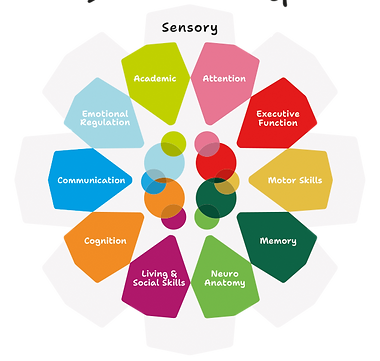
Executive Load

What if the person is not refusing to regulate — but their FASD-affected nervous system cannot return to safety without first borrowing calm, rhythm and connection from another regulated living being?
Today’s FASD-informed word is co-regulation.
Co-regulation means one nervous system helping another move towards safety, organisation and recovery through attuned presence, predictable rhythm, calm communication, sensory support and relationship. It is the foundation from which self-regulation develops; it is not a reward that must be earned after distress.
For babies, children, young people and adults with known prenatal alcohol exposure, who are at increased risk of FASD or who have confirmed FASD, regulation may be affected by differences in brain, central nervous system and autonomic nervous system development.
Memory, receptive language, processing speed, executive functioning, sensory processing, interoception, sleep, pain, attachment experiences, adaptive functioning and accumulated stress can all affect how quickly arousal rises, how distress is communicated and how much relational support is needed to recover.
How this relates specifically to co-regulation in FASD: Co-regulation is the relational and environmental scaffold that helps the person’s nervous system organise before independent self-regulation is available.
The adult temporarily carries parts of regulation that the FASD-affected brain may not be able to hold alone: noticing early signs, reducing sensory and executive load, slowing communication, remembering the plan, making safety visible, lending calm and staying through recovery.
This is why co-regulation links closely with an external brain, declarative language, low-arousal support, interoception, affect regulation, dysmaturity and environmental accommodation. It is not simply comforting the person after a crisis; it is proactive support before, during and after demand.
Co-regulation is not only for young children. A baby may need a caregiver’s voice, holding, feeding rhythm and paced movement; a child may need a trusted adult nearby; a young person may need reduced language and a predictable shared routine; and an adult may still need another person, animal or carefully designed environment to provide rhythm, safety and organisation when their own regulation is unavailable.
The aim is not forced calm or compliance. It is to reduce threat and load so the person can regain access to communication, thinking, choice, learning and safe participation.
This is not dependence, attention-seeking, manipulation, spoiling or poor resilience. It is a brain- and body-based support need. Co-regulation may need to be offered repeatedly and proactively across the lifespan, especially when fatigue, pain, hunger, sensory load, transition, uncertainty, shame, social pressure or accumulated stress reduces current capacity.
Co-regulation is not control: It must not be used to force eye contact, touch, silence, compliance, apology, emotional disclosure or a rapid return to the activity.
Physical closeness, holding, weighted or sensory input, breathing exercises, animal contact and movement must be individually agreed, welcomed and stopped when the person communicates “no”, “stop”, discomfort or withdrawal. A regulated adult may set a necessary safety boundary while still reducing threat, offering accessible choices and preserving dignity.
Where immediate danger requires protective action, this must follow the applicable safeguarding, legal and restrictive-practice framework; it should not be relabelled as co-regulation.
Practical action: become the regulation support before asking the person to regulate alone. Slow your breathing and movement, soften your face and voice, reduce words and audience, lower non-essential demand, make the environment safer and offer the person’s known sensory, body-needs and relational supports. Ask, “What is their nervous system having to manage, what signs show rising arousal, and what calm, rhythm, connection or space can I offer now?”
FASD-informed declarative language examples: “I am here,” “Your body is working hard,” “There are fewer words now,” “The quiet space is open,” “The rhythm can slow,” “The drink is beside you,” “We can breathe without talking,” “The dog is resting nearby,” “The horse is walking slowly,” “The demand can wait,” or “Repair can happen after recovery.” Use one calm statement, then pause.
Co-regulation: Examples for Carers, Parents and Professionals
Baby and infant example: A baby with known prenatal alcohol exposure may show dysregulation through crying, startle, gaze avoidance, feeding difficulty, arching, sleep disruption, shutting down or difficulty settling.
A familiar caregiver can offer paced feeding, calm voice, skin-to-skin or safe holding where appropriate, predictable movement, reduced light and noise, pauses during care and timely health assessment for new or concerning changes. The baby is borrowing regulation through the caregiver’s body, rhythm and responsiveness.
Nursery and early-years example: A child may need a predictable key person, a calm welcome, objects or photographs, one-step language, shared movement, body-needs checks and a familiar recovery space. The adult stays close enough to lend calm without crowding, and does not require eye contact, explanation, apology or return to the group before the child’s nervous system is ready.
Adult and supported-living example: An adult with FASD will need predictable staffing, a familiar tone and pace, reduced questioning, visual information, food or drink, quiet companionship, sensory comfort and time before discussing a decision, incident or change. Co-regulation should preserve autonomy and dignity: staff offer presence, choices and accessible communication rather than control, infantilisation or forced emotional disclosure.
Companion-animal and pet example: For some people, a familiar, calm dog, cat or other companion animal may support co-regulation through predictable presence, warmth, breathing, gentle movement, routine and non-verbal connection.
Sitting nearby, observing the animal rest, walking together, grooming or offering care may help organise attention and arousal without requiring conversation. This must remain individual and consent-aware: the person should never be required to touch or interact, the animal must have choice, rest and a safe exit, and adults must monitor signs of stress in both. Animal contact is a possible supportive relationship, not a guaranteed treatment effect or a replacement for health, psychological or safeguarding support.
Voice example: The adult lowers their voice, significantly slows their pace and uses fewer words so the child can ‘borrow calm’ rather than absorb more pressure.
School example: A pupil who is overwhelmed after lunch may need a familiar adult, quiet space, water, sensory support and a short settling routine before they can rejoin learning.
Home example: After school, a child may need food, quiet, low light, no questions and an adult nearby before they can talk, play, eat or manage another demand.
Transition example: During a difficult change, the adult walks alongside the child, shows the next visual, keeps language simple and stays calm while the child’s brain shifts.
Coming-home-from-school transition example: At the start or during the drive home from school, the adult deliberately slows their own breathing and takes a few calm, audible deep breaths without speaking, questioning or placing any demand on the child/young person/adult.
The adult continues to drive quietly, allowing their regulated breathing, steady pace and calm presence to provide a rhythm the child’s nervous system may begin to mirror.
This is an FASD-informed co-regulating mirroring technique: the adult does not instruct the child to breathe, demand eye contact or expect an immediate response. The child is simply offered a low-pressure nervous-system cue and time to shift from the sensory, social and executive load of school towards the relative safety of home. The technique should remain individual and consent-aware; if audible breathing increases irritation, anxiety or sensory discomfort, the adult should stop and use another known co-regulation support.
Equine horsemanship and ground-based co-regulation example: For some babies’ carers, children, young people and adults affected by prenatal alcohol exposure or FASD, calm contact with a well-matched horse may offer a powerful relational and sensory experience.
The benefit does not depend on riding. Standing at a safe distance, watching the horse breathe, grooming, walking alongside, resting a hand on the shoulder where this is welcomed, or simply sharing quiet space may help the person slow their breathing, notice rhythm, organise body position and experience connection without a heavy verbal or social demand.
The horse’s breathing, movement, warmth and steady presence can provide an external rhythm around which the person’s own breathing, heart rate and arousal may begin to settle; this should be described as an individual co-regulation response, not a guaranteed physiological effect or a substitute for clinical treatment.
A trained, FASD-informed equine practitioner should choose the horse, pace and activity; monitor both the person’s and the animal’s signals; use direct supervision and clear boundaries; and stop or change the activity if either shows stress, fatigue, fear or discomfort. The person must never be pressured to touch, lead or ride. Success may be quiet shared attention, breathing more evenly, matching a walking rhythm, remaining safely present or leaving the session regulated - not completing a horsemanship task.
Repair example: After a meltdown or shutdown, adults support safety, connection, sensory recovery and basic body needs before expecting apology, reflection, explanation or learning.
Assumptions and safeguarding risk: A common mistaken assumption is that co-regulation is unnecessary once a person can speak fluently, name a feeling, repeat a coping strategy or appear calm.
In FASD, verbal masking, dysmaturity, working-memory difficulty, interoceptive differences, sensory load, sleep debt, pain, shame and executive overload may mean that the person cannot independently recognise rising arousal, remember the strategy, organise the steps or seek help in time.
Quietness, freezing, quick agreement, leaving, laughter, shutdown or delayed collapse must not be treated as proof of regulation. If co-regulation is withheld as a consequence, offered only after escalation or replaced by repeated questioning, isolation, threat or forced reflection, distress and risk may increase around roads, transport, online contact, peer pressure, personal care, eating, medication, tools, animals, water, community access and emergencies.
The plan should identify early signs, trusted co-regulators, approaches that help or harm, consent and touch preferences, the required level of supervision, when demand and safety-critical activity must pause, and how health or safeguarding concerns will be escalated.
Meeting phrase: “They need co-regulation before we expect self-regulation, reasoning, reflection or repair.”
EHCP evidence prompt: Record the person’s individual signs of rising arousal, shutdown and recovery; what happened before; sleep, pain, hunger, thirst, sensory, social, language and transition load; which adult was present; the adult’s tone, pace, proximity and words; body-needs and environmental support; whether touch or closeness was welcomed; the co-regulation offered; time to return towards safety; participation after recovery; and any delayed impact at home or later in the day.
Record support that prevented escalation as well as support used after distress. Do not infer independent regulation from silence, compliance, fluent emotional language or one successful occasion.
EHCP phrase: “[Child/young person] requires co-regulation support from trusted adults to access regulation, learning, communication, transitions and repair. Provision should include calm adult presence, reduced verbal load, predictable scripts, visual supports, sensory adjustments, body-needs checks, safe space and recovery time before self-regulation, reasoning, reflection or independent task completion is expected.”
EHCP Section F provision — co-regulation plan: “[Child/young person] will have an individual written co-regulation plan used across all relevant nursery, school, alternative-provision, forest-school, equine, transport, off-site, home-learning, college, work-experience and supported-internship contexts.
The plan will specify individual early signs; trusted adults; preferred adult tone, pace, position and proximity; consent and touch preferences; reliable communication for ‘no’, ‘stop’, ‘help’, ‘too much’, ‘quiet’ and ‘pause’; body-needs checks; sensory and environmental adjustments; declarative scripts; reduced-demand actions; safe spaces; supervision; recovery routines; and health, safeguarding and emergency escalation.
A named trained adult will provide the agreed co-regulation proactively at identified high-load times and immediately when early signs appear, without requiring [child/young person] to explain, fail or escalate first. Reasoning, reflection, apology, repair, teaching and non-essential demands will wait until [child/young person] is sufficiently regulated to process them.”
EHCP objective: “By the end of the review period, with the specified Section F co-regulation provision in place, [child/young person] will use or accept the agreed trusted-adult, communication, sensory, environmental, body-needs and recovery supports to remain safely engaged in, pause or return to the next meaningful activity in [agreed proportion, for example 4 out of 5] of recorded opportunities across [number] relevant settings and with [number] trained adults.
Progress will be measured against baseline for frequency, intensity and duration of dysregulation or shutdown; time to recover; safe participation; support used; and whether adults offered co-regulation before increasing demand or expecting self-regulation, explanation, reflection or repair.”
Measurable review of objective, outcomes and provision: “The agreed baseline will record early signs, likely load, adult response, co-regulation offered, consent and communication, level of supervision, participation, unsafe action or leaving, recovery time and delayed impact.
Review records will show whether trained adults used the specified calm presence, reduced language, declarative scripts, body-needs support, sensory and environmental adjustments, safe space and recovery before escalation. Success means safer connection, communication and participation with the right relational support - not forced calm, compliance, suppressed distress or fewer requests for help. Provision will not be reduced because of age, fluent speech, emotional vocabulary, apparent calm or one successful occasion.”
Co-regulation and FASD Informed™ courses for families: Parents, carers and supporting family members may also benefit from family-focused training and individual support.
The Family programmes includes FASD Informed™ therapeutic-parenting, alongside specialist online sessions for families or supporting professionals navigating assessment, education, health, social care and home life. Within co-regulation, the courses help families look beyond presenting behaviour, understand how memory, processing, sensory load, dysmaturity and stress affect the nervous system, and use calm presence, reduced language, predictable routines, connection and recovery before expecting self-regulation.
The emphasis is practical and non-blaming: families can identify what helps their own child or young person borrow calm, adapt strategies at a manageable pace and build a shared FASD-informed approach across home and professional networks. A diagnosis is not required where prenatal alcohol exposure is known or suspected.
Explore FASD Informed™ courses and support for families: https://www.fasdinformed.co.uk/training/categories/families
Find us on Facebook: Follow and share FASD Informed UK for practical Words of the Day, resources and updates: https://www.facebook.com/profile.php?id=61589819114681
FASD-informed communication cards to support safeguarding: https://www.fasdinformed.co.uk/category/all-products
© FASD Informed UK™ All rights reserved.
Working Memory

What if reducing the demand is not avoiding learning — but creating the conditions in which an FASD-affected brain can access safety, connection and the next achievable step?
Today’s FASD-informed phrase is low-demand support.
This means intentionally reducing avoidable pressure, direct commands, rapid questions, urgency and unnecessary expectations so the child, young person or adult has more capacity for regulation, communication, participation, safety and learning.
In FASD, a demand that looks small from the outside may require receptive understanding, working memory, processing, set-shifting, initiation, sequencing, impulse control, affect regulation and adaptive functioning to work together.
Direct commands, repeated questions, rushed transitions, public correction, too many choices or pressure to explain can increase executive load and allostatic load, push the person towards threshold and make the requested skill less available.
Capacity may vary because of sporadic mastery, sleep debt, pain, hunger, sensory load, interoceptive difficulty, uncertainty, unfamiliar adults or a change in routine. Verbal masking may make the person sound ready while their brain cannot yet organise the response.
Low-demand support therefore asks adults to identify what is essential now, what can become a cue or visual, what can be shared with an external brain, what can wait and what can be removed because it adds pressure without improving safety or learning.
Low-demand support does not mean no boundaries, no teaching or no expectations. Necessary safety boundaries can remain clear while the adult reduces threat, makes the environment accessible, uses co-regulation, scaffolding and re-teaching, and matches the next step to the person’s current functional capacity and dysmaturity profile.
This is not permissive parenting, avoidance or lower aspiration. It is a neurobehavioral response that makes participation more achievable.
Practical action: before giving a demand, pause and ask: “Is this essential now? Can the environment, visual, object, movement or adult cue carry the message instead? Can I lower the language, reduce the choice, model the first step or begin alongside them?” Replace repeated commands with one calm cue, then pause long enough for processing.
FASD-informed declarative language and cues: Instead of “Start your work,” try “The first question is highlighted.” Instead of “Put your shoes on,” try “Your shoes are by the door,” while pointing to the visual or touching your own shoes as a kinaesthetic cue. Instead of “Stop asking,” try “The answer is on the card.” Instead of “Calm down,” try “The quiet space is open.” Instead of “Hurry up,” try “The next place is pictured, and the adult is walking with you.” Instead of “Tell me what is wrong,” try “There are fewer words now; help is here.” Cues should inform and support, not become disguised demands or tests of compliance.
Low-Demand Support: Examples for Carers, Parents and Professionals
Morning example: Instead of giving repeated instructions to get ready, the adult places the relevant photographic cue card (see example below*) where each step happens — for example, toilet, clothes, breakfast, teeth, shoes and bag — keeps items in predictable places every day visually and supports the first step alongside the child. If the child shows or points to the co-regulation communication wristband (see example below**), the adult reduces words, pauses non-essential demands and provides the agreed calm support before continuing.
School example: A pupil who is overloaded may need fewer words, one task at a time, reduced written output, a quiet space, a trusted adult or a smaller first step before they can engage with learning. Staff can offer one photographic cue card such as “first step”, “quiet”, “help” or “pause” rather than repeat the instruction. The pupil can point to or show the co-regulation communication wristband to request the agreed trusted-adult support without having to explain verbally.
Transition example: Instead of “hurry up”, adults use early warning, show one photographic cue card of the next place or activity, offer a calm bridge and allow recovery time so the change does not become a pressure point.
If the child or adults points or has turned the regulation wristband, the adult pauses, reduces or stops language and walks alongside them or activates the agreed transition support.
Home example: On a low-capacity day, the family uses a minimum safe plan: food, drink, supervision, quiet, predictable routines and fewer non-essential expectations. The adult may place out only the relevant photographic cards - such as “drink”, “quiet”, “help”, “pause” or “next” - and respond to the co-regulation wristband by offering calm presence and fewer words rather than asking the person to justify what they need.
Professional example: In meetings, adults ask which demands can be reduced or shared before expecting the child, young person or carer to manage more.
College or supported-internship example: Attendance, travel, room changes, unfamiliar staff, deadlines, customer contact and task switching can turn ordinary expectations into high demand. A named base, one point of contact, written priority, photographic task or place cues, protected pause, flexible timing and job-coach support can preserve participation.
The person may discreetly show the co-regulation communication wristband to activate the agreed response - fewer words, a trusted adult, a quiet base, help with the next step or a pause - without needing to explain in public.
Declarative cues might include, “The first task is marked,” “The quieter base is available,” or “This task can pause while the plan is checked,” while the matching photograph remains visible as an external prompt.
Alternative provision, forest school or equine example: A practical, outdoor or preferred activity is not automatically low demand. Travel, weather, instructions, animals, tools, clothing, peer interaction and changing routines may combine to exceed threshold.
Use a portable photographed plan, familiar adult, reduced group size, demonstrated first step, direct supervision, safe-pause option and recovery. The person can carry or select a photographic cue such as “snacks”, “quiet time”, “stop” or “pause”, and show the co-regulation wristband when relational support is needed. A declarative cue phrase such as “The tool stays with the adult” or “The warm base is open” gives essential information without avoidable confrontation.
Post-interruption and re-teaching example: After an interruption, the person may not retain the demand, sequence or reason for the task. Do not increase pressure by saying, “You know what to do.”
Restore the materials, return to the relevant photographic cue card, model the first action and use one declarative statement such as, “This is where the task paused.” If the person shows the co-regulation wristband, provide the agreed calm adult support before attempting the restart. Re-teach without shame and allow the activity to stop safely if capacity has not returned.
Assumptions and safeguarding risk: A common mistaken assumption is that reducing demand rewards avoidance, removes boundaries or teaches the person that escalation works. In FASD, behaviour may show that language, executive load, sensory input, social pressure, dysmaturity or allostatic load has exceeded current capacity.
If adults increase commands, questions, consequences or audience pressure, the person may move further beyond threshold and lose access to communication, judgement and safety. Low demand must not mean low safeguarding: roads, transport, medication, food, water, fire, tools, animals, machinery, online contact, money, relationships, personal care and emergencies may still require clear limits and nearby, line-of-sight or direct supervision.
The adult should reduce non-essential demand while keeping the essential safety boundary visible: “The road is crossed together,” “The medication stays with the adult,” or “The machine is paused.” Quiet compliance, shutdown, quick agreement or one successful occasion must not be treated as proof that pressure was manageable or supervision is no longer needed.
Meeting phrase: “Low-demand support is not the absence of boundaries or learning. It is the planned reduction of avoidable cognitive, sensory, emotional and relational pressure so the person can access the essential safety boundary, communication, co-regulation and next achievable step.”
EHCP evidence prompt: Record the demand, setting and timing; the number and type of instructions or questions; sensory and social load; sleep, pain, hunger and body-state factors; early signs of threshold; whether the person could understand and begin; the cues, visuals, environmental accommodations, co-regulation and scaffolding used; what happened when demand was softened, delayed or removed; and any delayed impact at home. Record adult implementation as well as the person’s response. Do not infer capacity from verbal masking, quiet compliance or sporadic mastery.
EHCP Section F provision — low-demand support plan: “[Child/young person] will have an individual written low-demand support plan used across all relevant nursery, school, alternative-provision, forest-school, equine, transport, off-site, home-learning, college, work-experience and supported-internship contexts. The plan will identify essential and non-essential demands; early signs of rising load; agreed declarative scripts; photographic, object-based, written and kinaesthetic cues; reduced choices; processing time; environmental accommodation; co-regulation; scaffolding; safe pausing; re-teaching; recovery; and the level of supervision required for safety-critical activity. A named trained adult will reduce avoidable demand proactively at identified high-load times and immediately at early signs, without requiring [child/young person] to fail, explain or escalate first. Essential boundaries will be communicated briefly, visually and consistently, with direct adult support where risk requires it.”
EHCP objective: “By the end of the review period, with the specified Section F low-demand provision in place, [child/young person] will use or accept the agreed declarative cues, visual or practical supports, environmental adjustments, co-regulation, scaffolding and safe-pause support to participate in, pause or return to identified learning, transition, daily-living and safety activities in [agreed proportion, for example 4 out of 5] of recorded opportunities across [number] settings and with [number] trained adults. Progress will be measured against baseline for safe participation, distress or shutdown, time to begin or recover, adult support used, and whether adults reduced avoidable demand before increasing pressure, applying sanctions or interpreting the response as refusal.”
Measurable review of objective, outcomes and provision: “The agreed baseline will record the activity, demand level, language used, number of prompts, sensory and environmental load, early threshold signs, co-regulation and scaffold provided, participation, safety impact, recovery time and delayed effect. Review records will show whether trained adults replaced avoidable demands with the agreed cues, visuals, modelling, environmental adjustment, processing time and safe-pause support. Success means safer, more reliable access with less unnecessary pressure—not forced compliance, silent masking, emotional suppression or the removal of all support. Provision will not be reduced because of age, fluent speech, one successful occasion or a period without visible distress.”
*NEW FASD Informed co-regulation communication wristband: A wearable visual cue may help a child, young person or adult communicate a need for co-regulation, fewer words, support or a pause without relying on lengthy spoken explanation when overloaded. The wristband should be introduced and rehearsed when the person is regulated, with adults agreeing in advance how they will respond; it must not be used as a behaviour-management tool or as proof of understanding or consent. Find the wristband here:
https://www.fasdinformed.co.uk/product-page/fasd-informed-communication-wristband
**NEW — Photographic Communication Cards: One clear photograph can replace repeated instructions, reduce demand and make needs, feelings or what happens next visible. The 30 double-sided cards act as a practical external brain when working memory, processing speed, sensory load, sleep debt or stress makes spoken language difficult, delayed or unavailable. The child, young person or adult can point to, choose, hold or hand over a card without needing to speak. Keep the cards visible, offer one cue at a time, use a calm declarative phrase, then pause for processing. They can support non-symbol ‘Now and Next’ routines, transitions, re-teaching and co-regulation across home, education and community settings; the aim is safer communication and low-arousal scaffolding, not compliance. Find the photographic cards here:
https://www.fasdinformed.co.uk/product-page/fasd-informed-communication-wristband
FASD-informed education training is essential: Low-demand support can be misunderstood as permissive practice unless education staff understand how prenatal alcohol exposure may affect processing speed, working memory, executive load, set-shifting, regulation, adaptive functioning, dysmaturity, suggestibility and generalisation.
The FASD Informed™ Education training offer includes whole-school and specialist options for schools, colleges, alternative provision, supported internships, SEN hubs or ARPs and multi-agency education teams. Training supports a shared, non-blaming approach to declarative language, cues instead of repeated demands, environmental accommodation, co-regulation, scaffolding, re-teaching, dynamic safeguarding and the distinction between supported success and independent mastery. It should be completed by teachers, SENCOs, teaching assistants, pastoral, lunchtime, transport, supply, residential, off-site, placement and leadership staff before the plan is implemented, included in induction and refreshed after significant incidents, staff or placement changes, or proposed reductions in support. Explore the education courses here:
https://www.fasdinformed.co.uk/training
Find us on Facebook: Follow and share FASD Informed UK for practical Words of the Day, resources and updates: https://www.facebook.com/profile.php?id=61589819114681
Please note: This information is for general education and FASD-informed support only. It is not a substitute for individual developmental, neuropsychological, occupational-therapy, speech and language, medical, mental-capacity, legal, safeguarding, social-care or EHCP assessment and advice. Low-demand support must be individual, functional, consent-aware, proportionate and regularly reviewed. It does not remove essential safety boundaries, lawful safeguarding action or the assessed need for nearby, line-of-sight or direct supervision. New, unexplained or concerning changes in health, functioning, distress or risk should receive the appropriate clinical, safeguarding or emergency response rather than being attributed automatically to FASD or demand-related overload.
© FASD Informed UK™ All rights reserved.
Affect Regulation

What if one striking strength is being used to judge the whole person — while equally real difficulties remain hidden between the peaks?
Today’s FASD-informed phrase is spiky profile.
This describes a markedly uneven pattern of strengths and needs across different areas of functioning. A child, young person or adult may perform at or above expectation in one domain while requiring substantial support in another.
However, FASD does not always produce clear areas of above age-expected strength: prenatal alcohol exposure is associated with severe and pervasive neurodevelopmental impairment across many assessed domains, with functioning significantly below expectation in most or all areas examined. [1–5]
The profile remains individual and should be established through comprehensive, domain-by-domain assessment rather than an assumption that every person will have obvious peaks.
The recognised neurodevelopmental brain-domain areas: SIGN 156 and UK FASD assessment guidance identify 10 areas that may be affected by prenatal alcohol exposure and should be considered within a comprehensive, multidisciplinary assessment:
-
Brain structure and neurological functioning — including head growth, seizures and structural or physiological evidence of central nervous system difference.
-
Motor skills — including gross motor, fine motor, balance, coordination, motor planning and visual-motor integration.
-
Cognition — including general reasoning, problem-solving, concept formation and intellectual functioning.
-
Language — including receptive and expressive language, pragmatic communication and the ability to understand and use information.
-
Academic achievement — including reading, spelling, writing and mathematics.
-
Memory — including learning, encoding, storage, retrieval, working memory, prospective memory and recall after delay.
-
Attention — including sustained, selective and shifting attention.
-
Executive functioning — including planning, organisation, initiation, sequencing, set-shifting, inhibition, impulse control, hyperactivity, time awareness and self-monitoring.
-
Affect regulation — including modulation of emotional arousal, emotional control and recovery.
-
Adaptive behaviour, social skills and social communication — including conceptual, practical and social functioning in everyday life, such as personal care, safety, money, travel, relationships, judgement and community participation.
These are assessment domains, not separate diagnoses, and each contains important subdomains.
Sensory processing, interoception, processing speed, sleep, regulation, generalisation and real-world safety may cut across several domains and should also be described wherever they affect functioning.
A child, young person/adult may have 'severe impairment' in several or many areas, rather than an obvious pattern of isolated peaks and troughs.
NICE confirms that FASD-related neurodevelopmental issues are complex and varied, so the content and professional involvement in assessment must be tailored to the individual: NICE QS204, Quality statement 4. The 10-domain framework is set out in SIGN-aligned UK assessment guidance: Assessment of Neurodevelopmental Domains in FASD.
In FASD, prenatal alcohol exposure can affect brain and central nervous system development across attention, receptive and expressive language, memory, processing speed, executive functioning, learning, motor and sensory skills, regulation, social understanding and adaptive functioning.
The pattern is individual: fluent speech, creativity, humour, empathy, factual knowledge, practical skill or a strong interest can sit alongside much greater difficulty with understanding language, holding information in mind, initiating, shifting, judging risk, organising daily life or applying learning in a new situation.
How this differs from ‘asynchronous development’ and ‘dysmaturity’: A spiky profile is the map of uneven strengths and needs across domains at a particular time. Asynchronous development describes those domains developing along different pathways or at different rates.
Dysmaturity describes functioning that may be substantially younger than chronological age in a particular skill or context. The terms overlap but are not interchangeable. None gives one fixed “developmental age”, and none should be used to infantilise the person or predict ability without functional evidence.
The shape of the profile may also change by task, setting and body state.
Sporadic mastery, sleep debt, pain, sensory or interoceptive load, allostatic load, unfamiliar adults, social pressure and proximity to threshold can make a skill look available on one occasion and inaccessible on another. A high point does not cancel a low point, and success with an external brain, co-regulation or scaffolding must not be mistaken for independent mastery.
Strengths are real, valuable and essential to planning.
FASD-informed good practice should include a differentiated curriculum that tunes in to the person’s interests, abilities and preferred ways of learning, uses these as meaningful routes into engagement and participation, and provides carefully scaffolded opportunities to practise, deepen, generalise and expand those strengths.
Strength-based teaching should build confidence, identity, connection and future pathways without assuming that a strength in one domain removes the need for support in another.
They can provide connection, motivation and routes into learning, but they must not be used to minimise disability, remove support or assume that performance transfers across domains.
A person who reads well may not understand implied meaning; a person who speaks fluently may have weaker receptive language; a person who remembers detailed facts may lose a three-step instruction; and a person who is physically capable may have much younger social judgement or danger awareness.
This is not manipulation, selective effort, inconsistency by choice or evidence that support has created dependence. It is a brain-based neurodevelopmental pattern.
The profile should be described domain by domain and through real-life functioning, not reduced to IQ, attainment, diagnosis, chronological age or one global score.
Practical action: build a strengths-and-support map. For each relevant domain, record what the person can do independently; what they can do only with prompting, modelling, environmental accommodation, co-regulation or supervision; what changes under fatigue, stress, novelty or interruption; and whether the skill generalises across people and settings.
Use strengths as a route into support - not as evidence that support is unnecessary.
FASD-informed declarative language examples: “Your strength can help us start,” “The part that needs support is pictured,” “The words are strong and the understanding is still being checked,” “The checklist can hold the steps,” “This skill has support around it,” “The safe adult is staying for this part,” or “Different parts of the brain may need different support.” Use one calm statement, then pause.
Spiky Profile: Examples for Carers, Parents and Professionals
Verbal-strength and verbal-masking example: A young person may speak fluently, use adult language or explain a specialist interest in detail while having much weaker receptive understanding, working memory, processing speed or ability to weigh risk. Adults should slow communication, use one concrete point, add visual support and check through showing or application rather than accepting fluent repetition or a quick “yes” as proof of understanding or capacity.
Academic-strength example: A child may decode text, remember facts or excel in art, technology, music, sport or a preferred subject but struggle with inference, organisation, written output, set-shifting, time, working memory or task completion. Staff should use the strength to engage the learner while providing a visible first step, modelled example, reduced executive load, processing time and support through to a clear finished point.
Social-strength and vulnerability example: A child or young person may be warm, sociable and strongly motivated by friendship while having difficulty reading motives, hidden rules, coercion or unsafe requests.
Suggestibility, dysmaturity and a wish to belong may increase vulnerability despite apparent confidence. Support may include explicit boundary teaching, role-play, an agreed safe adult, online safeguards, neutral checks of understanding and a reliable way to communicate “no”, “stop”, “not sure”, “help” or “pause”.
Adaptive-functioning example: A young person may use a smartphone, count money, discuss future plans or travel one familiar route while still needing substantial support with scams, spending, medication, meals, hygiene, appointments, route disruption, strangers, emergencies and asking for help. Strength in one visible task must not be generalised to the whole area of independence.
Variable-profile example: A skill may sit at a high point when the person is calm, interested, familiar with the adult and fully scaffolded, then become inaccessible under fatigue, sensory load, correction, interruption or change. This is where a spiky profile meets sporadic mastery. Adults should identify the support present when the skill appeared and re-teach or rebuild the scaffold rather than accuse the person of choosing when to cope.
Nursery and early-years example: A child may know letters, songs, facts or detailed vocabulary while needing a key person, photographs, objects, modelling and close supervision for play, waiting, toileting, eating, dressing, transitions and danger. Advanced knowledge must not be used to assume age-expected adaptive or regulation skills.
Alternative provision, forest school or equine example: Practical confidence or a strong connection with animals may be a genuine strength while memory, sequencing, impulse control, processing and danger awareness remain vulnerable. Use a photographed routine, one demonstrated step, familiar adult, organised equipment, dynamic risk assessment, safe pause and direct supervision around roads, fire, water, tools, animals and changing instructions.
College or supported-internship example: A young person may understand course or workplace content but need a named base, supported travel, one point of contact, written priority, job-coach modelling, explicit social boundaries, planned breaks and direct supervision of safety-critical work. A high academic or practical skill must not obscure support needs created by room changes, customer pressure, deadlines, unfamiliar supervisors or interruptions.
Home and supported-living example: A person may sustain a complex interest while needing an external brain for meals, hydration, hygiene, medication, money, visitors, phone use, sleep and appointments. Predictable staffing, visual routines, labelled organisation, co-regulation and proportionate supervision should be matched to each daily-living task.
Assessment example: A specialist FASD-informed neuropsychological and functional assessment can map strengths and needs across relevant neurodevelopmental domains and real settings. A brief conversation, an IQ score or one classroom attainment result is not enough. Assessment should distinguish expressive fluency from receptive understanding, knowledge from application, performance with support from independent performance, and stable ability from variability under load.
Specialist assessment to identify a spiky profile: A spiky profile should not be inferred from appearance, fluent speech, one strength, one low score or a brief conversation. A specialist FASD-informed neuropsychological and functional assessment can examine the recognised neurodevelopmental domains separately, identify both peaks and significant areas of impairment, and establish how performance changes with processing time, working-memory load, sensory input, fatigue, stress, novelty, interruption and the support available.
Assessment should distinguish expressive from receptive language, knowledge from real-life application, supported performance from independent mastery, and an isolated result from functioning across home, education, care, community and work settings. It should integrate standardised measures with observation, adaptive-functioning evidence, the person’s views, family or carer evidence and information from relevant professionals.
The outcome should ideally be a 'domain-by-domain' formulation and practical recommendations for communication, teaching, environmental accommodation, care, co-regulation, scaffolding, supervision and safeguarding - not one global “mental age” or an average that conceals the peaks and lower points.
Assessment across age and purpose: Specialist FASD-informed neuropsychological assessment may be helpful at any age, including for children and young people under 16, where the aim is to understand the individual profile, identify hidden needs, guide support and inform education, health, care, safeguarding or transition planning. It may be completed with (over 16) or without a mental-capacity assessment, depending on age, referral purpose and the particular decision. Where a decision-specific capacity assessment is required, neuropsychological findings can explain the communication, memory, processing, executive and adaptive supports needed, but do not themselves determine capacity globally.
Assumptions and safeguarding risk: The central risk is the “halo effect”: one visible high point - an area of relative strength, such as fluent language, reading, factual knowledge, sociability or physical confidence - is allowed to define the whole person.
A high point (peak in the spiky profile) is not necessarily above age expectation; it is simply stronger than other areas in that individual profile. Fluent language may be mistaken for comprehension; academic attainment for judgement; sociability for social safety; physical confidence for danger awareness; and success with support for independence.
In FASD, lower points are domains in which functioning is less developed, less reliable or requires substantially more support than the person’s stronger areas or outward presentation suggests. These may include working memory, processing speed, executive functioning, adaptive functioning, interoception, affect regulation or social understanding.
Lower points are not fixed defects, a single “mental age” or proof that the person lacks ability; they describe where support need is greater. They may remain hidden until the person is tired, pressured, alone or faced with change.
A high point in one domain does not cancel a lower point in another, and it does not show that the same skill will transfer across tasks, settings, adults or levels of stress.
If support is withdrawn because of a high point, the person may be exposed to exploitation, coercion, unsafe consent, online grooming, financial loss, travel danger, medication error, missed body needs, unsafe use of tools or machinery, or inability to respond in an emergency.
Risk planning must therefore map the exact domain and task, the support present, variability, level of supervision and evidence required before support changes. Quiet compliance, verbal knowledge or one success must not be treated as proof of safety across the profile.
Meeting phrase: “Which part of the profile are we seeing, what support is making that strength possible, and what needs remain hidden if we judge the whole person from this one high point? Please map each domain separately and distinguish supported performance from safe, reliable independence.”
EHCP evidence prompt: Record strengths and needs separately across receptive and expressive communication, attention, memory, processing speed, executive functioning, learning, motor and sensory skills, regulation, social understanding, adaptive functioning, danger awareness and independence. For each relevant task, state what the child or young person can do independently, with a cue, with modelling, with an external brain, with co-regulation or only under supervision; what support was present when success occurred; whether the skill transfers across people and settings; and what changes under fatigue, stress, sensory load, interruption or novelty. Do not average the peaks and troughs into one global description.
EHCP phrase: “[Child/young person] has a spiky FASD-related neurodevelopmental profile, with genuine strengths alongside substantial and sometimes hidden needs across communication, memory, processing, executive functioning, regulation, social understanding, adaptive functioning and safety. Provision will be based on assessed functional need in each domain and setting, not chronological age, IQ, fluent speech, academic attainment, physical presentation, apparent compliance or isolated success.”
EHCP Section F provision — spiky-profile support plan: “[Child/young person] will have an individual written strengths-and-support profile used across all relevant nursery, school, alternative-provision, forest-school, equine, transport, off-site, home-learning, college, work-experience and supported-internship contexts. The profile will map each assessed domain separately; identify high points, hidden needs and variability; specify receptive-language adjustments, processing time, visual and kinaesthetic cues, external-brain support, co-regulation, low-demand communication, environmental accommodation, scaffolding, re-teaching and the level of supervision required for each identified activity.
A named trained adult will ensure that strengths are used as routes into participation but are not used to remove support in another domain. Safety-critical support will be reduced only through a written, gradual, task-specific review showing safe, reliable and generalised performance across [number] settings, [number] adults and [agreed period].”
EHCP objective: “By the end of the review period, with the specified Section F provision in place, [child/young person] will use or accept the agreed domain-specific communication, visual, practical, co-regulation, environmental, adaptive-functioning and supervision supports to participate in, safely pause or seek help within identified learning, social, daily-living, transition and safety activities in [agreed proportion, for example 4 out of 5] of recorded opportunities across [number] settings and with [number] trained adults. Progress will be measured against a domain-specific baseline and will not be inferred from strengths in an unrelated area.”
Measurable review of objective, outcomes and provision: “The agreed baseline will record functioning by domain; support present; prompt or supervision level; variability under fatigue, stress, sensory load and change; participation; recovery; safety incidents; and delayed impact. Review records will show whether adults used strengths appropriately and delivered the specified communication, processing, visual, environmental, co-regulation, scaffolding, re-teaching and safeguarding supports.
Success means safer, more reliable participation with the right support - not a flatter profile, increased masking or fewer prompts. Provision will not be reduced because of a high score, fluent speech, physical maturity, quiet compliance or one successful occasion.”
Thank you for reading this and sharing in this learning journey if you would like more or would like to follow us please 'like or love' this post.
Follow our Facebook page for our FASD Informed book updates: Follow our sharable page on Facebook for news about the forthcoming FASD Informed ‘Word of the Day’ book, which will bring together all the Words of the Day, EHCP objectives and outcomes and add further practical guidance, examples and resources to support your FASD toolkit. Don’t forget to like us and share this knowledge with your team around you! https://www.facebook.com/profile.php?id=61589819114681
FASD-informed training: Everyone implementing the plan should understand that FASD can produce complex, varied neurodevelopmental needs and that visible strengths may conceal substantial functional difficulty. Training should cover spiky profiles, asynchronous development, dysmaturity, verbal masking, sporadic mastery, working memory, processing speed, executive load, adaptive functioning, suggestibility, declarative language, co-regulation, scaffolding, re-teaching, domain-specific risk and the difference between supported success and independent mastery. It should be completed before implementation, included in induction, refreshed at least annually and after significant changes in need, setting, staffing or risk, with observation or coaching used to check practice:
https://www.fasdinformed.co.uk/training
Professional note: “Spiky profile” is a practical descriptive phrase, not a diagnosis or a substitute for specialist assessment. NICE states that children and young people with confirmed prenatal alcohol exposure and clinical concerns should have a neurodevelopmental assessment, and that a management plan should address identified needs. Assessment should be multidisciplinary where indicated, interpret standardised results alongside adaptive functioning and real-life evidence, and preserve the person’s strengths, dignity, preferences and age-respectful identity.
Disclaimer: This information is for general education and FASD-informed support only. “Spiky profile” is a descriptive phrase, not a diagnosis, a single test result, a global developmental age or a determination of mental capacity. It is not a substitute for individual multidisciplinary, neuropsychological, developmental, medical, occupational-therapy, speech and language, mental-capacity, legal, safeguarding, social-care or EHCP assessment and advice. Strengths and needs vary by person, domain, task, setting, support and time. Assessment and provision should be individual, functional, dignity-preserving and regularly reviewed using evidence from real-life settings; new, unexplained or concerning changes in health, functioning, distress or risk should receive the appropriate clinical, safeguarding or emergency response rather than being attributed automatically to FASD or a spiky profile.
Selected evidence and guidance: [1] NICE Quality Standard QS204, Quality statement 3: Referral for assessment, recognises probable prenatal alcohol exposure alongside significant physical, developmental or behavioural difficulties and supports referral to professionals with additional FASD training: https://www.nice.org.uk/guidance/qs204/chapter/Quality-statement-3-Referral-for-assessment. [2] NICE Quality Standard QS204, Quality statement 4: Neurodevelopmental assessment, states that FASD-associated neurodevelopmental issues are complex and varied and that the content and professional involvement in assessment will therefore differ by individual need: https://www.nice.org.uk/guidance/qs204/chapter/Quality-statement-4-Neurodevelopmental-assessment. [3] Kodituwakku (2009), Neurocognitive Profile in Children with Fetal Alcohol Spectrum Disorders, reviews reduced intellectual functioning, slower information processing, attention and executive-function differences, and difficulties across language, visual perception, memory, learning, social functioning and number processing, concluding that some children show a generalised difficulty integrating information: https://pmc.ncbi.nlm.nih.gov/articles/PMC3104937/. [4] Kingdon, Cardoso and McGrath (2016), a meta-analysis of 51 studies, found broad executive-function impairment in FASD, with particularly consistent difficulties in planning, fluency, set-shifting and working memory: https://pmc.ncbi.nlm.nih.gov/articles/PMC5760222/. [5] Kautz-Turnbull and Petrenko (2022), A meta-analytic review of adaptive functioning in fetal alcohol spectrum disorders, found significantly lower adaptive functioning than in alcohol-non-exposed and ADHD comparison groups, with impairment not explained by IQ or age: https://formedfamiliesforward.org/wp-content/uploads/2023/01/Kautz-Turnbull-Petrenko-2021-metaanalysis-adaptive-functioning-IQ-FASD.pdf. These sources support comprehensive, domain-by-domain assessment; they do not imply that every person with prenatal alcohol exposure will show the same pattern or severity.
© FASD Informed UK™ All rights reserved.