
FASD in Education:
Seeing the need behind the behaviour

Fetal Alcohol Spectrum Disorder (FASD) is not simply SEMH.
It is not a behaviour problem with a different name. It is a brain-based disability that can change what a child can understand, remember, regulate, communicate and apply.
When professionals start with behaviour, they may reach for sanctions, consequences or containment.
When they start with FASD, they ask a different question: what support does this child’s brain need to learn, feel safe and take part?
FASD-informed understanding is important for all professionals involved in assessment, EHCP planning, placement decisions and day-to-day support. This includes Educational Psychologists, SEND case workers, SENCOs, teachers, designated teachers, virtual school staff, social workers, health and therapy professionals, CAMHS practitioners, alternative provision and specialist setting staff.
When a child presents with complex, uneven or unexplained needs, recognising prenatal alcohol exposure as a possible factor can help professionals describe those needs more accurately and plan support that reflects the child’s neurodevelopmental profile.
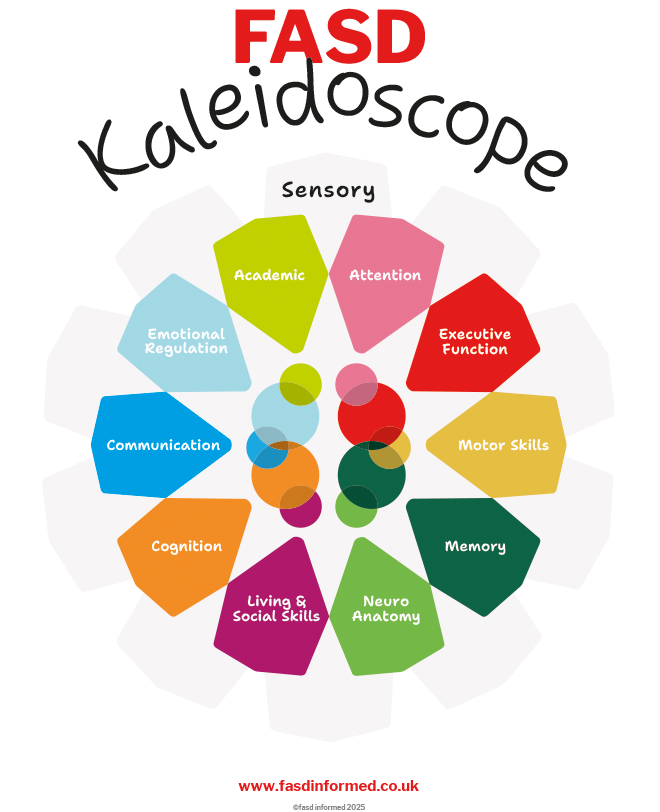
Fetal Alcohol Spectrum Disorder can affect memory, processing, communication, executive functioning, sensory regulation, emotional regulation, adaptive skills, social understanding and the ability to learn from consequences. These needs may not be immediately visible, particularly where a child is verbally fluent, masks difficulty or appears capable in some contexts but not others.
FASD should not be considered simply as SEMH. Social, emotional and behavioural distress may be visible in school, but where those presentations arise from prenatal alcohol exposure and brain-based neurodevelopmental impairment, the starting point must be the child’s underlying disability, not the behaviour adults see.
Describing FASD primarily as SEMH can lead to the wrong questions, the wrong expectations and the wrong provision. It may encourage adults to focus on sanctions, consequences, emotional containment or behaviour management, when the child may actually need support for memory, processing, communication, executive functioning, sensory regulation, adaptive functioning, social vulnerability and the generalisation of learning.
This distinction matters for assessment, EHCP wording and placement decisions. If FASD is treated as SEMH alone, Section B may fail to describe the child’s actual needs, Section F may fail to specify the right provision, and Section I may name a placement designed to manage outward behaviour rather than meet complex neurodevelopmental needs.
This page is intended to support professional reflection and practical decision-making. It invites education professionals to look beneath outward presentation and ask: what does this child’s brain need in order to learn, communicate, regulate, participate and feel safe?
Use this page to navigate the key questions: hidden presentations; behaviour and interpretation; early recognition; trauma and FASD; practical support; and professional implications.
For EHCP drafting, safeguarding analysis and placement suitability, see the tab page above FASD-Informed EHCP: A Practical Guide to Drafting, Safeguarding and Educational Need.
“What looks like refusal, impulsivity or inconsistency may be a symptom of unmet neurodevelopmental need.”
“The central question is not whether adults can manage the behaviour, but whether the child’s brain-based needs are understood and met.”
“FASD-informed practice helps professionals move from blame and consequence to understanding, adjustment and support.”
FASD is often hidden, but its impact is real
Fetal Alcohol Spectrum Disorder is a lifelong neurodevelopmental condition caused by prenatal alcohol exposure. It can affect learning, memory, attention, communication, sensory regulation, emotional regulation, adaptive functioning and social understanding.
Many children with FASD do not have visible facial features, and some have strong verbal skills, so their needs can be easily missed or misunderstood.
FASD is often noticed through behaviour. But FASD-informed practice recognises that behaviour is communication: what adults see may be a 'symptom of unmet neurodevelopmental need', not wilful defiance, deliberate non-compliance, poor parenting or a lack of effort.
The risk of seeing only the behaviour
If FASD is understood only through a behavioural or SEMH lens, the child may be offered the wrong support. Behaviour systems often assume that a child can remember the rule, understand the consequence, regulate their response and apply the learning next time. For many children with FASD, these are the very skills affected by their disability.
What may look like refusal, avoidance, impulsivity, inconsistency, shutdown or emotional outburst may actually reflect difficulty with processing, working memory, language, sensory overload, adaptive delay or executive functioning. The issue is not whether adults can manage the behaviour in the moment, but whether they understand and meet the neurodevelopmental need beneath it.
“Behaviour is the starting point for curiosity, not the end point of assessment.”
Why early recognition matters
Early recognition of prenatal alcohol exposure and possible FASD is not about labelling a child. It is about opening the door to the right support. Without recognition, children may be viewed as naughty, oppositional, attention-seeking or poorly parented. With recognition, adults can understand the child’s developmental profile and put in place strategies that reduce distress, improve access to learning and protect self-esteem.
Early intervention also sits within wider public health and clinical guidance. UK clinical guidance on alcohol treatment in pregnancy and perinatal care emphasises the importance of clear information, sensitive discussion, multi-agency care planning and support to reduce or stop alcohol use during pregnancy. For education professionals, this reinforces why documented or suspected prenatal alcohol exposure should not be ignored later in childhood: it can provide vital context for understanding a child’s learning, regulation, communication and safeguarding needs.
Early recognition does not mean making assumptions or assigning blame. It means noticing the possibility of prenatal alcohol exposure, recording concerns accurately, seeking appropriate assessment and putting practical support in place as early as possible. This supports the principle that children should receive help before repeated misunderstanding leads to exclusion, family crisis, placement instability or breakdown.
“Early recognition is not about blame or labels; it is about putting the right support in place before crisis becomes the evidence.”
-
Earlier support can reduce repeated failure, shame and exclusion.
-
FASD-informed strategies can prevent escalation before it becomes crisis.
-
Understanding prenatal alcohol exposure can guide assessment, EHCP planning and appropriate provision.
-
Families are more likely to be believed, supported and included when professionals understand FASD.
-
Children are more likely to thrive when support is based on need rather than punishment.
FASD is not simply SEMH
Some children with FASD are described as having social, emotional and mental health needs because their distress is visible in school. But if the primary need is neurodevelopmental, support must address memory, executive functioning, communication, sensory processing, adaptive functioning and social understanding. A setting must be able to understand and meet those needs, not only manage the behaviour they produce.
In an EHCP, it is important that FASD is not recorded simply as SEMH if the child’s primary needs arise from prenatal alcohol exposure and neurodevelopmental impairment. The plan should name and describe the child’s actual needs clearly, so that provision is directed towards the underlying difficulties rather than only the behaviour adults see.
What schools may notice
-
Difficulty remembering instructions, routines or previous learning.
-
Overload in noisy, busy or unpredictable environments.
-
Impulsivity, emotional dysregulation, shutdown or distress.
-
Difficulty coping with change, transitions and unstructured times.
-
Difficulty learning from consequences or applying rules in a new context.
-
Strong talking skills alongside weaker understanding, judgement or independence.
-
Social vulnerability, suggestibility and difficulty reading risk.
-
Uneven development, where the child may seem capable in one area but much younger in another.
What support should look like
Many children with FASD need support that is structured, predictable, repetitive and explicitly scaffolded. This may include visual structure, simplified and concrete language, reduced cognitive load, adult checking for understanding, close supervision, sensory support, opportunities for co-regulation and repetition over time.
Where communication needs are present, specialist speech and language-informed strategies may be needed to support receptive language, expressive language, processing of verbal information, social communication and understanding of abstract language. Where sensory needs are present, support should be embedded across the school day, rather than offered only when a child has already reached crisis.
When trauma is not the whole story
Consultant Clinical Psychologist Dr Cassie Jackson has highlighted the systemic risk of interpreting FASD-related difficulties primarily through trauma, attachment or behaviour frameworks, particularly for children in adoption, foster and kinship care. In Seen and Heard, she explains that conventional therapies and support may fail to address the complexities of FASD, leaving many children at high risk of placement disruption where prenatal alcohol exposure and neurodevelopmental impairment are not recognised.
This is highly relevant for education. Many children affected by prenatal alcohol exposure are outwardly sociable, verbally engaging or apparently capable in short interactions, while still experiencing significant underlying difficulties with executive functioning, receptive or expressive language, auditory processing, sensory regulation, adaptive functioning and social cognition. Their presentation can therefore be mistaken for attachment-related, trauma-related or behavioural difficulty alone.
Jackson’s article also draws attention to the fact that many children with FASD have no visible facial features and may have a near-normal IQ, while functioning in everyday life at a much lower adaptive level than their cognitive scores suggest. For schools, this means that verbal fluency, isolated strengths or success in structured tasks should not be taken as evidence that the child can cope independently across the whole school day.
The key message for education professionals is not that trauma-informed practice is unimportant. It is that trauma-informed practice is not enough if FASD is part of the child’s profile and remains unrecognised. Assessment, EHCP planning and school provision must remain curious about prenatal alcohol exposure, acquired brain injury, adaptive functioning and the neurodevelopmental reasons why a child may not learn reliably from consequences, generalise learning or regulate in unstructured environments.
“Trauma-informed practice matters, but it does not replace the need to understand prenatal alcohol exposure and brain-based disability.”
What every school can do now
-
Recognise prenatal alcohol exposure as a possible factor when a child has a complex, uneven or unexplained neurodevelopmental profile.
-
Record concerns accurately and seek appropriate assessment, advice and support.
-
Describe needs in neurodevelopmental terms rather than relying only on behavioural labels.
-
Adapt teaching, communication and regulation support before behaviour escalates.
-
Ensure EHCPs describe the child’s actual needs and specify practical, consistent provision.
-
Train staff so that FASD-informed practice is understood across the whole school day.
Further information and professional learning
Professionals working with children and young people affected by prenatal alcohol exposure may need access to reliable information, training and reflective support. FASD-informed practice is most effective when it is embedded across assessment, planning, teaching, safeguarding and review, rather than treated as a one-off awareness issue.
For Educational Psychologists, SEND case workers, SENCOs, designated teachers, virtual schools, specialist settings and wider education teams, the key professional task is to describe need accurately, link provision to the child’s functional profile and review whether support is working across the whole school day.
Key professional implications
FASD-informed education is not only about classroom strategies. It also affects how professionals formulate need, interpret behaviour, advise on provision, draft or review EHCPs, and consider placement suitability. A child’s outward presentation should be understood in the context of their underlying neurodevelopmental profile and the support required to access learning safely and consistently.
When reviewing assessment evidence or EHCP wording, it may be helpful to consider whether the plan describes needs in functional terms, including communication, cognition and learning, executive functioning, adaptive functioning, sensory regulation, social vulnerability and generalisation of learning. Provision should then be specified clearly enough to show what support is required, how it will be delivered and how consistency will be maintained.
This page is intended as an information resource. It should be read alongside professional guidance, local SEND procedures, the child or young person’s assessment evidence and the views of the child, family and professionals involved.
References and further reading
-
FASD Informed UK. FASD information and early intervention resource.
-
UK Government. Fetal alcohol spectrum disorder: health needs assessment.
© FASD Informed UK. This page is provided for information and professional learning. Please reference FASD Informed UK when sharing or quoting from this page.