
Education.
Recognising prenatal alcohol exposure early can change how a child is understood, supported and included.
School teams do not need to wait until a child is in crisis to become FASD-informed. Training helps staff consider the whole child by recognising prenatal alcohol exposure as a possible factor, understanding the spectrum of FASD, and responding to symptoms of unmet neurodevelopmental need with practical classroom strategies.

FASD is often hidden, but its impact is real
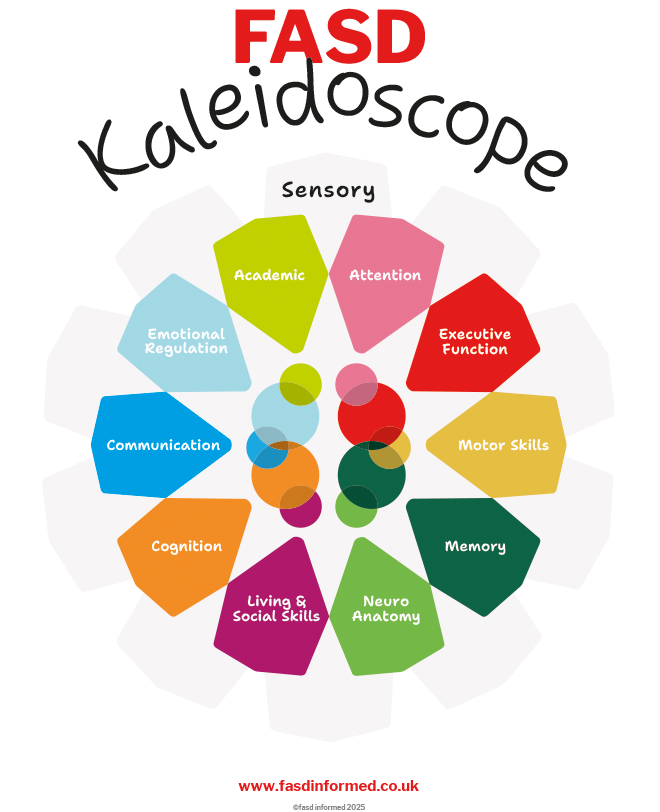
Fetal Alcohol Spectrum Disorder (FASD) is a lifelong neurodevelopmental condition caused by prenatal alcohol exposure. It can affect learning, memory, attention, communication, sensory regulation, emotional regulation, adaptive functioning and social understanding. 90% of children with FASD do not have visible facial features, and many have strong verbal skills, so their needs can be easily missed or misunderstood.
In school, FASD is often noticed through behaviour. But FASD-informed practice recognises that behaviour is communication: what adults see may be a symptom of unmet neurodevelopmental need, not wilful defiance. What may look like refusal, impulsivity, inconsistency or emotional outburst may actually reflect difficulty with processing, memory, sensory regulation, developmental delay or executive functioning.
When schools understand the possibility of prenatal alcohol exposure, they can stop asking “Why won’t this child behave?” and start asking “What support does this child’s brain need to learn, regulate and feel safe?”
Why early recognition matters
Early recognition of prenatal alcohol exposure and possible FASD is not about labelling a child. It is about opening the door to the right support. Without recognition, children may be viewed as naughty, oppositional, attention-seeking or poorly parented. With recognition, adults can understand the child’s developmental profile and put in place strategies that reduce distress, improve access to learning and protect self-esteem.
-
Earlier support can reduce repeated failure, shame and exclusion.
-
FASD-informed strategies can prevent escalation before it becomes crisis.
-
Understanding prenatal alcohol exposure can guide assessment, EHCP planning and appropriate provision.
-
Families are more likely to be believed, supported and included when professionals understand FASD.
-
Children are more likely to thrive when support is based on need rather than punishment.
What schools may notice
-
Difficulty remembering instructions, routines or previous learning.
-
Overload in noisy, busy or unpredictable environments.
-
Impulsivity, emotional dysregulation, shutdown or distress.
-
Difficulty coping with change, transitions and unstructured times.
-
Difficulty learning from consequences or applying rules in a new context.
-
Strong talking skills alongside weaker understanding, judgement or independence.
-
Social vulnerability, suggestibility and difficulty reading risk.
-
Uneven development, where the child may seem capable in one area but much younger in another.
Why behaviour-led responses are not enough
Traditional behaviour systems often assume that a child can remember the rule, understand the consequence, regulate their response and apply the learning next time. For many children with FASD, these are the very skills affected by their disability. Sanctions, repeated consequences or exclusion from activities may therefore fail to teach the intended lesson and may increase distress, anxiety and dysregulation.
FASD is not simply SEMH
Some children with FASD are described as having social, emotional and mental health needs because their distress is visible in school. But if the primary need is neurodevelopmental, support must address memory, executive functioning, communication, sensory processing, adaptive functioning and social understanding. A setting must be able to understand and meet those needs, not only manage the behaviour they produce.
In an EHCP, it is important that FASD is not recorded simply as SEMH if the child’s primary needs arise from prenatal alcohol exposure and neurodevelopmental impairment. The plan should name and describe the child’s actual needs clearly, so that provision is directed towards the underlying difficulties rather than only the behaviour adults see.
Examples of FASD-related neurodevelopmental needs may include difficulties with working memory, processing speed, attention, impulse control, flexible thinking, planning, sequencing, receptive language, sensory regulation, adaptive functioning, social understanding, risk awareness and the ability to transfer learning from one situation to another.
When trauma is not the whole story
Many children with FASD have also experienced trauma, loss, care proceedings, foster care, adoption or kinship care. Trauma-informed practice matters, but it is not enough if prenatal alcohol exposure and brain-based disability are not recognised. FASD-related dysregulation, social vulnerability, poor adaptive functioning and difficulty learning from consequences can be mistaken for attachment-related or behavioural difficulties, delaying the right support.
What every school can do now
-
Recognise prenatal alcohol exposure as a possible factor when a child has a complex, uneven or unexplained neurodevelopmental profile.
-
Record concerns accurately and seek appropriate assessment, advice and support.
-
Describe needs in neurodevelopmental terms rather than relying only on behavioural labels.
-
Adapt teaching, communication and regulation support before behaviour escalates.
-
Ensure EHCPs describe the child’s actual needs and specify practical, consistent provision.
-
Train staff so that FASD-informed practice is understood across the whole school day.
FASD Informed UK can help
FASD Informed UK supports schools, families and professionals to recognise the impact of prenatal alcohol exposure, understand the spectrum of FASD, and respond with strategies that are compassionate, practical and neurodevelopmentally informed.
If you are a teacher, SENCO, designated teacher, school leader, EHCP professional or member of a wider support team, learning about FASD matters.
Recognition can change the story from blame, punishment and breakdown to understanding, early intervention and support that gives children a better chance to succeed.
Teacher training and education resources
Teachers and school teams do not need to wait until a child is in crisis to become FASD-informed. Training helps staff recognise prenatal alcohol exposure as a possible factor, understand the spectrum of FASD, and respond to symptoms of unmet neurodevelopmental need with practical classroom strategies.
Our education courses are designed for teachers, SENCOs, designated teachers, school leaders, alternative provision, specialist settings, virtual schools, post-16 teams and wider education professionals. Sessions can support whole-school understanding, INSET training, transitions, safeguarding, EHCP planning and provision for learners whose needs are linked to prenatal alcohol exposure and FASD.
Explore our education training linked here or drop us an email to find a tailored course that supports your setting to move from behaviour-led responses to FASD-informed understanding, early intervention and consistent support.
Email us: info@fasdinformed.co.uk