
Homework, FASD and Attendance:
What Schools and Colleges Need to Know
Reducing demand, protecting attendance and meeting your duties to learners with complex needs

Every website has a story, and your visitors want to hear yours. This space is a great opportunity to give a full background on who you are, what your team does and what your site has to offer. Double click on the text box to start editing your content and make sure to add all the relevant details you want site visitors to know.
If you’re a business, talk about how you started and share your professional journey. Explain your core values, your commitment to customers and how you stand out from the crowd. Add a photo, gallery or video for even more engagement.
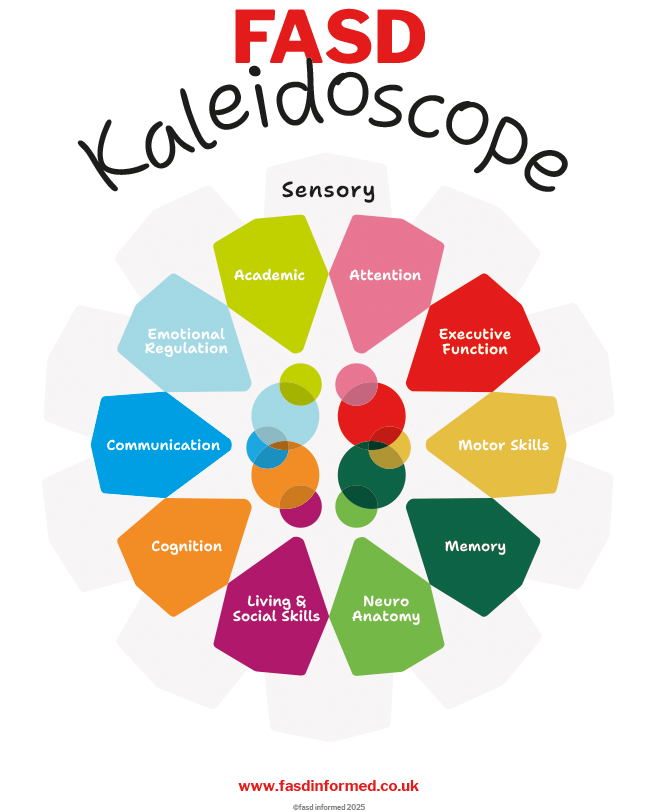
Image: 'Spiky' Neurodevelopmental Profile
Fetal Alcohol Spectrum Disorder (FASD) is a lifelong neurodevelopmental condition associated with prenatal alcohol exposure. It is best understood as an enduring brain injury that affects cognition, learning, memory, behaviour, communication, emotional regulation, sensory processing and day-to-day functioning. For these learners, the school or college day is already demanding, and homework can be the point at which a manageable week becomes unsustainable.
Why this matters for your setting
FASD can affect all brain domains, including attention, executive functioning (such as impulse control and hyperactivity), motor skills, memory, social communication and adaptive behaviour, cognition, language, emotional regulation and academic achievement. Every learner is affected differently, and the profile is typically “spiky”: strengths sit alongside significant difficulties, and needs change across settings and over time.
Commonly reported features include:
-
Slow information processing, and slower auditory processing of spoken language
-
Difficulties with working and short-term memory, and with following directions or multi-step tasks
-
Difficulty planning, organising, sequencing and starting tasks
-
Emotional regulation difficulties, including frustration and a longer recovery time
-
Attention, concentration, hyperactivity and impulsivity challenges
-
Sensory differences, with over- or under-sensitivity to sound, light, touch or smell
-
Difficulty linking actions with consequences, and understanding abstract concepts such as time, money and cause and effect
-
Learning difficulties, commonly including maths, and difficulty with transitions, routines and generalising knowledge
-
Poor judgement and increased vulnerability to influence from others
These features are not exclusive to FASD and sit within a full clinical and developmental assessment. A balanced picture should also recognise each learner’s strengths.
Why FASD is so often misread in education. Learners with FASD can superficially present as more able than they are, so their needs are underestimated and their difficulties are misinterpreted as “behaviour”. It is also often assumed that a child will grow out of their difficulties. In fact the developmental gap can widen over childhood, which means support needs usually increase rather than decrease. When a learner appears to be refusing, avoiding or not trying, ask first what the demand is asking of a brain that is already working at capacity. This is the thinking behind FASD Informed UK’s approach to “stop before you start®”: consider the full spectrum of needs before deciding what a behaviour means.
Over time, the combination of a demanding day and evening homework can lead to exhaustion, anxiety, disrupted sleep and, eventually, reduced attendance or school and college avoidance. Early recognition and adjustment are far easier than recovering a learner who has disengaged. Many learners are undiagnosed, and some have co-occurring conditions, so adjustments should be based on observed need rather than waiting for a diagnosis.
Stuck in the loop: perseveration, pressure and school avoidance
Many learners with FASD experience perseverative needs. They can become “stuck in a loop”: unable to shift from one task, thought, worry or expectation to the next, even when they want to. Homework can trigger this. An unfinished task may feel impossible to leave, an instruction may replay again and again, and a small mistake, a missed deadline or a teacher’s comment can become fixed in the mind long after the lesson has ended.
Homework can significantly increase pressure and demand for these learners:
-
The demand follows them home. The school day does not end at 3.30pm. Tasks, deadlines and worries continue into the evening, weekends and holidays, leaving no recovery time.
-
Rigid thinking makes tasks harder to start and finish. A learner may be unable to begin until everything feels “right”, unable to stop until it is perfect, or unable to move on once they are stuck.
-
Pressure compounds. Difficulties with memory, planning, processing and emotional regulation mean each task takes more effort, and the longer recovery time after frustration means the next day starts already depleted.
-
The cycle reinforces itself. Unfinished homework brings reminders, sanctions or catch-up demands, which raise anxiety, which makes the loop tighter. Over time the learner links school itself with pressure and failure.
The result can be exhaustion, shutdown, meltdowns at home, refusal to start or complete tasks, and eventually school avoidance and rising absence. This is not a choice or a parenting failure. It is a predictable outcome of pressure on a brain that is already working at capacity.
Why this is an attendance issue. The DfE’s statutory guidance, Working together to improve school attendance (July 2026), is clear that schools should build strong relationships with families, listen to and understand the barriers to attendance, and work in partnership with families to remove them.
It also expects schools to be particularly mindful of pupils who are absent because of mental or physical ill health or special educational needs and disabilities, and to give them additional support. For more complex cases, the guidance sets out a “support first” approach, with holistic support for the pupil and family rather than a purely linear, sanction-led process.
Applied to homework, this means that when a learner with FASD is becoming exhausted, anxious or reluctant to attend, homework demand is one of the barriers that should be identified and addressed early, before absence becomes persistent.
Reasonable adjustments to homework, agreed with the learner and family and recorded in their support plan, are a practical “support first” step. Because the guidance also treats remote education as a last resort and expects absence to be recorded accurately, early adjustment at school is far preferable to waiting until attendance has broken down.
What the evidence and guidance say about homework
-
Homework is not a legal requirement. The Department for Education has said that schools are not obliged to set homework, there is no legal reason to do so. Head teachers and governing bodies decide policy and the consequences of non-completion, and that good policies avoid excessive time requirements and focus on quality over quantity.
-
Ofsted does not inspect homework, but it does inspect how schools support pupils with SEND, children in care and previously looked-after children. Ofsted has stated that it is up to schools to decide whether to set homework and that inspectors do not assess it. Under the renewed inspection framework, however, inclusion is an evaluation area in its own right. Inspectors focus on barriers to learning and wellbeing for pupils with SEND, disadvantaged pupils and pupils known or previously known to children’s social care, which includes children in care and previously looked-after children. They speak with leaders and the SENCo or inclusion lead, use case sampling and learning walks to see how support works in practice for individual pupils, and look at the impact of that support and how it is monitored and reviewed.
-
Quality matters more than quantity. Research summarised by the Centre for Educational Neuroscience shows benefits are less clear for younger children, that excessive homework can lead to mental fatigue, stress and disrupted sleep, and that autonomy-supportive approaches work better than controlling ones.
Your duties and how you will be viewed
-
Equality Act 2010. Schools and colleges must make reasonable adjustments for disabled learners, and must not treat them unfavourably because of something arising from their disability. In colleges, the duty is anticipatory, which means thinking ahead about the barriers disabled learners are likely to face rather than waiting for an individual request.
-
SEND Code of Practice. The 0 to 25 Code applies to schools and further education institutions, with duties covering identification of need, support, and preparing for adulthood.
-
Attendance. DfE attendance guidance expects schools to work with families to identify and remove barriers to attendance.
-
Ofsted. Under the renewed inspection framework, inclusion is an evaluation area in its own right. Inspectors focus on barriers to learning and wellbeing, particularly for pupils with SEND and those known or previously known to children’s social care, and look at the steps a school has taken to meet its duty to make reasonable adjustments for disabled pupils.
Pupils who are in care or previously looked after
FASD is over-represented among children in care and those who have left care through adoption, special guardianship or a child arrangements order. Schools must have a designated teacher to promote the educational achievement of looked-after and previously looked-after children, and local authorities must have a Virtual School Head. For looked-after children, the Personal Education Plan (PEP) is the natural place to record agreed homework adjustments. For previously looked-after children, the designated teacher and Virtual School can advise and support parents and carers.
Shame and blame. Many children who are in care or were previously looked after carry a deep sense of shame and blame. Having experienced separation, loss, neglect or early trauma, they may believe, often without being able to say so, that they are bad, unwanted or to blame for what has happened. For these learners, a sense of “I am the problem” is often a core belief, not a passing feeling.
When this sits alongside FASD, the effect is compounded. A learner who cannot complete homework because of an invisible brain-based difficulty may read the failure as proof that they are stupid or bad. Reminders, criticism, comparison with peers or a sanction can all be experienced as blame, and can confirm the belief they already hold. The response may be a shame state: shutdown, withdrawal, anger, denial, running away, or insisting that they do not care. This is protection from overwhelming feeling, not defiance.
Shame also helps explain school avoidance. If school repeatedly makes a learner feel exposed, blamed or inadequate, staying away can feel like the only way to feel safe. Staff should:
-
Separate the child from the task. Say “this was too hard to do tonight”, never “you didn’t do it”.
-
Avoid public correction, comparison with others, and any language that implies fault, laziness or choice.
-
Repair quickly after a difficult moment, and reassure the learner that they are still valued and belong.
-
Involve the designated teacher, the Virtual School and the learner’s carers or parents in understanding the learner’s history and triggers, and record what helps.
-
Use a calm, predictable and relationship-based approach, building trust before expecting demands to be met.
Why homework sanctions should never be used
Learners with FASD should not receive sanctions for homework. This includes detentions, lost break or lunch times, behaviour points, public warnings, letters home and threats of escalation. There are three reasons.
-
Sanctions rely on a link the learner may not be able to make. Many learners with FASD have difficulty linking actions with consequences and understanding cause and effect. A sanction that depends on the learner connecting “I did not do it” with “this happened to me” will not teach what it is intended to teach. The learner is likely to experience it as unfair, confusing and punishing.
-
Sanctions trigger a stress response, not learning. Threat, shame and loss of control can push a learner into a survival response of fight, flight or freeze. In that state the thinking part of the brain is not available, so the learner cannot reflect, plan or comply. This can look like shouting, running, shutting down or refusing, which is then wrongly treated as further misbehaviour.
-
Sanctions feed the loop and drive avoidance. For a learner who is already stuck in a loop of pressure and unfinished tasks, a sanction adds more demand and more anxiety. The learner learns that school is a place of threat and failure, and avoidance, exhaustion and absence become more likely. This is the opposite of the support-first approach expected in the DfE attendance guidance.
For children who are in care or were previously looked after, sanctions carry an additional risk. They can trigger a shame and blame state, confirming a learner’s belief that they are bad or at fault, and making it harder still for them to feel safe in school.
The DfE’s position is that head teachers decide their homework policy and what happens when it is not completed. This means schools are free to decide that learners with FASD will not receive homework sanctions. Doing so is a reasonable adjustment, not special treatment, and it should be recorded in the learner’s support plan so that every member of staff applies it consistently.
Instead of a sanction, ask what the missing homework is telling you. Was the task too long, too unclear or too hard to start? Was the learner too exhausted? Then change the demand, the timing or the support, not the pressure.
Why adjustments should be discreet
An adjustment only works if the learner can accept it. If a child with FASD is visibly excused from homework, handed different work in front of the class, or asked publicly why it has not been done, the adjustment can create a new barrier: shame, exposure and a sense of being different.
-
Peers notice and draw conclusions. Children quickly spot who does not hand work in. Without a discreet approach, classmates may label the learner as lazy, naughty or “getting away with it”, which can lead to teasing, exclusion or resentment.
-
Shame increases stress and avoidance. Research on homework shows that stress and negative feelings lead to disengagement and avoidance. Learners with FASD often have difficulty with emotional regulation and a longer recovery time, so public embarrassment can trigger a meltdown, shutdown or refusal to attend.
-
Learners with FASD can be highly aware of difference. Because they may present as more able than they are, they can feel pressure to mask their difficulties. They may also be vulnerable to influence from others, so being singled out can put them at risk of friendships built on the wrong terms.
-
The learner’s dignity and privacy matter. Information about a disability or care history belongs to the learner and family. Reasonable adjustments should be delivered without disclosing a diagnosis, care status or support plan to classmates.
-
It protects relationships and belonging. A learner who feels part of the group is far more likely to stay connected to school, which supports attendance and wellbeing.
What discreet adjustments can look like:
-
Set the same homework task for the class but agree a shorter or modified version with the learner privately.
-
Offer an “in-school homework” slot, such as a lunchtime or form-time session, framed as available to anyone who wants it.
-
Make homework optional or choice-based for all, with tasks pitched at different levels, so that no one stands out.
-
Use a private signal, a note in the planner or a quiet word at the end of the lesson instead of public checking of homework.
-
Avoid reading out who has or has not handed work in, public homework records, visible sanction systems or whole-class chasing.
-
Brief all staff who teach the learner so that supply teachers and subject teachers do not undo the agreement by accident.
-
Agree with the learner and family in advance what they want staff to say if a peer asks.
Discretion is not secrecy from the family. The learner, parents and carers, and key staff should all be clear about what has been agreed and why, and the arrangement should be reviewed regularly. Treat it as a way of meeting the reasonable adjustments duty in a way that is respectful and effective, not as a reason to hide the learner’s needs from the people who support them.
Practical steps you can take now
-
Review homework as a reasonable adjustment. Reduce, simplify, make optional or replace homework with in-school practice, and record the agreement in the SEN support plan, EHCP or PEP.
-
Never use homework sanctions. Learners with FASD have difficulty linking actions with consequences, and sanctions are more likely to trigger a stress response or school avoidance. Do not use detentions, lost breaks or behaviour points, and do not treat incomplete homework as a measure of effort or behaviour.
-
Keep adjustments discreet. Agree modified tasks privately, avoid public homework checks and make sure the learner is not singled out in front of peers.
-
Protect recovery time. Keep any tasks short, chunked, clearly explained and well away from late evening.
-
Reduce demand and offer choice. Use clear structure, predictable routines and collaborative language that guides rather than controls.
-
Monitor early warning signs. Track fatigue, distress, lateness and attendance patterns and share them with the SENCo, designated teacher and attendance team.
-
Work with families. Invite parents and carers to share what works at home, and respond to adjustment requests promptly and in writing.
-
Train your staff. Make sure teachers, tutors and attendance staff understand FASD and the difference between avoidance driven by stress and unwillingness.
A low-cost way to demonstrate inclusion
Adjusting homework costs little, protects learners’ wellbeing and attendance, and shows that your inclusion duties are being put into practice. When a school or college treats avoidance as communication and responds with flexibility, learners are far more likely to stay connected and to achieve.
Want to know more?
FASD Informed UK offers FASD Informed™ training, tailored professional consultation and support for designated teachers, SEND teams, virtual schools and education settings.
Contact us at info@fasdinformed.co.uk or visit www.fasdinformed.co.uk to become FASD informed and move towards becoming FASD responsive™.
This article is for general information and is not legal advice. Please check current statutory guidance for your setting.
Key policy and guidance
-
Working together to improve school attendance (DfE statutory guidance, July 2026)
-
Education Secretary: I trust head teachers to decide their homework policies (DfE Education Hub)
-
Ofsted: State-funded school inspection toolkit and Equality duties on education inspection
-
DfE and DHSC: SEND code of practice: 0 to 25 years
-
DfE: Further education: guide to the 0 to 25 SEND code of practice
-
Council for Disabled Children: Disabled students and the Equality Act 2010: what colleges need to know and do
-
DfE: Designated teacher for looked-after and previously looked-after children (statutory guidance)
-
DfE: Promoting the education of looked-after and previously looked-after children (statutory guidance)
-
DfE: Providing remote education: guidance for schools
References
Entries are listed alphabetically by author or publisher.
Centre for Educational Neuroscience (2025) Does homework work? The science of when and how to approach it. Blog post by Mahi Elgamal, 4 February 2025. University College London, Birkbeck and UCL Institute of Education.
Council for Disabled Children (2025) Disabled students and the Equality Act 2010: What colleges need to know and do. Philippa Stobbs OBE, July 2025. https://councilfordisabledchildren.org.uk/sites/default/files/uploads/attachments/Disabled%20students%20and%20the%20Equality%20Act%20Plain%20Text%20-%20final.pdf
Department for Education (2014) Promoting the education of looked-after and previously looked-after children. Statutory guidance for local authorities (updated February 2018). https://www.gov.uk/government/publications/promoting-the-education-of-looked-after-children
Department for Education (2014) SEND: guide for further education providers (Further education: guide to the 0 to 25 SEND code of practice). https://www.gov.uk/government/publications/send-guide-for-further-education-providers
Department for Education (2018) Designated teacher for looked-after and previously looked-after children. Statutory guidance (updated 26 February 2018). https://www.gov.uk/government/publications/designated-teacher-for-looked-after-children
Department for Education (2018) Education Secretary: I trust head teachers to decide their homework policies. The Education Hub, 28 October 2018. https://educationhub.blog.gov.uk/2018/10/education-secretary-i-trust-head-teachers-to-decide-their-homework-policies/
Department for Education (2022, updated July 2026) Working together to improve school attendance. Statutory guidance. https://assets.publishing.service.gov.uk/media/6a4f9ec6a6586e258d371bd0/Working_together_to_improve_school_attendance_2026.pdf (publication page: https://www.gov.uk/government/publications/working-together-to-improve-school-attendance)
Department for Education (2024) Providing remote education: guidance for schools. Updated 19 August 2024. https://www.gov.uk/government/publications/providing-remote-education-guidance-for-schools/providing-remote-education-guidance-for-schools
Department for Education and Department of Health and Social Care (2014) SEND code of practice: 0 to 25 years. Statutory guidance (updated 12 September 2024). https://www.gov.uk/government/publications/send-code-of-practice-0-to-25
FASD Informed UK (n.d.) What is FASD? https://www.fasdinformed.co.uk/what-is-fasd
Inclusion Studio (2026) Reasonable adjustments for students in further education colleges. Updated 9 October 2026. https://inclusionstudio.co.uk/guides/reasonable-adjustments-in-further-education/
Ofsted (2025) Equality duties on education inspection. Published 5 November 2025. https://www.gov.uk/guidance/equality-duties-on-education-inspection
Ofsted (2026) State-funded school inspection toolkit. Version 2.0, June 2026, for use from 7 September 2026. https://assets.publishing.service.gov.uk/media/6a915d1c01bbff0bf8f97b51/Schools_inspection_toolkit.pdf
Roberts, J. (2019) Ofsted defends removing homework from school inspection. Tes Magazine, 2 September 2019. https://www.tes.com/magazine/archive/ofsted-defends-removing-homework-school-inspection
West Sussex County Council (2025) SEND and Inclusion within the new Ofsted Framework. November 2025. https://content.govdelivery.com/attachments/UKWSCC/2025/11/25/file_attachments/3472731/Ofsted%20New%20Framework%20article%20-%20Nov2025.pdf